





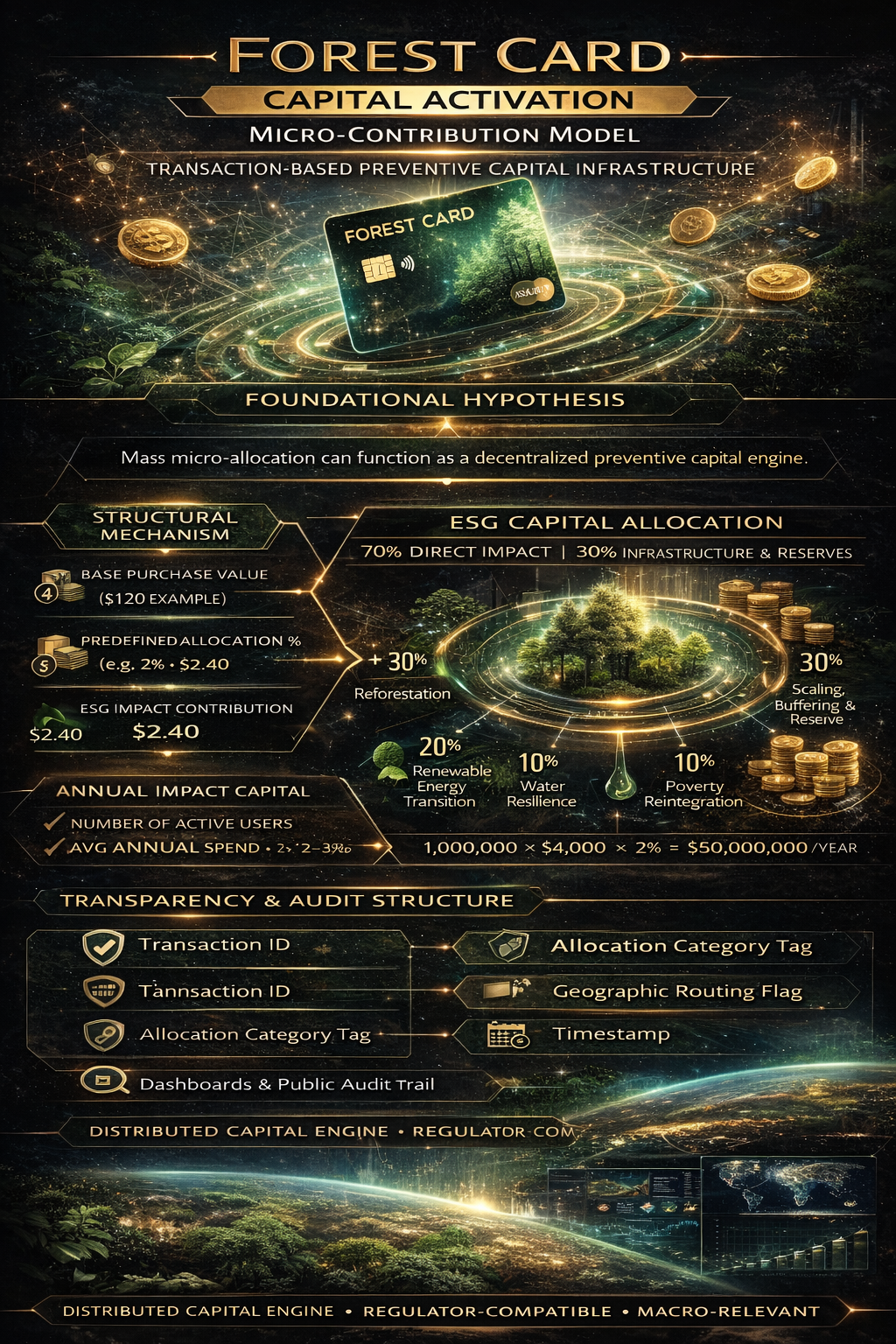
Regulator-Compatible Capital Routing Infrastructure
1. Conceptual Definition
The Fintech Architecture defines the technological and financial infrastructure that enables Forest Card to operate as a programmable micro-contribution capital activation system.
It is not a bank.
It is not a parallel currency.
It is not a deposit-taking entity.
It is a structured transaction-overlay system integrated with licensed financial rails.
The objective is to ensure:
• Secure transaction processing
• Automated capital allocation
• Regulatory compliance
• Data protection
• Audit-grade traceability
• Sovereign compatibility
2. Foundational Hypothesis
The architecture is based on eight structural premises:
- Capital activation must operate on existing regulated financial rails.
- Security must be embedded at the protocol level.
- Allocation must be deterministic and non-discretionary.
- Data protection is foundational to trust.
- AML/KYC enforcement cannot be bypassed.
- Scalability requires modular design.
- System risk must be compartmentalized.
- Sovereign oversight compatibility is essential for macro-scaling.
Therefore:
Forest Card must function as a regulated fintech overlay, not a financial substitute.
3. High-Level System Architecture
The Fintech Architecture consists of seven integrated layers:
1️⃣ User Interface Layer
2️⃣ Identity & Authentication Layer
3️⃣ Transaction Processing Layer
4️⃣ Allocation Engine
5️⃣ Settlement & Segregation Layer
6️⃣ Compliance & Monitoring Layer
7️⃣ Reporting & Audit Layer
Each layer is modular and independently securable.
4. User Interface Layer
Includes:
• Web portal
• Mobile wallet interface
• QR payment interface
• Merchant integration endpoints
Responsibilities:
• Display allocation rate
• Show real-time impact tracking
• Ensure transparency of routing
No sensitive financial data is stored client-side.
5. Identity & Authentication Layer
Implements:
• Multi-factor authentication (MFA)
• OAuth2 secure authentication
• Role-based access control (RBAC)
• Hardware-based admin security keys
Compliance integration:
• KYC via licensed payment providers
• Sanctions screening
• Politically exposed person (PEP) checks
This layer prevents unauthorized system manipulation.
6. Transaction Processing Layer
Operates through:
• Licensed payment processors
• Card networks (Visa/Mastercard equivalent rails)
• Acquiring banks
• Settlement networks
Forest Card does not:
• Hold consumer deposits
• Act as a clearing bank
• Replace settlement infrastructure
It operates via:
Post-authorization allocation tagging.
7. Allocation Engine
The Allocation Engine is the deterministic core of the system.
Inputs:
• Transaction value
• Allocation percentage
• Category matrix
• Geographic routing logic
Outputs:
• Direct Impact allocation (70%)
• Infrastructure allocation (30%)
• Category distribution
• Transaction-level trace ID
The engine operates via rule-based algorithms.
No discretionary override.
8. Settlement & Segregation Layer
Capital flows into:
• Segregated impact accounts
• Infrastructure reserve accounts
• Program-specific SPIV structures
Segregation ensures:
• No operational commingling
• Clear audit trails
• Legal isolation
• Risk compartmentalization
Funds are not used for operational float.
9. Compliance & Monitoring Layer
Includes:
• AML transaction monitoring
• AI anomaly detection
• Velocity pattern analysis
• Geographic risk profiling
• Exposure caps
Escalation Protocol:
- Automated anomaly flag
- Risk classification
- Compliance review
- Conditional suspension if necessary
This converts fraud detection from reactive to predictive.
10. Data Security & Encryption Framework
Implements:
• AES-256 encryption at rest
• TLS 1.3 encryption in transit
• Hardware Security Modules (HSM)
• Field-level encryption for personal identifiers
• Tokenization of transaction IDs
Data separation ensures:
Personal data ≠ Allocation data.
This reduces privacy risk exposure.
11. API Integration Architecture
Forest Card supports:
• Merchant API integration
• ESG corporate integration
• Sovereign reporting API
• Audit verification endpoints
API design principles:
• RESTful architecture
• Rate limiting
• Authentication tokens
• Audit logging
Integration remains lightweight.
12. Regulatory Classification
Forest Card is classified as:
• A transaction-based allocation overlay
• Not a bank
• Not an e-money issuer
• Not a deposit-taking entity
It operates strictly through:
Licensed financial institutions.
This prevents shadow banking exposure.
13. Sovereign Compatibility
The architecture ensures:
• No currency creation
• No interference with monetary policy
• No fiscal dominance
• No off-balance-sheet monetary activity
Optional integration may include:
• CBDC-compatible tagging
• Sovereign oversight APIs
• Climate-designated capital routing
Central bank independence remains intact.
14. Scalability & Load Management
The system is cloud-based and horizontally scalable.
Key components:
• Containerized microservices
• Load balancing
• Redundant failover systems
• Geographic server distribution
Scaling cost increases sub-linearly relative to capital volume.
15. Risk Containment Matrix
| Risk Category | Mitigation |
|---|---|
| Cyber intrusion | Zero Trust Architecture |
| Allocation manipulation | Deterministic engine |
| Data breach | Encryption + segmentation |
| AML violation | Integrated screening |
| Settlement delay | Licensed processor integration |
| Regulatory friction | Jurisdictional mapping |
Systemic risk is minimized through modular design.
16. Comparative Structural Model
| Traditional Fintech | Forest Card Fintech Architecture |
|---|---|
| Deposit-based model | Overlay allocation model |
| Banking risk exposure | Segregated routing |
| Manual ESG reporting | Automated allocation tagging |
| High regulatory burden | Regulator-aligned integration |
| Centralized vulnerability | Layered modular design |
17. Macroeconomic Relevance Hypothesis
At scale, secure fintech-based micro-allocation:
• Reduces environmental fiscal shocks
• Increases preventive capital formation
• Improves ESG market depth
• Enhances sovereign climate alignment
Thus:
Fintech architecture becomes macro-financially relevant.
18. Long-Term Structural Objective
The Fintech Architecture is designed to evolve into:
A standardized ESG-compliant capital routing protocol that can be replicated across:
• National retail networks
• Corporate ecosystems
• Sovereign-aligned programs
• Multilateral climate finance structures
The goal is:
Permanent preventive capital infrastructure embedded in economic activity.
19. Strategic Conclusion
The Forest Card Fintech Architecture is:
Secure
Regulator-aligned
Modular
Scalable
Audit-compatible
Sovereign-compatible
It enables:
Transaction-based capital activation
Deterministic allocation
AML compliance
Data protection
Systemic resilience
Without:
Monetary distortion
Shadow banking exposure
Deposit-taking risk