

Measurable Environmental Capital Structuring System
1. Conceptual Definition
The Carbon Asset Framework defines the structured methodology through which environmental restoration activities—primarily reforestation, regeneration, and carbon sequestration—are quantified, verified, registered, and recognized as measurable environmental assets.
It is not symbolic tree planting.
It is a quantified environmental asset creation protocol.
The objective is to transform:
Ecological restoration → Verified carbon capture → Structured environmental asset → ESG-aligned capital recognition.
2. Foundational Hypothesis
The framework is based on eight structural premises:
- Climate risk is a macroeconomic risk.
- Carbon sequestration must be measurable to have financial credibility.
- Greenwashing undermines ESG capital markets.
- Asset verification increases investor trust.
- Registry reconciliation prevents double counting.
- Environmental restoration has long-term economic value.
- Preventive ecological investment reduces sovereign fiscal exposure.
- Standardized carbon metrics improve cross-border capital compatibility.
Therefore:
Environmental action must be translated into auditable, structured environmental assets.
3. Carbon Asset Definition
A Carbon Asset within this framework is defined as:
A verified, quantified, time-bound carbon sequestration unit generated through structured environmental intervention, validated by independent monitoring and registered within a recognized accounting system.
Key characteristics:
• Measurable (tonnes CO₂ equivalent)
• Time-indexed
• Geographically tagged
• Independently verified
• Registry reconciled
• Non-duplicative
4. Carbon Quantification Model
Let:
A = Area reforested (hectares)
S = Sequestration rate per hectare (tCO₂/year)
T = Time horizon (years)
Carbon Sequestration (CS):
CS = A × S × T
Example:
10,000 hectares
8 tCO₂/year
10 years
CS = 800,000 tCO₂
All estimates must be:
Scientifically benchmarked and regionally calibrated.
5. Measurement & Verification Protocol (MRV)
The framework incorporates a structured MRV model:
Measurement
• Baseline carbon stock assessment
• Soil carbon analysis
• Biomass estimation
Reporting
• Periodic sequestration reports
• Geospatial mapping
• Satellite imagery integration
Verification
• Third-party audit
• Registry reconciliation
• Cross-database validation
MRV ensures carbon claims are defensible.
6. Registry & Double Counting Prevention
To prevent duplication:
• Each carbon asset receives a unique identifier
• Assets are recorded in a transparent ledger
• Cross-registry reconciliation occurs
• Allocation-linked carbon mapping is traceable
Double issuance invalidates credibility.
Integrity is non-negotiable.
7. ESG & Financial Classification
Carbon assets generated through this framework may support:
• Corporate carbon neutrality strategies
• Sovereign NDC reporting
• ESG investment disclosure
• Green bond backing narratives
• Climate risk mitigation portfolios
They are not speculative instruments.
They are structured environmental performance indicators.
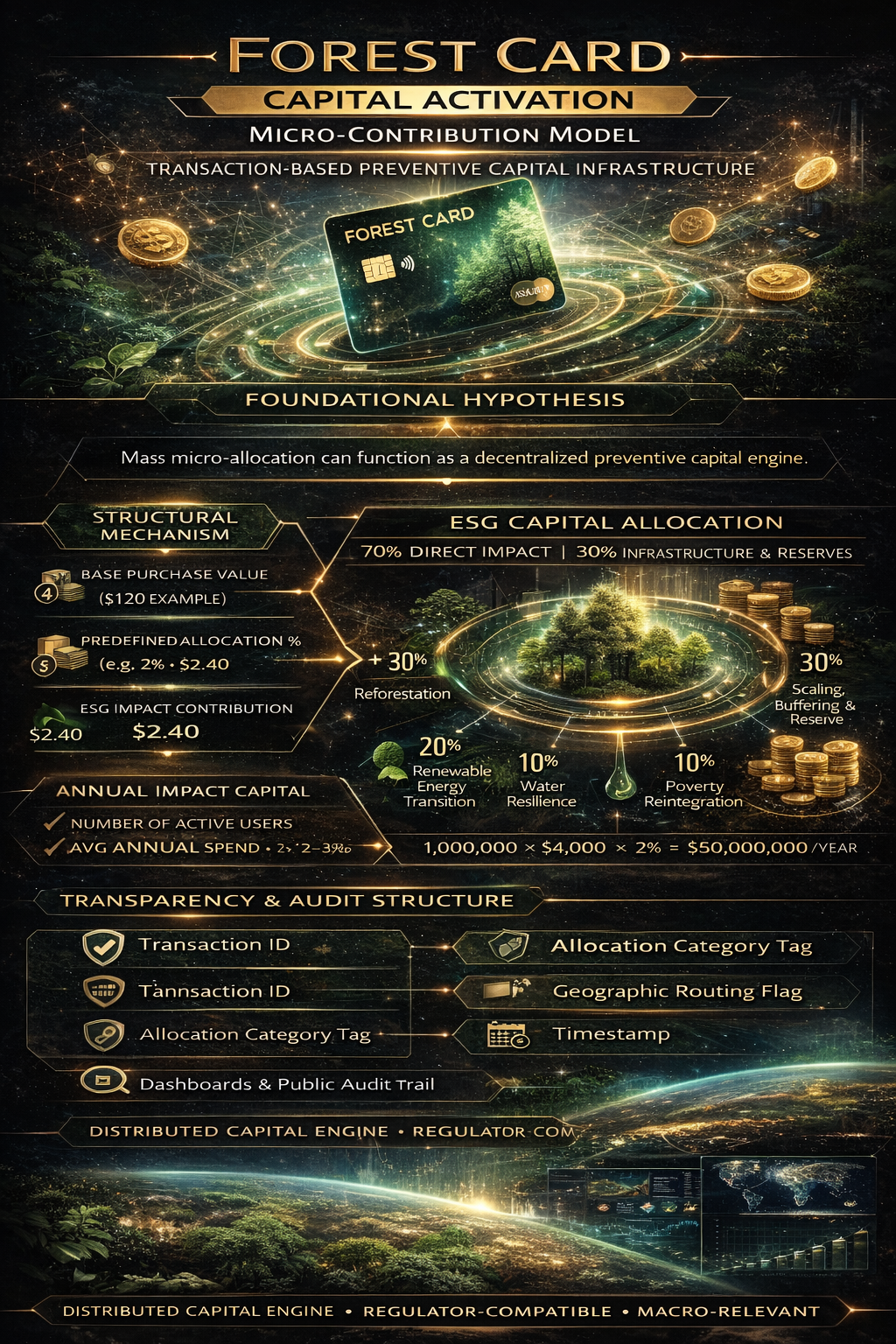
8. Allocation Integration with Forest Card
Micro-contributions routed via Forest Card may fund:
• Verified reforestation programs
• Regenerative agriculture
• Biodiversity corridors
• Wetland restoration
Each funded intervention produces:
Carbon-linked impact metrics.
Capital routing and carbon accounting remain segregated but linked via traceable identifiers.
9. Sovereign Integration Potential
At sovereign level, carbon assets may:
• Support nationally determined contributions (NDCs)
• Improve climate disclosure credibility
• Enhance ESG sovereign ratings
• Strengthen green bond narratives
• Reduce climate transition risk perception
This enhances macro-financial positioning.
10. Risk Containment Framework
Primary risks:
• Overestimation of sequestration
• Permanence failure (forest loss)
• Leakage (emissions displacement)
• Greenwashing claims
• Registry duplication
Mitigation mechanisms:
• Conservative sequestration assumptions
• Permanence buffers (reserve pool)
• Satellite monitoring
• Insurance structures
• Independent verification
Risk-adjusted accounting increases credibility.
11. Permanence & Buffer Model
Let:
CS = Calculated sequestration
B = Buffer percentage (e.g., 10–20%)
Adjusted Carbon Asset (ACA):
ACA = CS × (1 − B)
Buffer pools protect against:
Fire
Illegal logging
Natural disaster
Climate shock
This preserves long-term asset integrity.
12. Comparative Model
| Informal Tree Planting | Carbon Asset Framework |
|---|---|
| Symbolic action | Quantified sequestration |
| No verification | Independent MRV |
| No registry | Unique asset ID |
| Risk of duplication | Cross-registry reconciliation |
| Narrative impact | Audit-compatible metrics |
13. Macroeconomic Relevance Hypothesis
Structured carbon asset creation reduces:
• Climate transition risk
• Carbon pricing volatility exposure
• Regulatory penalty exposure
• Sovereign spread risk
Let:
R_c = Climate risk exposure
As verified sequestration increases:
R_c ↓
Carbon assets become:
Preventive macro-stabilization instruments.
14. Integration with ESG Capital Markets
Carbon Asset Framework supports:
• Impact-linked bond narratives
• Sustainable finance reporting
• Institutional portfolio alignment
• Climate resilience investment theses
Carbon becomes:
A measurable environmental performance metric embedded in capital markets.
15. Scalability Model
Carbon asset generation scales through:
• Geographic diversification
• Long-term restoration programs
• Satellite monitoring automation
• Data integration platforms
• Sovereign alignment
Scaling must preserve MRV discipline.
Volume without verification destroys value.
16. Long-Term Structural Objective
The Carbon Asset Framework aims to:
Institutionalize verified ecological restoration as measurable environmental capital.
It transforms:
Reforestation → Quantified Carbon → Verified Asset → ESG Alignment → Sovereign Credibility → Capital Confidence.
This creates:
Environmental stability through financial discipline.
17. Strategic Conclusion
The Carbon Asset Framework is:
Quantified
Verified
Registry-aligned
Risk-adjusted
Sovereign-compatible
ESG-integrated
It provides:
Audit-grade carbon metrics
Greenwashing prevention
Investor confidence
Sovereign climate alignment
Macro-relevant stabilization
Without:
Speculative exposure
Unverified claims
Regulatory conflict