

Activate Impact Commerce
1. Conceptual Definition
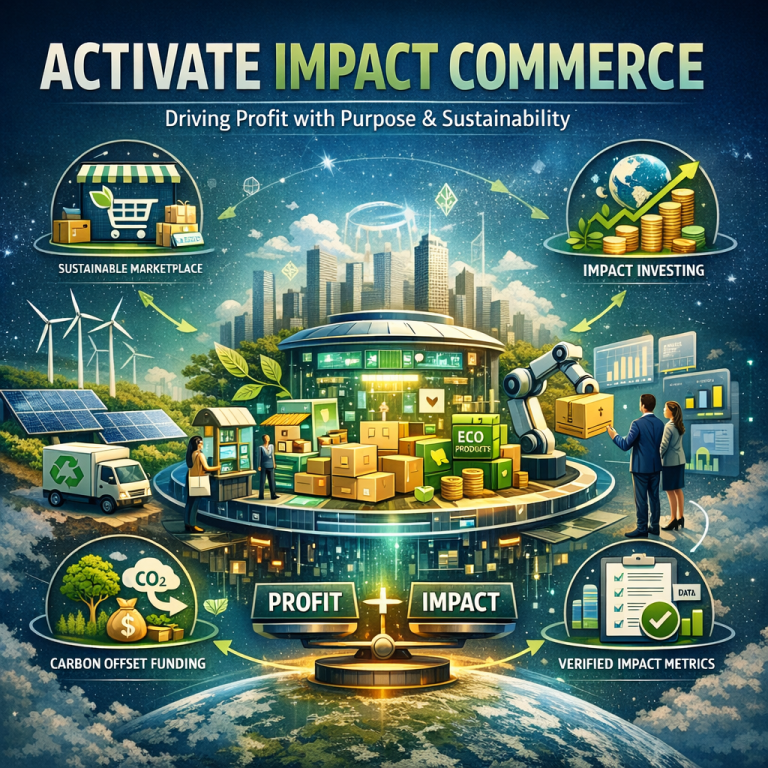
Activate Impact Commerce (AIC) refers to a structured commercial activation framework through which economic transactions, digital marketplaces, service platforms, and infrastructure ecosystems are intentionally designed to generate measurable social and environmental impact alongside financial returns.
Within the SpaceArch strategic architecture, Activate Impact Commerce represents the operational commercialization layer that converts sustainability objectives, technological innovation, and infrastructure development into scalable market-driven economic activity.
Rather than relying exclusively on philanthropic or public-sector funding mechanisms, the AIC model integrates profit-generating commercial platforms with impact-oriented objectives, allowing economic systems to actively contribute to environmental sustainability, social development, and infrastructure modernization.
This approach transforms impact from a secondary outcome of economic activity into a primary design principle embedded in commercial systems.
2. Strategic Context
Evolution of Impact-Oriented Economic Models
Traditional economic systems historically separated commercial activity from social or environmental objectives.
In conventional models:
- corporations focus on profit generation
- governments address social and environmental challenges through regulation or subsidies
- philanthropic organizations attempt to mitigate systemic problems
However, this fragmented model has proven insufficient to address complex global challenges such as:
- climate change
- environmental degradation
- global inequality
- infrastructure deficits
In response, a new generation of economic frameworks has emerged in which commercial systems themselves become vehicles for positive societal impact.
Activate Impact Commerce builds on this evolution by designing digital marketplaces, financial instruments, and service platforms where every economic transaction contributes to measurable sustainability outcomes.
3. Core Objectives
The Activate Impact Commerce framework pursues several strategic objectives.
3.1 Converting Consumption into Impact
Commercial transactions can be structured so that a portion of economic value generated by each transaction supports environmental or social initiatives.
3.2 Scaling Impact Through Market Mechanisms
Market-based economic systems can scale much more rapidly than grant-funded initiatives.
Impact commerce platforms therefore allow sustainability initiatives to expand through commercial adoption rather than public subsidies alone.
3.3 Aligning Profit with Sustainability
The framework demonstrates that financial profitability and environmental or social impact are not mutually exclusive objectives, but can reinforce each other when properly designed.
3.4 Mobilizing Consumer Participation
Consumers increasingly prefer products and services associated with sustainability objectives.
Impact commerce systems enable individuals and businesses to participate directly in sustainability initiatives through everyday economic activity.
4. Structural Architecture
Activate Impact Commerce operates through an integrated ecosystem composed of several operational components.
4.1 Impact-Oriented Marketplaces
Digital platforms can host marketplaces where commercial transactions are directly linked to impact outcomes.
Examples include:
- sustainable product marketplaces
- green infrastructure services
- climate-neutral logistics platforms
- circular economy supply chains
In these systems, commercial activity simultaneously generates economic value and sustainability benefits.
4.2 Impact Transaction Mechanisms
The framework introduces structured transaction mechanisms that allocate a defined portion of transaction value toward impact initiatives.
Typical mechanisms include:
- percentage-based impact contributions
- sustainability-linked transaction fees
- environmental offset integration
- ecosystem restoration funding mechanisms
These systems ensure that every transaction contributes to measurable environmental or social impact outcomes.
4.3 Impact Verification Systems
To maintain credibility and transparency, impact commerce platforms incorporate verification mechanisms.
These may include:
- environmental impact measurement tools
- sustainability certification systems
- blockchain-based transaction tracking
- independent verification protocols
Such systems ensure that impact claims are verifiable, measurable, and transparent.
5. Economic Model
The Activate Impact Commerce model combines commercial profitability with impact generation through a hybrid economic structure.
Revenue sources may include:
- platform transaction fees
- digital marketplace commissions
- sustainability-linked financial products
- impact investment participation
These revenue streams support both commercial platform sustainability and ongoing impact initiatives.
6. Technological Infrastructure
The AIC framework relies heavily on digital infrastructure to scale efficiently.
Core technological components include:
- cloud-based marketplace platforms
- digital payment integration systems
- blockchain-based transaction tracking
- real-time sustainability data monitoring
Digital technologies enable impact commerce systems to operate at global scale with high transparency and operational efficiency.
7. Comparative Model
| Dimension | Traditional Commerce | Activate Impact Commerce |
|---|---|---|
| Economic Objective | Profit maximization | Profit + measurable impact |
| Consumer Participation | Passive purchasing | Active participation in sustainability |
| Environmental Integration | Limited | Integrated into transaction systems |
| Transparency | Low impact visibility | Real-time impact tracking |
| Scalability | Market-driven | Market-driven + sustainability outcomes |
This hybrid model allows commercial ecosystems to generate systemic environmental and social benefits while maintaining economic viability.
8. Institutional Integration
Activate Impact Commerce platforms may integrate with broader institutional frameworks including:
- climate transition financing systems
- ESG reporting frameworks
- global infrastructure investment platforms
- sustainability certification bodies
Such integration strengthens the credibility and impact measurement capacity of commercial initiatives.
9. Strategic Impact
The Activate Impact Commerce framework can generate multiple systemic benefits.
Accelerated Environmental Action
Market-driven mechanisms can scale sustainability initiatives more rapidly than traditional policy interventions.
Consumer Empowerment
Individuals and businesses become active participants in environmental and social progress.
Sustainable Economic Growth
Commercial activity can generate both financial value and environmental restoration.
Increased Investment Interest
Impact-oriented commercial platforms attract investors seeking sustainable investment opportunities.
10. Long-Term Vision
Activate Impact Commerce represents a transformational evolution in economic systems, where sustainability and economic activity become structurally integrated.
Within the SpaceArch ecosystem, this framework enables the creation of commercial platforms capable of mobilizing global markets toward environmental restoration, infrastructure modernization, and sustainable economic development.
By embedding impact generation directly into commercial transactions, Activate Impact Commerce establishes a scalable economic model in which everyday market activity contributes to the long-term stability and sustainability of planetary systems.