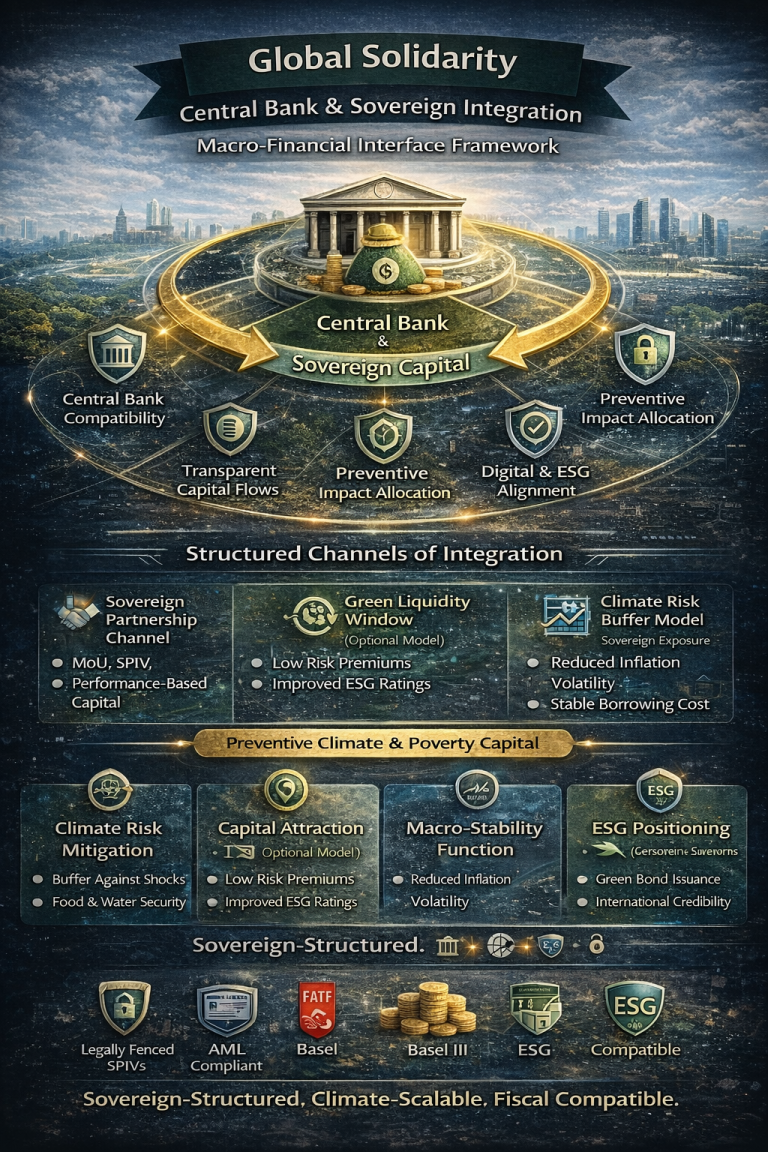


Developed in a scientific, financial, and governance-compliant format suitable for sovereign partners, institutional investors, and regulatory review.
ALLOCATION MODEL
70 / 30 STRUCTURAL FRAMEWORK
1. Conceptual Overview
The 70/30 Allocation Model is a capital structuring mechanism designed to ensure:
- Maximum direct impact deployment
- Long-term system sustainability
- Operational scalability
- Financial resilience
- Predictable reinvestment capacity
It divides net capital inflows into two functional categories:
70% → Direct Impact Deployment
30% → System Stabilization & Regenerative Capacity
The model enforces structural discipline while enabling long-term growth.
2. Structural Rationale
Traditional aid systems often fail due to:
- Administrative expansion
- Overhead absorption
- Lack of reinvestment structure
- Absence of reserves
- Unsustainable funding dependence
The 70/30 structure solves this by:
• Hard-coding capital discipline
• Creating regenerative financial buffers
• Maintaining liquidity stability
• Avoiding bureaucratic drift
It is a structural safeguard against mission dilution.
3. Mathematical Definition
Let:
C = Net capital inflow
D = Direct impact allocation
S = Stabilization & regenerative allocation
Then:
D = 0.70C
S = 0.30C
Where:
D funds immediate execution.
S funds sustainability, reserves, technology, and capital recycling.
4. The 70% Direct Impact Allocation
4.1 Purpose
Maximize measurable environmental and humanitarian outcomes.
4.2 Eligible Categories
• Reforestation programs
• Carbon sequestration infrastructure
• Renewable energy projects
• Water security systems
• Poverty reintegration programs
• Food resilience systems
4.3 Performance Requirements
Each funded project must report:
- Cost per outcome unit
- CO₂ captured per dollar (if climate-related)
- Beneficiary reintegration rate
- Time-to-impact metric
- Administrative ratio at node level
Capital release is conditional upon performance validation.
5. The 30% Stabilization & Regenerative Allocation
The 30% is not “overhead.”
It is strategic infrastructure capital.
It is subdivided into four components:
5.1 System Infrastructure (Technology & Compliance)
- AI monitoring systems
- Cybersecurity infrastructure
- Compliance frameworks (AML/KYC)
- Transparency dashboards
- Audit systems
Purpose:
Maintain institutional-grade integrity.
5.2 Capital Reserves & Liquidity Buffer
- Shock absorption
- Funding continuity during volatility
- Disaster response acceleration
- Risk mitigation reserve
This reduces systemic fragility.
5.3 Regenerative Investment Pool
Portion of 30% allocated to:
- Low-risk green yield instruments
- Carbon credit structured assets
- Sustainable infrastructure returns
Returns are recycled back into:
Impact scaling capacity.
5.4 Strategic Expansion Fund
Supports:
- New geographic nodes
- Scaling successful pilot programs
- Sovereign partnership onboarding
- Technology upgrades
Ensures controlled growth without dilution of discipline.
6. Capital Flow Dynamics
The 70/30 structure creates a regenerative flywheel:
Capital → 70% Impact → Verified Results
30% → Infrastructure & Reserves → Stability
Stability → Investor Confidence → Increased Capital Inflow
This improves:
Capital velocity and long-term sustainability.
7. Risk Mitigation Benefits
| Risk | Mitigation via 70/30 |
|---|---|
| Capital depletion | Reserve buffer |
| Administrative expansion | Fixed structural cap |
| Growth stagnation | Expansion fund |
| Technology degradation | Infrastructure allocation |
| Liquidity shock | Stabilization reserve |
8. Comparative Analysis
| Traditional Model | 70/30 Model |
|---|---|
| Undefined overhead | Structurally capped |
| No reserves | Built-in liquidity buffer |
| No reinvestment structure | Regenerative pool |
| Ad hoc growth | Funded expansion mechanism |
| Vulnerable to volatility | Stabilized capital cycle |
9. Macroeconomic Logic
Let:
I = Impact generation
R = Regenerative return
L = Liquidity stability
Cₙ = Next capital cycle
Then:
Cₙ₊₁ = Cₙ + (Confidence × R × L)
The 30% increases L (stability) and R (regenerative return), which increases future C.
This prevents short-termism.
10. Governance Safeguards
• 70% allocation cannot be repurposed
• 30% allocation audited quarterly
• Reserve ratios publicly disclosed
• Expansion capital requires performance validation
• Regenerative pool investment guidelines strictly defined
Transparency prevents drift.
11. Scenario Modeling
Scenario A: High Capital Inflow
Impact scales rapidly.
Reserves strengthen.
Expansion accelerates.
Scenario B: Capital Contraction
70% remains impact-focused.
30% buffer maintains operational continuity.
No emergency institutional downsizing required.
12. Integration with Forest Card & Sovereign Models
Under micro-contribution models:
If annual inflow = $120M:
$84M → Direct reforestation & poverty programs
$36M → Infrastructure, reserves, regenerative assets
This enables:
- National-level scaling
- Carbon asset creation
- Stable ESG reporting
13. Long-Term Structural Hypothesis
The 70/30 model ensures that:
- Impact remains dominant (70%)
- Sustainability remains guaranteed (30%)
- Growth remains controlled
- Capital remains regenerative
- The system avoids entropy
It balances:
Moral objective + Financial discipline.
14. Strategic Conclusion
The 70/30 Allocation Model transforms:
Capital → Structured Deployment
Deployment → Verified Impact
Impact → Confidence
Confidence → Capital Growth
It is not an accounting ratio.
It is a structural stability algorithm embedded into the financial DNA of Global Solidarity.