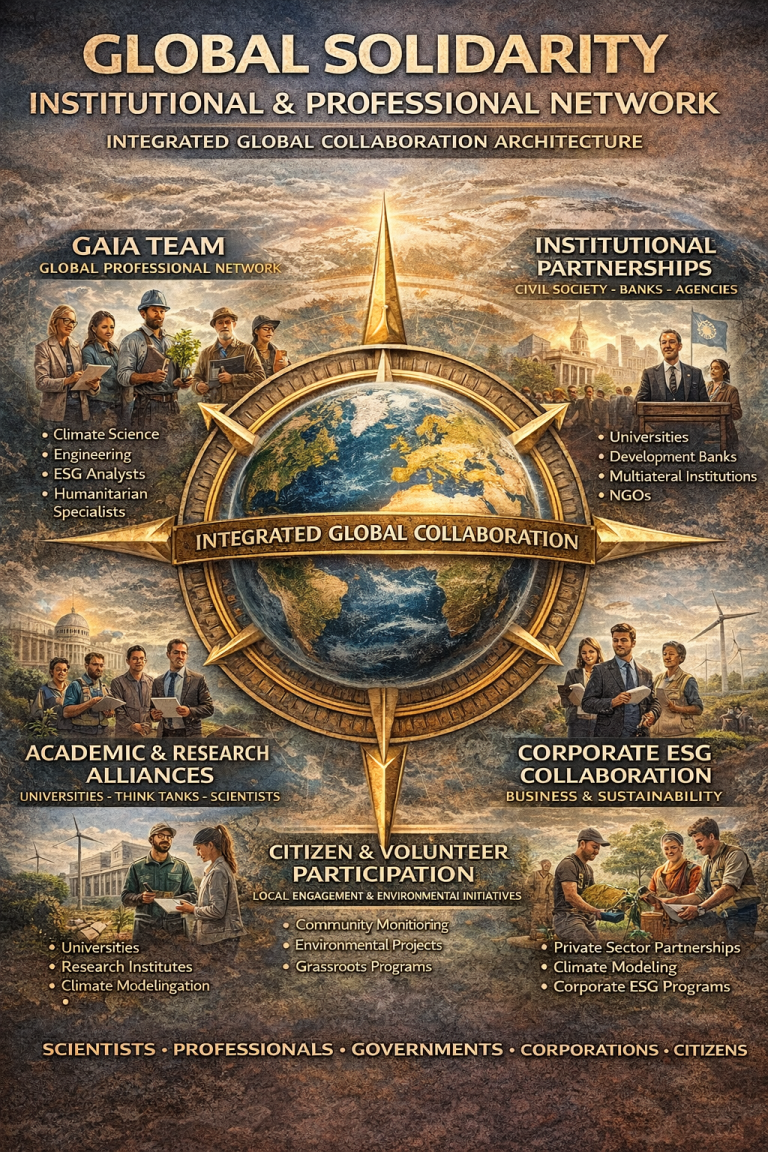


Institutional Cooperation Framework for Global Sustainability and Humanitarian Action
1. Conceptual Definition
The Multilateral & NGO Collaboration Program is the institutional framework through which the Global Solidarity platform cooperates with international organizations, multilateral institutions, development agencies, and non-governmental organizations.
The objective of this framework is to align Global Solidarity initiatives with existing international cooperation mechanisms, humanitarian networks, and global development programs.
Global challenges such as climate change, ecosystem degradation, humanitarian crises, and environmental displacement require coordinated action among multiple institutional actors.
Through structured collaboration with multilateral institutions and NGOs, Global Solidarity seeks to integrate operational capacity, financial resources, scientific knowledge, and field experience into a coordinated global response.
2. Strategic Hypothesis
The Multilateral & NGO Collaboration framework is based on several core assumptions regarding international cooperation.
- Global environmental and humanitarian challenges exceed the capacity of individual institutions.
- Multilateral organizations possess extensive operational networks and governance structures.
- NGOs provide essential field-level expertise and community engagement capabilities.
- Coordinated institutional cooperation improves resource allocation efficiency.
- Collaboration reduces duplication of efforts among sustainability initiatives.
- International cooperation enhances the legitimacy and credibility of large-scale programs.
- Multilateral frameworks provide regulatory and diplomatic support for global initiatives.
- Integrated cooperation accelerates the deployment of sustainability and humanitarian programs.
Under this framework, Global Solidarity operates not as an isolated institution but as a collaborative platform integrating multiple institutional actors.
3. Multilateral Institutional Partnerships
Multilateral institutions play a central role in global governance, development financing, and international cooperation.
Global Solidarity seeks to collaborate with multilateral organizations in areas including:
• climate mitigation and adaptation programs
• environmental protection initiatives
• sustainable infrastructure development
• humanitarian assistance programs
• global environmental policy development
Collaboration with multilateral institutions strengthens the institutional foundation of Global Solidarity initiatives.
4. NGO Collaboration Network
Non-governmental organizations represent essential actors in environmental protection, humanitarian response, and community development.
The NGO collaboration network enables cooperation with organizations specializing in:
• environmental conservation
• humanitarian aid delivery
• community development programs
• disaster response operations
• biodiversity protection initiatives
NGOs often possess direct operational experience in affected communities, making them key partners in program implementation.
5. Areas of Institutional Cooperation
Multilateral institutions and NGOs may collaborate with Global Solidarity across several strategic domains.
Climate and Environmental Programs
Collaboration may include initiatives such as:
• large-scale reforestation projects
• ecosystem restoration initiatives
• biodiversity conservation programs
• climate adaptation strategies
These programs contribute to global environmental resilience.
Humanitarian Assistance Systems
Humanitarian organizations may collaborate in programs related to:
• emergency response operations
• disaster relief coordination
• refugee assistance programs
• climate migration support systems
Such collaboration strengthens humanitarian response capacity.
Sustainable Infrastructure Development
Development organizations and international agencies may cooperate in projects such as:
• renewable energy infrastructure
• sustainable water systems
• climate-resilient housing programs
• sustainable urban planning initiatives
Infrastructure projects contribute to long-term sustainability and resilience.
6. Operational Coordination Mechanisms
Effective collaboration requires structured coordination mechanisms between Global Solidarity and partner institutions.
These mechanisms may include:
• joint program planning
• institutional partnership agreements
• shared project implementation frameworks
• collaborative monitoring systems
Structured coordination ensures efficient cooperation.
7. Data and Knowledge Exchange
Collaboration with multilateral institutions and NGOs enables the exchange of knowledge and operational data.
This exchange may include:
• environmental research findings
• humanitarian field data
• sustainability best practices
• policy analysis and evaluation reports
Knowledge exchange strengthens the effectiveness of sustainability initiatives.
8. Joint Program Implementation
Global Solidarity may implement programs jointly with multilateral institutions and NGOs.
Such collaboration may involve:
• co-financed sustainability projects
• coordinated humanitarian operations
• shared environmental monitoring systems
• collaborative research initiatives
Joint implementation leverages the strengths of multiple institutions.
9. Policy and Governance Collaboration
Multilateral cooperation also contributes to policy development and global governance discussions.
Collaborative policy initiatives may address:
• international environmental regulation
• climate mitigation frameworks
• global sustainability standards
• humanitarian governance mechanisms
Policy collaboration strengthens global governance frameworks.
10. Institutional Legitimacy and Credibility
Collaboration with established multilateral institutions and NGOs enhances the institutional credibility of Global Solidarity initiatives.
Such partnerships demonstrate alignment with recognized international standards and best practices in sustainability and humanitarian action.
Institutional legitimacy is essential for attracting investment, governmental support, and public trust.
11. Comparative Institutional Perspective
Many global sustainability initiatives operate independently or within limited networks.
The Multilateral & NGO Collaboration model differs by emphasizing structured partnerships across multiple institutional levels.
This approach enables:
• broader operational reach
• improved coordination of resources
• increased effectiveness of sustainability initiatives
Integrated collaboration enhances the impact of global programs.
12. Long-Term Strategic Objective
The long-term objective of the Multilateral & NGO Collaboration framework is to establish a global cooperation ecosystem capable of addressing complex environmental and humanitarian challenges.
Through coordinated action among international institutions, NGOs, and Global Solidarity operational programs, the platform aims to contribute to the development of a more resilient and sustainable global system.
13. Strategic Conclusion
The Multilateral & NGO Collaboration framework represents a key pillar of the Global Solidarity platform.
By integrating the operational expertise of NGOs, the institutional capacity of multilateral organizations, and the financial and technological resources of the Global Solidarity system, this collaborative model enables coordinated global action addressing environmental restoration, climate resilience, and humanitarian stability.
Through structured international cooperation, Global Solidarity operates as a collaborative platform supporting sustainable development and humanitarian progress at global scale.