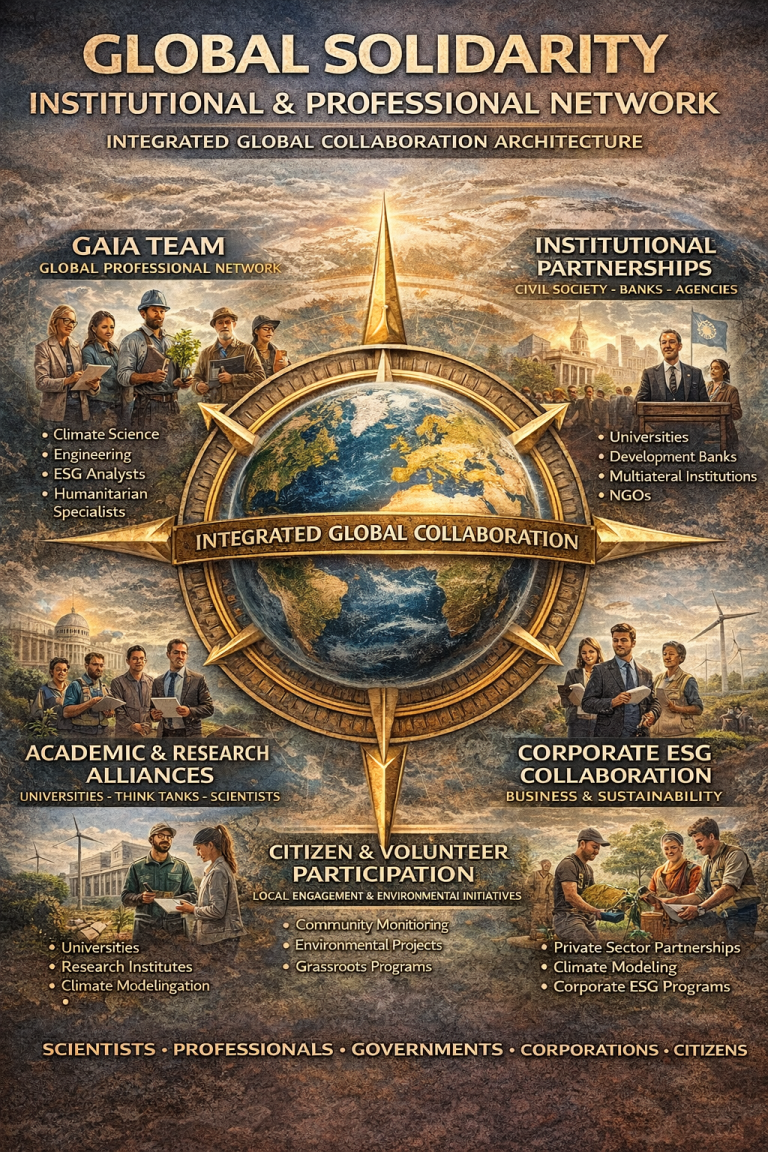


Global Solidarity – Strategic Advisory Architecture
1. Conceptual Definition
The Strategic Advisors Council is the high-level advisory body supporting the strategic direction, institutional credibility, and technical rigor of the Global Solidarity platform.
It functions as a multidisciplinary advisory structure composed of recognized experts, senior professionals, and institutional leaders capable of contributing strategic insights across the fields relevant to the Global Solidarity mission.
The advisory council does not operate as an executive body.
Its purpose is to provide independent expertise, long-term strategic orientation, and institutional validation for the platform’s initiatives.
The Strategic Advisors architecture reinforces the intellectual, institutional, and operational foundations of Global Solidarity.
2. Strategic Hypothesis
The Strategic Advisors model is based on the following premises:
- Large-scale global initiatives require multidisciplinary expertise.
- Independent advisory structures improve institutional credibility.
- Strategic oversight strengthens governance transparency.
- Expert guidance reduces systemic risk in complex programs.
- High-level advisors facilitate institutional partnerships.
- Multidisciplinary evaluation improves decision quality.
- Institutional legitimacy increases the ability to mobilize capital.
- Long-term vision improves program sustainability.
From this perspective, a structured advisory network enables Global Solidarity to combine operational execution with strategic intelligence.
3. Role of Strategic Advisors
Strategic Advisors provide guidance in four key areas:
1️⃣ Strategic Orientation
Advisors contribute long-term perspectives regarding:
• global environmental challenges
• geopolitical risks
• infrastructure transition strategies
• climate resilience frameworks
• global economic trends
Their role is to support long-term alignment between programs and global sustainability priorities.
2️⃣ Technical Expertise
Advisors provide subject-matter expertise in specialized fields, including:
• climate science
• environmental engineering
• energy transition systems
• sustainable finance
• humanitarian logistics
• urban resilience planning
• global governance frameworks
This expertise strengthens program design and operational feasibility.
3️⃣ Institutional Connectivity
Strategic Advisors often possess extensive institutional networks that facilitate cooperation with:
• international organizations
• development banks
• universities
• technology companies
• environmental NGOs
• humanitarian agencies
Through these networks, advisors contribute to expanding the institutional reach of Global Solidarity initiatives.
4️⃣ Governance Integrity
The presence of an advisory council strengthens governance standards by promoting:
• transparency
• accountability
• ethical oversight
• strategic coherence
Independent advisors contribute to maintaining institutional credibility.
4. Advisory Structure
The Strategic Advisors Council operates through a structured yet flexible framework designed to accommodate multidisciplinary expertise.
4.1 Core Advisors
Core Advisors are senior experts who contribute strategic guidance across multiple domains relevant to Global Solidarity.
They participate in:
• strategic reviews
• program evaluations
• institutional consultations
4.2 Domain Advisors
Domain Advisors contribute expertise in specific technical areas, such as:
Energy Systems
Environmental Science
Humanitarian Logistics
Climate Modeling
Sustainable Finance
Urban Infrastructure
Their role is to provide specialized insights for targeted programs.
4.3 Institutional Advisors
Institutional Advisors represent organizations or institutions collaborating with Global Solidarity.
Their participation strengthens coordination between Global Solidarity initiatives and institutional frameworks.
5. Areas of Advisory Expertise
The Strategic Advisors Council integrates expertise across several domains essential to the platform.
Environmental Systems
• climate risk analysis
• biodiversity conservation
• ecosystem restoration
Infrastructure & Engineering
• sustainable urban systems
• water infrastructure
• renewable energy systems
Sustainable Finance
• impact investment strategies
• green bonds and climate finance
• blended finance models
Humanitarian Systems
• disaster response frameworks
• refugee support infrastructure
• community stabilization programs
Governance & Policy
• environmental regulation
• international cooperation frameworks
• public policy analysis
6. Advisory Process
The advisory process follows a structured methodology designed to support institutional governance.
Strategic Reviews
Advisors periodically evaluate the strategic alignment of Global Solidarity initiatives.
Technical Consultation
Specialized advisors contribute expertise during the design and development of projects.
Institutional Dialogue
Advisors facilitate communication between Global Solidarity and relevant institutions.
Risk Assessment
Advisors contribute to the identification of operational, environmental, and financial risks.
7. Governance Integration
The Strategic Advisors Council interacts with other components of the Global Solidarity architecture.
It supports:
• Gaia Team operational units
• Mayday humanitarian systems
• sustainable infrastructure programs
• environmental regeneration initiatives
Through advisory input, these operational components benefit from strategic guidance and risk mitigation.
8. Ethical Principles
All advisors adhere to the ethical principles guiding Global Solidarity.
These principles include:
• environmental responsibility
• transparency in decision-making
• professional independence
• conflict-of-interest disclosure
• commitment to sustainable development
Ethical governance ensures institutional trust.
9. Comparative Institutional Model
The Strategic Advisors Council follows a governance structure similar to advisory bodies used by:
• international organizations
• research institutions
• global foundations
• multilateral development initiatives
Such advisory frameworks are widely recognized as essential components of large-scale institutional programs.
10. Strategic Value
The Strategic Advisors architecture generates several benefits:
• enhanced strategic vision
• improved technical rigor
• institutional credibility
• expanded collaboration networks
• reduced operational risk
These factors increase the long-term effectiveness of Global Solidarity initiatives.
11. Long-Term Objective
The long-term objective of the Strategic Advisors Council is to contribute to the development of a globally coordinated knowledge and governance framework capable of supporting environmental restoration, humanitarian resilience, and sustainable infrastructure transformation.
12. Strategic Conclusion
The Strategic Advisors Council represents an essential pillar within the Global Solidarity institutional architecture.
By integrating multidisciplinary expertise, institutional experience, and independent strategic guidance, the advisory framework strengthens the capacity of Global Solidarity to address complex global challenges through informed, collaborative, and responsible decision-making.