
Structured Operational Ground Deployment Architecture
1. Conceptual Definition
The Field Network (FN) is a geographically distributed, competence-verified, digitally integrated operational infrastructure responsible for executing:
• Emergency deployment
• Direct aid distribution
• Community stabilization
• Infrastructure recovery support
• Environmental regeneration projects
It is not an informal volunteer pool.
It is not decentralized improvisation.
It is a structured, pre-credentialed, operationally standardized field execution system aligned with:
• Institutional governance
• Compliance frameworks
• Digital reporting systems
• Risk management protocols
The objective is to transform:
Capital authorization → Structured deployment → Verified on-ground execution → Measurable impact.
2. Foundational Hypothesis
The Field Network framework is based on twelve structural premises:
- Institutional capital requires verified field execution.
- Local presence reduces response latency.
- Standardization reduces operational variability.
- Credentialed field teams reduce execution risk.
- Digital reporting increases transparency.
- Local knowledge enhances logistical efficiency.
- Decentralized nodes increase resilience.
- Modular field units enable scalability.
- Compliance discipline protects institutional credibility.
- Pre-trained networks reduce activation friction.
- Integrated command reduces duplication.
- Structured coordination reduces humanitarian inefficiency.
Therefore:
A disciplined field network is a critical infrastructure layer of humanitarian and stabilization systems.
3. Structural Architecture of the Field Network
The Field Network operates across six integrated layers:
1️⃣ Node-Based Geographic Deployment Model
2️⃣ Credentialing & Training Framework
3️⃣ Operational Standardization Protocols
4️⃣ Digital Command & Reporting Integration
5️⃣ Logistics & Supply Chain Coordination
6️⃣ Risk & Security Management Layer
Each layer ensures operational consistency and institutional reliability.
4. Layer I – Node-Based Geographic Deployment
Field Network operates through:
• Regional hubs
• National coordination centers
• Local operational nodes
• Cross-border coordination corridors
Each node includes:
• Trained personnel
• Communication systems
• Logistics access
• Digital reporting capability
Let:
R_t = Response time
N_d = Density of deployment nodes
As N_d increases:
R_t decreases.
Distributed nodes increase response efficiency.
5. Layer II – Credentialing & Training Framework
All field operators must meet:
• Identity verification
• Role-based certification
• Operational protocol training
• Compliance training (AML, KYC where applicable)
• Humanitarian ethics training
Personnel categories include:
• Logistics coordinators
• Medical field teams
• Water & sanitation specialists
• Registration officers
• Community liaison officers
• Security coordinators
Competence verification reduces operational error probability.
6. Layer III – Operational Standardization
Standard Operating Procedures (SOPs) define:
• Registration workflows
• Aid distribution protocols
• Incident reporting
• Data handling standards
• Escalation mechanisms
• Resource allocation rules
Let:
P_v = Operational variance
Standardization reduces:
P_v’ < P_v
Consistency increases institutional trust.
7. Layer IV – Digital Command & Reporting Integration
The Field Network integrates with:
• Central emergency dashboard
• Real-time beneficiary registry
• Capital disbursement monitoring
• GIS-based deployment tracking
• Compliance audit systems
Digital integration ensures:
• Transparent resource flow
• Field-to-headquarters synchronization
• Reduced information asymmetry
Real-time visibility reduces governance risk.
8. Layer V – Logistics & Supply Chain Coordination
Includes:
• Pre-approved suppliers
• Warehouse agreements
• Transportation contracts
• Cross-border customs facilitation
• Inventory management systems
Let:
L_d = Logistics delay
Structured pre-contracting reduces:
L_d’ < L_d
Logistics discipline is central to field reliability.
9. Layer VI – Risk & Security Management
Risk categories include:
• Physical security threats
• Civil unrest
• Corruption risk
• Diversion of aid
• Communication breakdown
• Disease exposure
Mitigation mechanisms:
• Security protocols
• Independent audits
• Whistleblower mechanisms
• Redundant communication channels
• Insurance coverage
Field risk must be proactively structured.
10. Field Network Scalability Model
Let:
N_p = Number of affected population
F_c = Field capacity per operational unit
Required operational units:
U = N_p / F_c
Scalability depends on:
Pre-trained personnel pool
Logistical redundancy
Capital continuity
Field Network must scale without proportional administrative expansion.
11. Performance Metrics
Key performance indicators (KPIs):
• Time-to-deployment
• Beneficiary coverage rate
• Resource delivery accuracy
• Compliance incident rate
• Cost per beneficiary
• Operational continuity index
Performance benchmarking enhances continuous improvement.
12. Comparative Model
| Ad Hoc Field Operations | Structured Field Network |
|---|---|
| Volunteer-driven | Credentialed personnel |
| Fragmented reporting | Integrated digital dashboard |
| Irregular procedures | SOP-based operations |
| Limited compliance | Audit-ready framework |
| High variance | Standardized execution |
13. Integration with Emergency & Stabilization Systems
The Field Network is the execution layer for:
• 72-Hour Deployment Protocol
• 10M+ Displacement Response
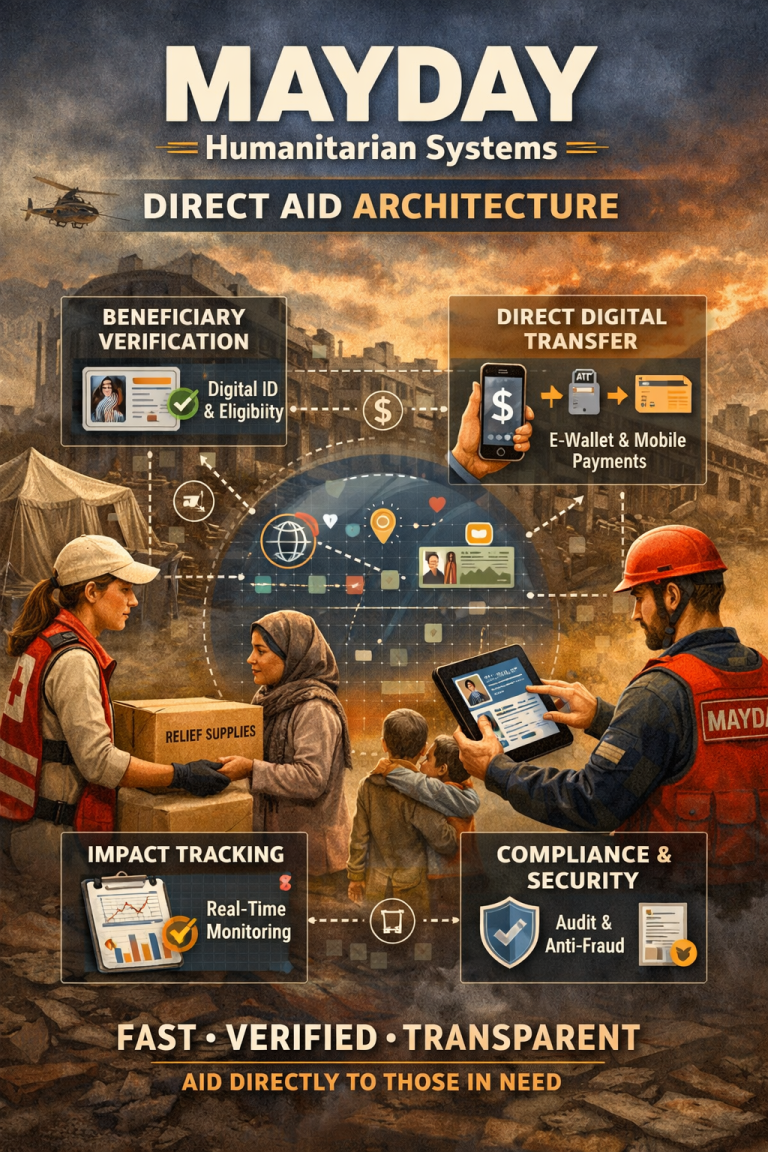
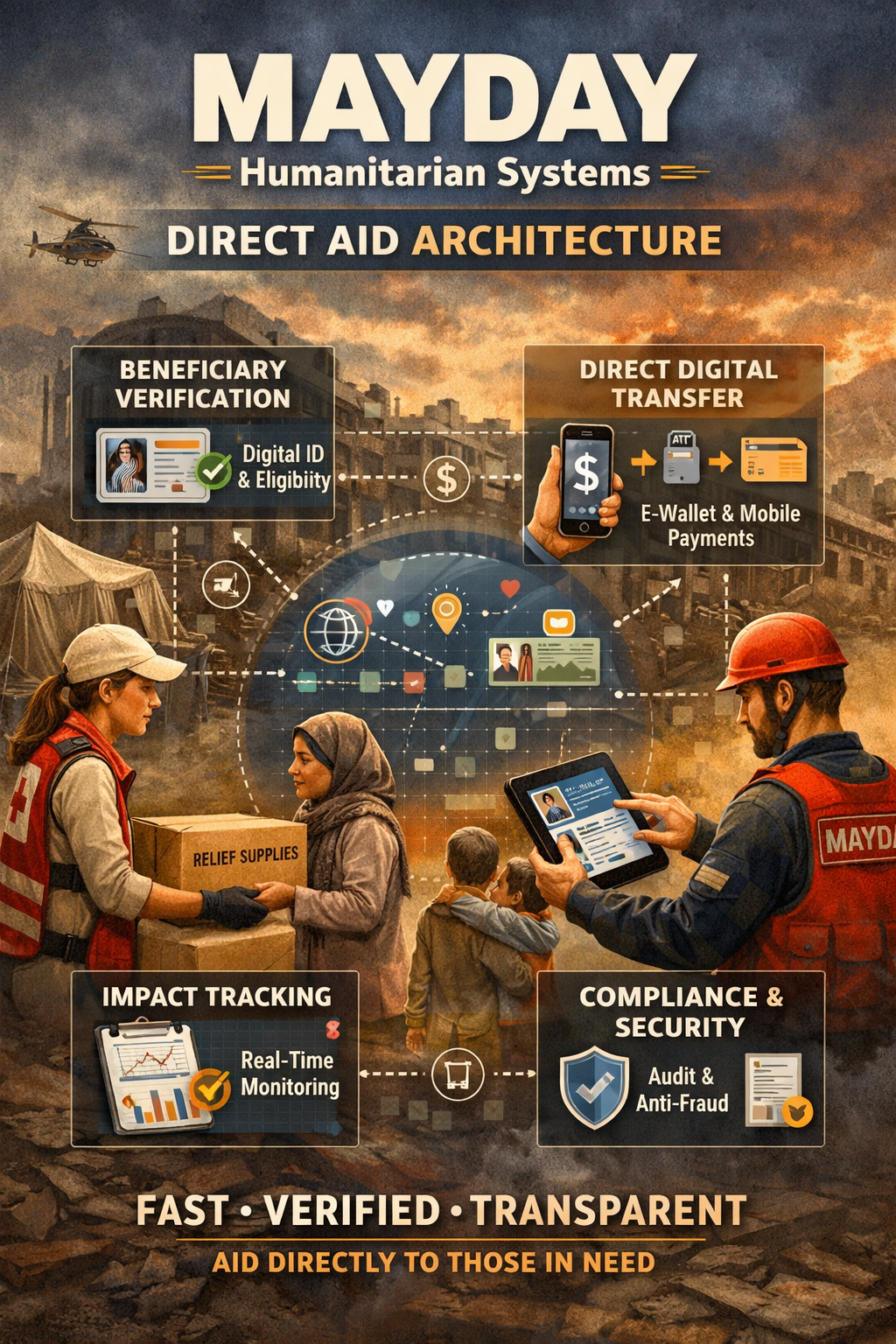
• Direct Aid Architecture
• Community Stabilization
• Environmental Regeneration projects
Without field execution, capital deployment is theoretical.
Field Network converts capital into measurable impact.
14. Sovereign Compatibility
The Field Network:
• Operates under national legal frameworks
• Coordinates with local authorities
• Respects public security protocols
• Does not create parallel governance
• Strengthens local institutional capacity
It integrates with civil protection and public systems.
15. Macroeconomic Stabilization Hypothesis
Let:
R_r = Response reliability
P_s = Probability of social instability
As R_r increases:
P_s decreases.
Structured field execution reduces:
• Civil unrest risk
• Aid diversion risk
• Recovery delay
• Sovereign reputational exposure
Field execution becomes a macro-level stabilizer.
16. Long-Term Structural Objective
The Field Network aims to:
Institutionalize geographically distributed, standardized, digitally integrated, compliance-disciplined operational capacity capable of supporting humanitarian, stabilization, and regenerative deployment at scale.
It transforms:
Institutional capital → Structured operational execution → Verified impact → Reduced systemic fragility.
17. Strategic Conclusion
The Field Network is:
Node-based
Credentialed
Digitally integrated
Standardized
Logistically structured
Risk-managed
Compliance-aligned
Scalable
It enables:
Rapid deployment
Reliable distribution
Transparent reporting
Institutional credibility
Reduced operational variance
Sovereign-compatible coordination
Without:
Volunteer fragmentation
Execution opacity
Unstructured logistics
Governance inconsistency
MILITARY–CIVIL INTEGRATION ANNEX
Structured Dual-Channel Emergency Support Framework
1. Conceptual Definition
Military–Civil Integration (MCI) is a structured coordination framework that enables temporary, legally compliant collaboration between:
• Civil humanitarian systems
• Military logistical and engineering capabilities
during:
• Large-scale natural disasters
• Climate catastrophes
• Mass displacement events
• Infrastructure collapse
• Extreme-scale humanitarian emergencies
It is not militarization of aid.
It is not substitution of civilian governance.
It is a defined, time-bound operational integration mechanism to leverage high-capacity logistics, mobility, and engineering assets during systemic stress.
2. Foundational Hypothesis
The MCI framework is based on twelve structural premises:
- Military logistics capacity often exceeds civilian emergency capacity.
- Rapid airlift and engineering units reduce mortality.
- Civilian humanitarian neutrality must be preserved.
- Legal clarity prevents jurisdictional conflict.
- Command separation reduces operational confusion.
- Military assets should be support-only, not governance actors.
- Transparent role definition reduces reputational risk.
- Time-bound activation prevents institutional overreach.
- Joint planning reduces duplication.
- Pre-signed protocols reduce activation friction.
- Security coordination reduces field risk.
- Integration must comply with international humanitarian law.
Therefore:
Military support may serve as a structured force multiplier under controlled civilian leadership.
3. Legal & Governance Principles
The annex operates under:
• National constitutional authority
• Civilian control of armed forces
• International humanitarian law
• Geneva Conventions (where applicable)
• Sovereign regulatory frameworks
Core rule:
Civilian humanitarian command retains strategic authority.
Military assets operate in support capacity only.
4. Structural Integration Architecture
Military–Civil Integration operates across five coordinated channels:
1️⃣ Strategic Command Interface
2️⃣ Logistics & Airlift Integration
3️⃣ Engineering & Infrastructure Support
4️⃣ Security & Risk Mitigation Coordination
5️⃣ Intelligence & Situational Awareness Sharing
Each channel is predefined and documented.
5. Channel I – Strategic Command Interface
Establish:
• Joint Coordination Cell (JCC)
• Civilian Incident Commander (CIC)
• Military Liaison Officer (MLO)
Authority model:
Civilian Lead → Operational Directive
Military → Execution Support within defined mandate
No operational autonomy beyond agreed scope.
6. Channel II – Logistics & Airlift Integration
Military assets may provide:
• Strategic airlift (cargo aircraft)
• Heavy transport vehicles
• Maritime transport support
• Rapid deployment of modular units
• Fuel logistics
Let:
L_c = Civilian logistics capacity
L_m = Military supplemental capacity
Total capacity:
L_total = L_c + L_m
Military integration reduces response time (R_t).
7. Channel III – Engineering & Infrastructure Support
Military engineering units may assist in:
• Bridge reconstruction
• Temporary road clearance
• Airstrip rehabilitation
• Water purification installation
• Power restoration support
Engineering capacity multiplier:
E_total = E_civil + E_military
Temporary infrastructure restoration reduces:
Economic loss severity (L_d).
8. Channel IV – Security & Risk Mitigation
In unstable environments:
Military may provide:
• Perimeter security for aid hubs
• Escort of supply convoys
• Crowd control under civil authority
• Border coordination support
Security model must respect:
• Humanitarian neutrality
• Proportional force principles
• Clear separation from political enforcement
Security stabilizes field operations and reduces aid diversion risk.
9. Channel V – Intelligence & Situational Awareness
Military assets may provide:
• Satellite imagery
• Aerial reconnaissance
• Damage mapping
• Logistics route viability assessment
Data sharing must be:
Limited to operational humanitarian scope
Free from political or intelligence exploitation
Situational awareness reduces deployment inefficiency.
10. Time-Bound Activation Model
Military–Civil Integration must be:
• Trigger-based
• Time-limited
• Reviewable at defined intervals
Example:
Activation window: 30–90 days
Mandatory reassessment every 30 days
Exit condition:
Civilian capacity restored above threshold (C_t).
Prevents institutional dependency.
11. Risk Management Framework
Risks include:
• Humanitarian neutrality erosion
• Political misuse
• Public perception distortion
• Operational confusion
• Command conflict
Mitigation mechanisms:
• Clear mandate documentation
• Public transparency statements
• Independent oversight
• Segregated operational domains
• Regular audit review
Institutional clarity protects legitimacy.
12. Financial Structuring
Military support may be:
• Government-funded (sovereign budget)
• Cost-reimbursed under emergency appropriation
• Integrated under development bank emergency facilities
Financial rules must define:
• Cost attribution
• Resource tracking
• Audit trail documentation
Transparency reduces fiscal ambiguity.
13. Comparative Model
| Unstructured Military Deployment | Structured Military–Civil Integration |
|---|---|
| Autonomous command | Civilian-led coordination |
| Undefined scope | Mandated support role |
| Open-ended duration | Time-bound activation |
| Political ambiguity | Legal framework alignment |
| Limited reporting | Documented oversight |
14. Refugee-Scale Application (10M+ Scenario)
In extreme displacement:
Military–Civil Integration enables:
• Rapid mass airlift
• Temporary megashelter engineering
• Mobile water purification at scale
• Strategic fuel transport
• Border stabilization support
Without MCI:
Response latency increases exponentially.
With MCI:
Δt (response time) significantly reduced.
15. Macroeconomic Stabilization Impact
Let:
R_r = Response reliability
P_s = Social unrest probability
GDP_loss = Economic contraction
Structured military–civil integration reduces:
R_r increases
P_s decreases
GDP_loss decreases
Rapid infrastructure restoration reduces:
Currency volatility
Capital flight
Bond yield pressure
16. Sovereign Compatibility
The annex:
• Respects civilian control
• Preserves humanitarian independence
• Operates under national law
• Requires formal activation
• Avoids governance substitution
It strengthens state capacity under stress.
17. Long-Term Structural Objective
The Military–Civil Integration Annex aims to:
Institutionalize a disciplined, lawful, temporary, high-capacity force multiplier mechanism for extreme-scale emergencies.
It transforms:
Overwhelmed civilian systems → Structured joint response → Reduced mortality → Accelerated stabilization → Restored civil leadership.
18. Strategic Conclusion
The Military–Civil Integration Annex is:
Legally structured
Civilian-led
Time-bound
Role-defined
Transparent
Audit-ready
Sovereign-compatible
Crisis-scalable
It enables:
Rapid mass logistics
Infrastructure restoration
Security stabilization
Operational acceleration
Reduced systemic collapse risk
Without:
Militarization of aid
Governance overreach
Political ambiguity
Institutional confusion