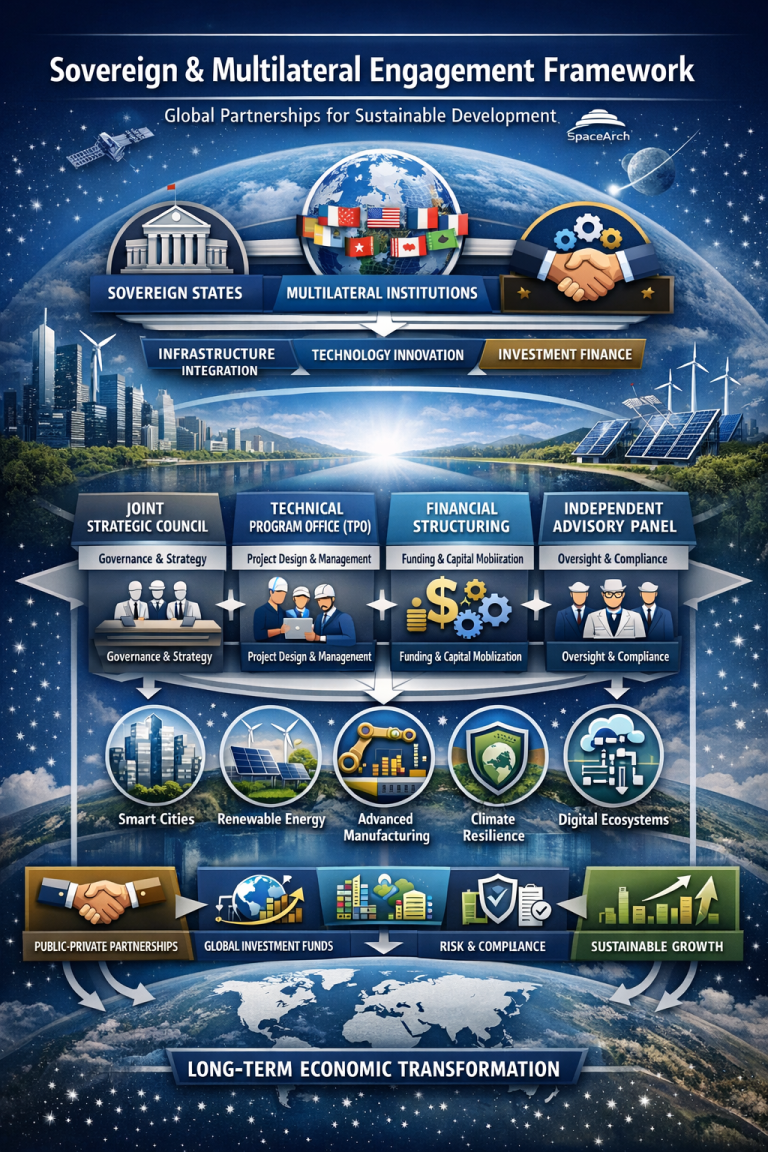


7.1 Sovereign Partnership Framework
1. Conceptual Definition
The Sovereign Partnership Framework (SPF) is a structured institutional engagement model designed to facilitate cooperation between SpaceArch Solutions International and sovereign states, regional authorities, and multilateral institutions for the development and implementation of large-scale technological, infrastructure, environmental, and urban transformation programs.
The framework establishes a formalized operational interface through which governments can collaborate with SpaceArch to deploy integrated development ecosystems, including digital infrastructure, smart urban systems, climate adaptation platforms, advanced industrial clusters, and AI-enabled economic acceleration programs.
Unlike traditional consultancy or project-based procurement models, the Sovereign Partnership Framework is conceived as a long-term strategic alliance architecture, enabling co-development, co-financing, and co-governance of transformative initiatives aligned with national development priorities and global sustainability objectives.
The model is designed to operate across multiple scales:
- National transformation programs
- Regional development corridors
- Smart city and hyper-city projects
- Climate resilience and energy transition initiatives
- Digital infrastructure and AI ecosystem development
- Advanced manufacturing and robotics hubs
Through this framework, SpaceArch functions not merely as a service provider but as a strategic development partner, integrating technological capabilities, financial engineering, global professional networks, and project execution capacity.
2. Strategic Rationale
Limitations of Traditional Development Models
Conventional public-sector development processes often face structural constraints, including:
- Fragmented planning across ministries
- Limited access to innovative financing mechanisms
- Slow bureaucratic procurement cycles
- Technological capability gaps
- Insufficient integration of digital infrastructure
- Misalignment between public policy and private-sector innovation
These structural inefficiencies frequently result in delayed project execution, budget overruns, and suboptimal outcomes, particularly in complex multi-sector infrastructure initiatives.
The Sovereign Partnership Framework addresses these limitations by introducing a holistic and modular collaboration architecture, enabling governments to leverage the agility of private-sector innovation while maintaining sovereign oversight and strategic alignment.
3. Structural Architecture of the Framework
The Sovereign Partnership Framework is organized around five operational pillars that structure the interaction between SpaceArch and sovereign or multilateral partners.
3.1 Strategic Alignment Layer
The first layer establishes alignment between national strategic priorities and SpaceArch’s technological and operational capabilities.
This process includes:
- National development strategy assessment
- Infrastructure gap analysis
- Technological readiness evaluation
- Economic diversification opportunities
- Climate resilience priorities
- Demographic and urbanization projections
Through this analysis, a joint strategic roadmap is produced, identifying priority programs suitable for implementation through the partnership framework.
Typical areas of collaboration may include:
- Smart urban infrastructure
- Renewable energy systems
- AI-enabled governance platforms
- Sustainable architecture and construction
- Advanced manufacturing clusters
- Digital education ecosystems
- Climate mitigation and adaptation projects
3.2 Institutional Governance Layer
The governance architecture ensures that projects developed under the Sovereign Partnership Framework operate within clear institutional oversight and transparent decision-making structures.
The governance model typically includes:
Joint Steering Committee
Responsible for strategic oversight, policy alignment, and program prioritization.
Participants may include:
- National government representatives
- Regional authorities
- SpaceArch executive leadership
- Multilateral observers when applicable
Technical Program Office (TPO)
A specialized operational entity responsible for:
- project design
- feasibility analysis
- engineering coordination
- technology integration
- financial structuring
Independent Advisory Board
In large-scale initiatives, external experts may be incorporated to provide:
- technical validation
- sustainability assessment
- regulatory compliance oversight
- risk evaluation
This governance architecture ensures that public-sector accountability and private-sector efficiency operate simultaneously.
4. Financial Structuring and Investment Mechanisms
A critical component of the Sovereign Partnership Framework is the integration of innovative financing structures capable of mobilizing large-scale capital while minimizing fiscal pressure on sovereign budgets.
Potential financing mechanisms include:
Public-Private Partnership (PPP) Models
Infrastructure projects may be structured through PPP frameworks allowing shared investment and risk allocation between public authorities and private investors.
Special Purpose Investment Vehicles (SPIV)
Dedicated financial entities may be established to channel capital toward specific programs, enabling:
- international investor participation
- risk diversification
- transparent capital allocation
- long-term project financing
Green and Climate Finance Instruments
For environmental or energy transition initiatives, financing may incorporate:
- green bonds
- climate adaptation funds
- carbon credit mechanisms
- multilateral environmental financing programs
Development Bank Participation
Collaboration with international financial institutions may include:
- development banks
- sovereign wealth funds
- climate investment funds
- regional infrastructure funds
Through these financial instruments, the Sovereign Partnership Framework aims to unlock large-scale investment capacity while maintaining sustainable fiscal structures for partner governments.
5. Operational Implementation Model
Projects developed under the framework follow a structured multi-phase implementation process.
Phase 1 — Strategic Assessment
Comprehensive evaluation of:
- national development objectives
- technological opportunities
- infrastructure gaps
- economic impact potential
Phase 2 — Conceptual Program Design
Development of:
- technical master plans
- feasibility studies
- regulatory compatibility analysis
- environmental impact assessments
Phase 3 — Financial Structuring
Design of investment architecture including:
- capital sources
- investment timelines
- risk allocation models
- revenue-generation mechanisms
Phase 4 — Project Deployment
Implementation of:
- infrastructure construction
- technology deployment
- operational systems
- workforce training programs
Phase 5 — Long-Term Operational Management
Operational oversight ensures:
- performance monitoring
- economic impact evaluation
- system optimization
- long-term sustainability
6. Comparative Advantages of the Framework
The Sovereign Partnership Framework offers several structural advantages compared to traditional infrastructure development models.
| Dimension | Traditional Model | Sovereign Partnership Framework |
|---|---|---|
| Project Scope | Sector-specific | Integrated multi-sector programs |
| Financing | Public budgets | Hybrid public-private capital |
| Technology Integration | Limited | Advanced digital infrastructure |
| Governance | Bureaucratic | Joint strategic governance |
| Implementation Speed | Slow | Modular accelerated deployment |
| Global Collaboration | Limited | Multilateral engagement |
This integrated approach allows governments to accelerate development initiatives while benefiting from global technological ecosystems and capital markets.
7. Multilateral Collaboration
The Sovereign Partnership Framework is designed to operate in coordination with multilateral institutions and international development organizations.
Potential collaboration partners may include:
- international development banks
- climate finance institutions
- regional economic unions
- global research networks
- international infrastructure funds
Such partnerships enable the scaling of projects beyond national boundaries, supporting regional development corridors and transnational infrastructure ecosystems.
8. Risk Management and Institutional Safeguards
To ensure institutional integrity and operational resilience, the framework incorporates multi-layered risk management systems.
These include:
- regulatory compliance monitoring
- financial transparency mechanisms
- independent auditing structures
- environmental and social safeguards
- anti-corruption compliance protocols
This structure ensures that all initiatives maintain international governance standards and sustainable development principles.
9. Long-Term Strategic Impact
The Sovereign Partnership Framework is designed to produce long-term structural transformation rather than isolated infrastructure projects.
Expected outcomes include:
- accelerated economic diversification
- large-scale job creation in advanced sectors
- improved climate resilience
- enhanced technological sovereignty
- sustainable urbanization
- stronger integration into global innovation networks
By aligning sovereign strategic objectives with private-sector innovation and global financial capital, the framework provides a scalable model for 21st-century development partnerships.
Sovereign & Multilateral Engagement
7.1 Sovereign Partnership Framework
1. Conceptual Definition
The Sovereign Partnership Framework (SPF) constitutes the institutional architecture through which SpaceArch Solutions International engages with sovereign governments, regional authorities, and multilateral organizations to design, finance, and deploy large-scale development programs involving advanced infrastructure, digital ecosystems, climate transition projects, and next-generation urban systems.
The framework is conceived as a long-term strategic collaboration platform, moving beyond conventional consulting relationships or isolated infrastructure contracts. Instead, it establishes a structured partnership model that integrates:
- public policy objectives
- technological innovation
- global capital markets
- multidisciplinary professional networks
- large-scale operational deployment capacity
Within this architecture, SpaceArch operates as a strategic technological partner and systems integrator, coordinating multidisciplinary expertise across architecture, artificial intelligence, energy transition, digital infrastructure, and sustainable economic development.
The Sovereign Partnership Framework is therefore designed to support systemic transformation initiatives, including:
- smart urban infrastructure
- climate adaptation and environmental resilience
- advanced manufacturing clusters
- AI-enabled governance systems
- renewable energy transition
- digital economic ecosystems
These initiatives are aligned with both national development strategies and global sustainability agendas, including climate transition commitments and technological modernization goals.
2. Strategic Rationale
Structural Challenges in Traditional Development Models
Many national development strategies face persistent structural barriers that reduce efficiency and delay implementation. These include:
- fragmented institutional coordination
- slow procurement procedures
- limited access to innovative financing mechanisms
- technological capability gaps
- weak integration between infrastructure and digital systems
- insufficient coordination between public policy and private-sector innovation
Traditional project models often operate through sector-specific programs with limited cross-sector integration, leading to inefficiencies and reduced economic impact.
In contrast, the Sovereign Partnership Framework introduces an integrated development architecture, enabling governments to coordinate complex transformation programs through a unified operational platform.
3. Strategic Objectives of the Framework
The Sovereign Partnership Framework pursues five primary strategic objectives.
1. Accelerating Infrastructure Modernization
The framework enables governments to implement next-generation infrastructure systems including smart mobility networks, digital connectivity platforms, and advanced urban planning architectures.
2. Mobilizing Global Investment Capital
Through structured investment vehicles and international financing partnerships, the framework facilitates access to global capital markets and institutional investors.
3. Enabling Technological Leapfrogging
Developing economies may bypass intermediate technological stages by directly adopting AI-enabled infrastructure, automation systems, and digital governance platforms.
4. Strengthening Climate Resilience
The partnership architecture integrates climate mitigation and adaptation strategies into infrastructure planning, including renewable energy systems, sustainable construction, and environmental monitoring networks.
5. Supporting Long-Term Economic Diversification
By promoting the development of advanced industrial sectors and innovation ecosystems, the framework contributes to sustainable economic diversification and knowledge-based growth.
4. Institutional Architecture
The Sovereign Partnership Framework operates through a multi-layer institutional structure designed to ensure transparency, accountability, and operational efficiency.
4.1 Joint Strategic Council
The Joint Strategic Council represents the highest governance body within the partnership structure.
Its responsibilities include:
- defining strategic priorities
- approving major investment programs
- ensuring alignment with national policy objectives
- supervising program implementation
Participants may include:
- national government representatives
- regional authorities
- SpaceArch executive leadership
- representatives from partner institutions or development organizations
4.2 Technical Program Office (TPO)
The Technical Program Office acts as the operational coordination center for all projects implemented under the Sovereign Partnership Framework.
Key functions include:
- technical feasibility studies
- engineering coordination
- architectural design integration
- technological system deployment
- operational project management
The TPO integrates multidisciplinary teams including:
- engineers
- architects
- AI specialists
- financial analysts
- environmental scientists
4.3 Independent Advisory Panel
For large-scale projects, an Independent Advisory Panel may be established to ensure technical validation and compliance with international standards.
This panel may include:
- academic experts
- sustainability specialists
- financial governance advisors
- regulatory compliance specialists
The objective is to ensure that all programs operate according to best practices in governance, sustainability, and technological reliability.
5. Financial Architecture and Capital Mobilization
One of the defining characteristics of the Sovereign Partnership Framework is its capacity to integrate public policy initiatives with sophisticated financial structuring mechanisms.
The framework incorporates multiple financing channels to ensure sustainable project funding.
Public-Private Partnership (PPP) Structures
Large infrastructure programs may be implemented through PPP models, distributing financial risk and operational responsibilities between public institutions and private investors.
Special Purpose Investment Vehicles (SPIV)
Dedicated investment vehicles may be established to finance specific projects or development corridors.
These entities allow:
- international investor participation
- transparent financial governance
- project-specific capital allocation
- long-term revenue management
Green Finance Instruments
Environmental and climate-related programs may be financed through:
- green bonds
- climate adaptation funds
- carbon credit mechanisms
- sustainability-linked financial instruments
Multilateral Development Financing
Collaboration with international financial institutions may provide additional capital and risk mitigation.
Potential partners include:
- development banks
- sovereign wealth funds
- international infrastructure funds
- climate finance institutions
6. Implementation Methodology
Projects implemented through the Sovereign Partnership Framework follow a structured multi-stage development process.
Phase 1 — Strategic Assessment
Initial evaluation includes:
- national development priorities
- economic growth opportunities
- infrastructure gaps
- environmental sustainability considerations
Phase 2 — Conceptual Program Design
Detailed program architecture is developed, including:
- technical master plans
- engineering design
- regulatory compatibility analysis
- environmental impact studies
Phase 3 — Financial Structuring
Investment architecture is developed, defining:
- funding sources
- capital allocation mechanisms
- risk distribution frameworks
- projected financial returns
Phase 4 — Deployment
Infrastructure construction and system deployment are implemented through coordinated engineering and operational teams.
Phase 5 — Operational Management
Long-term operational oversight includes:
- performance monitoring
- economic impact evaluation
- technological upgrades
- sustainability optimization
7. Multilateral Cooperation Architecture
The Sovereign Partnership Framework is designed to operate in collaboration with international institutions and multilateral organizations that support sustainable development and infrastructure modernization.
These collaborations enable access to:
- global expertise networks
- international financing mechanisms
- cross-border infrastructure initiatives
- global climate transition programs
Potential institutional collaborators may include:
- international development banks
- global sustainability funds
- regional economic alliances
- research institutions and innovation networks
8. Risk Governance and Institutional Safeguards
To maintain institutional integrity and investor confidence, the framework incorporates comprehensive risk management mechanisms.
These include:
- regulatory compliance monitoring
- financial transparency systems
- independent auditing procedures
- environmental and social safeguards
- anti-corruption protocols
These mechanisms ensure alignment with international governance standards and responsible investment principles.
9. Comparative Advantages
The Sovereign Partnership Framework offers significant advantages compared with traditional infrastructure development models.
| Dimension | Conventional Model | Sovereign Partnership Framework |
|---|---|---|
| Institutional Integration | Fragmented | Coordinated multi-sector governance |
| Financing | Public budgets | Hybrid global capital structures |
| Technology Adoption | Gradual | Accelerated technological deployment |
| Implementation Speed | Slow | Modular and scalable |
| Economic Impact | Limited | Systemic transformation potential |
10. Long-Term Strategic Impact
The Sovereign Partnership Framework is designed to support structural transformation of national economies rather than isolated infrastructure projects.
Expected long-term outcomes include:
- accelerated technological modernization
- resilient climate-adaptive infrastructure
- increased economic competitiveness
- development of innovation ecosystems
- large-scale employment generation in advanced sectors
- strengthened integration into global economic networks
By combining sovereign policy direction, private-sector innovation, and global financial resources, the framework establishes a scalable model for 21st-century development partnerships capable of supporting national transformation and sustainable growth.