

7.2 Central Bank Integration
1. Conceptual Definition
Central Bank Integration (CBI) refers to the institutional and technological interface through which SpaceArch Solutions International collaborates with national central banks, monetary authorities, and international financial institutions to support the modernization of financial infrastructure, capital allocation mechanisms, and macroeconomic stability systems associated with large-scale development initiatives.
Within the SpaceArch ecosystem, Central Bank Integration represents a financial governance layer that ensures compatibility between sovereign monetary systems and the investment, financing, and capital mobilization mechanisms used to implement infrastructure, technology, and climate transition programs.
The framework is not designed to interfere with or replace central bank authority. Instead, it functions as a cooperative integration model, ensuring that large-scale investment programs—often involving international capital flows—remain aligned with:
- national monetary policies
- financial stability objectives
- regulatory frameworks
- macroprudential risk management standards
The objective is to enable secure and transparent financial coordination between sovereign monetary authorities and large international development programs.
2. Strategic Rationale
Financial Coordination in Large-Scale Development Programs
Large infrastructure and technological transformation programs frequently involve multi-billion-dollar capital flows, cross-border investment participation, and complex financial instruments.
Without adequate coordination with national monetary authorities, such financial activity can generate:
- currency volatility
- capital flow instability
- banking sector liquidity imbalances
- regulatory compliance risks
- payment system bottlenecks
The Central Bank Integration model addresses these risks by establishing structured coordination channels between development programs and national financial systems.
This integration ensures that development financing mechanisms operate within the macroeconomic stability framework defined by sovereign monetary authorities.
3. Core Objectives
The Central Bank Integration framework pursues several strategic objectives.
3.1 Financial Stability Protection
By coordinating capital inflows, financing structures, and payment flows with central banks, the framework helps maintain monetary and financial system stability.
3.2 Transparent Capital Flow Management
Large development investments often involve international capital. The framework ensures that these flows remain transparent, regulated, and compliant with national financial laws.
3.3 Financial Infrastructure Modernization
Central Bank Integration supports the modernization of financial infrastructure, including:
- digital payment systems
- cross-border settlement platforms
- sovereign financial data architecture
- capital market infrastructure
3.4 Facilitation of Strategic Development Financing
The integration model enables central banks to monitor and coordinate macroeconomic impacts associated with large-scale infrastructure investment programs.
4. Institutional Architecture
Central Bank Integration operates through a multi-layered institutional interface designed to respect sovereign monetary authority while enabling efficient coordination with development programs.
4.1 Monetary Coordination Interface
A formal coordination interface may be established between SpaceArch financial program structures and national central bank departments responsible for:
- monetary policy monitoring
- financial stability supervision
- capital market regulation
- international reserve management
This interface enables continuous information exchange and macroeconomic monitoring.
4.2 Financial Infrastructure Working Group
A specialized working group may be established to coordinate modernization initiatives involving financial infrastructure.
Participants may include:
- central bank technical departments
- financial regulatory authorities
- commercial banking representatives
- financial technology specialists
Areas of collaboration may include:
- payment system modernization
- financial data interoperability
- blockchain-based settlement systems
- real-time cross-border transaction infrastructure
4.3 Financial Oversight Committee
In large-scale programs involving international investors, a Financial Oversight Committee may be established to ensure compliance with regulatory standards.
Responsibilities may include:
- monitoring capital inflows
- ensuring regulatory compliance
- coordinating anti-money laundering controls
- supervising financial transparency mechanisms
5. Financial System Integration Mechanisms
Central Bank Integration supports multiple financial system components.
5.1 Payment System Coordination
Large infrastructure programs require high-capacity transaction systems capable of handling:
- international investment flows
- contractor payments
- public-private financial settlements
Coordination with national payment infrastructure ensures that transactions are processed through secure, regulated channels.
5.2 Sovereign Capital Market Alignment
Development programs often rely on capital markets to finance large infrastructure projects.
The integration framework supports collaboration between SpaceArch financial vehicles and:
- sovereign bond markets
- infrastructure investment funds
- sovereign wealth funds
- pension funds
This alignment ensures efficient capital mobilization while preserving financial system stability.
5.3 Digital Financial Infrastructure
Central banks around the world are increasingly developing digital financial systems, including:
- Central Bank Digital Currencies (CBDCs)
- real-time gross settlement systems
- digital identity infrastructure
- programmable payment platforms
Central Bank Integration enables compatibility between SpaceArch financial platforms and these emerging digital financial infrastructures.
6. Regulatory Compliance Architecture
Central Bank Integration incorporates comprehensive compliance mechanisms to ensure adherence to national and international financial regulations.
Key regulatory areas include:
- anti-money laundering (AML) compliance
- counter-terrorism financing safeguards (CFT)
- capital controls and cross-border flow regulations
- banking sector supervisory standards
- financial reporting transparency
This compliance architecture is essential to maintain institutional trust among sovereign governments, investors, and international financial institutions.
7. Comparative Model Analysis
The Central Bank Integration framework differs significantly from traditional infrastructure financing models.
| Dimension | Conventional Infrastructure Financing | Central Bank Integration Model |
|---|---|---|
| Financial Coordination | Limited | Structured coordination with monetary authorities |
| Capital Flow Monitoring | Fragmented | Integrated monitoring mechanisms |
| Regulatory Compliance | Reactive | Proactive regulatory integration |
| Payment Systems | Traditional banking channels | Advanced digital financial infrastructure |
| Transparency | Project-level reporting | System-level financial governance |
This approach reduces systemic risk while facilitating large-scale development financing.
8. International Coordination
Central Bank Integration also supports collaboration with international monetary and financial institutions, including global financial stability networks.
Potential collaboration channels include:
- international monetary organizations
- regional financial stability forums
- cross-border payment system initiatives
- global financial regulatory coordination networks
Such collaboration strengthens the global financial legitimacy and operational resilience of development programs implemented under the SpaceArch ecosystem.
9. Risk Governance Framework
Large-scale capital flows require robust risk management.
The framework incorporates:
- macroeconomic risk monitoring
- currency exposure analysis
- liquidity risk supervision
- sovereign credit risk monitoring
- financial system stress testing
This risk governance layer ensures that development programs remain financially sustainable and macroeconomically stable.
10. Strategic Impact
The Central Bank Integration model provides significant long-term benefits.
Strengthening Financial System Resilience
Coordinated financial infrastructure improves the resilience and efficiency of national financial systems.
Facilitating International Investment
Transparent financial governance encourages greater participation from global institutional investors.
Supporting Economic Development
Efficient capital allocation mechanisms accelerate infrastructure deployment and economic modernization.
Enhancing Monetary Policy Effectiveness
Integration between development financing and central bank monitoring improves the ability of monetary authorities to manage macroeconomic impacts.
11. Long-Term Vision
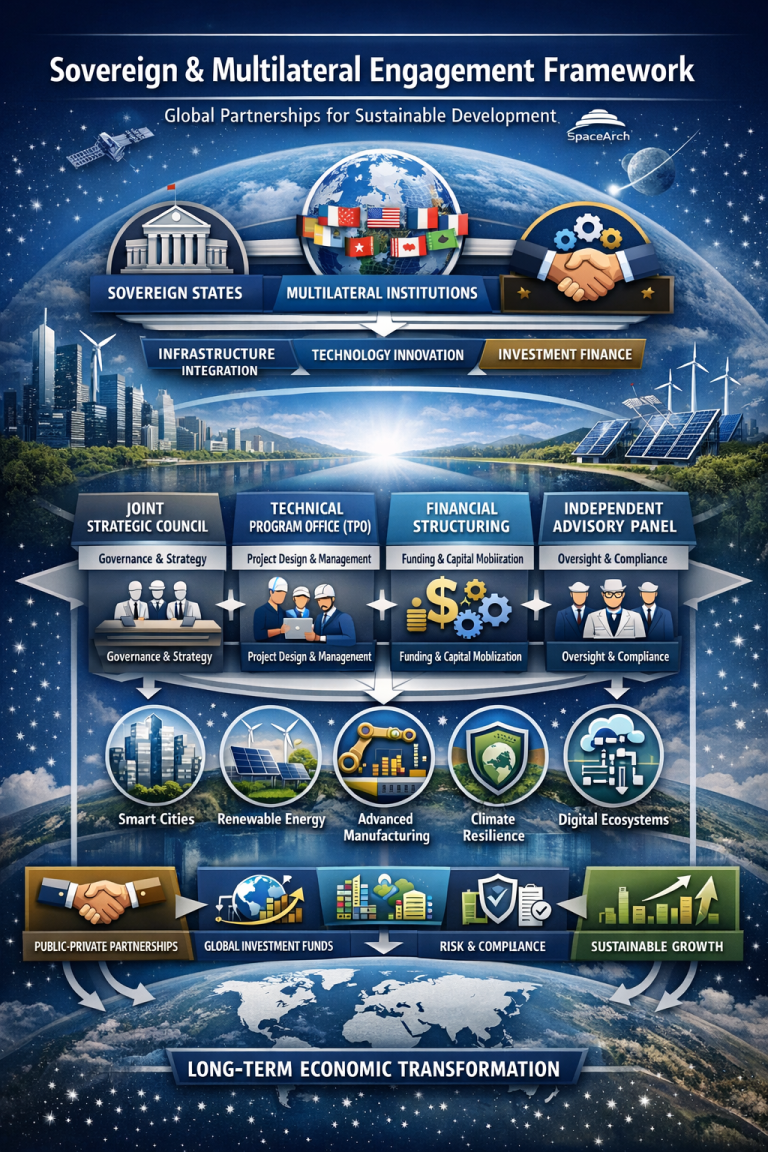
Central Bank Integration forms a critical component of the Sovereign & Multilateral Engagement architecture of SpaceArch, enabling the alignment of large-scale technological and infrastructure development programs with the financial governance systems of sovereign states.
Through structured collaboration with central banks, the framework helps create stable, transparent, and scalable financial environments capable of supporting 21st-century development programs.
This integration ultimately contributes to the creation of advanced economic ecosystems where infrastructure modernization, technological innovation, and financial system stability operate in coordinated synergy.
Sovereign & Multilateral Engagement
7.3 Sovereign Digital Finance Infrastructure
1. Conceptual Definition
Sovereign Digital Finance Infrastructure (SDFI) refers to the integrated financial technology architecture through which national governments, central banks, financial institutions, and development platforms interact within a secure, scalable, and digitally native financial ecosystem.
Within the SpaceArch institutional framework, Sovereign Digital Finance Infrastructure functions as the digital financial backbone enabling the efficient mobilization, allocation, monitoring, and settlement of capital flows associated with large-scale development programs, infrastructure investments, climate transition initiatives, and cross-border economic corridors.
The architecture is designed to integrate the following elements:
- sovereign monetary systems
- central bank digital currencies (CBDCs)
- real-time settlement systems
- digital identity and compliance frameworks
- programmable financial instruments
- cross-border capital flow infrastructure
The goal is to create a high-transparency, high-efficiency digital financial ecosystem capable of supporting complex investment flows and development financing programs in a secure and scalable manner.
2. Strategic Rationale
Traditional financial infrastructure was developed for 20th-century banking systems, characterized by slower transaction speeds, fragmented regulatory frameworks, and limited interoperability between national financial systems.
However, modern development programs increasingly require:
- high-frequency financial transactions
- international capital participation
- real-time monitoring of financial flows
- programmable investment structures
- transparent financial reporting
Without modern digital infrastructure, the management of large-scale development financing can become inefficient and vulnerable to operational risk.
The Sovereign Digital Finance Infrastructure model addresses these limitations by creating digitally integrated financial ecosystems capable of supporting large-scale investment and infrastructure programs.
3. Core Architectural Components
3.1 Digital Payment Infrastructure
The first layer of Sovereign Digital Finance Infrastructure involves the modernization of national payment systems.
Key components include:
- real-time gross settlement systems (RTGS)
- instant payment networks
- cross-border digital settlement platforms
- programmable payment protocols
These systems enable high-speed financial transactions and efficient capital allocation across development programs.
3.2 Central Bank Digital Currency Integration
Many central banks are currently exploring or implementing Central Bank Digital Currencies (CBDCs).
Sovereign Digital Finance Infrastructure provides compatibility with CBDC platforms, enabling:
- programmable financial transfers
- automated compliance monitoring
- transparent transaction records
- smart contract-based financial settlements
CBDC integration can significantly improve the efficiency and transparency of government financial programs and infrastructure investments.
3.3 Digital Identity and Compliance Infrastructure
Financial transparency and regulatory compliance are critical components of modern financial ecosystems.
The infrastructure incorporates digital identity frameworks supporting:
- Know Your Customer (KYC) verification
- Anti-Money Laundering (AML) compliance
- financial transaction monitoring
- cross-border regulatory compatibility
Digital identity systems allow governments and financial institutions to maintain secure and transparent financial participation environments.
3.4 Programmable Financial Instruments
Digital financial infrastructure enables the creation of programmable financial instruments capable of automating financial operations.
These instruments may include:
- smart bonds
- programmable infrastructure financing instruments
- automated revenue distribution mechanisms
- digitally managed investment funds
Programmable finance enables greater transparency, efficiency, and automation in large-scale development financing programs.
4. Cross-Border Financial Connectivity
Modern development initiatives frequently involve international investment participation.
Sovereign Digital Finance Infrastructure supports cross-border financial interoperability through:
- digital currency exchange platforms
- international settlement protocols
- regulatory data-sharing frameworks
- multi-currency digital transaction networks
These mechanisms facilitate secure international capital participation while maintaining regulatory oversight.
5. Institutional Governance
To ensure effective oversight and operational reliability, Sovereign Digital Finance Infrastructure operates under structured institutional governance.
Digital Financial Governance Council
A governance body responsible for:
- policy alignment
- financial system coordination
- digital financial infrastructure oversight
Participants may include:
- central bank representatives
- financial regulators
- technology infrastructure providers
- institutional investment stakeholders
Technical Infrastructure Coordination Unit
A specialized technical unit responsible for:
- platform integration
- cybersecurity protocols
- digital financial system architecture
- interoperability standards
This unit ensures that all digital financial components operate within secure and reliable technological frameworks.
6. Cybersecurity and Operational Resilience
Digital financial systems require strong protection against cyber risk and operational disruption.
The Sovereign Digital Finance Infrastructure incorporates:
- multi-layer cybersecurity protocols
- distributed ledger integrity mechanisms
- redundancy and backup infrastructure
- real-time financial anomaly detection systems
These safeguards ensure continuous operational reliability and protection against systemic risk.
7. Comparative Advantages
| Dimension | Traditional Financial Infrastructure | Sovereign Digital Finance Infrastructure |
|---|---|---|
| Transaction Speed | Slow settlement cycles | Real-time digital settlement |
| Transparency | Limited reporting | Transparent transaction architecture |
| Automation | Manual financial processes | Programmable financial instruments |
| Cross-Border Efficiency | Complex intermediaries | Direct digital interoperability |
| Regulatory Monitoring | Delayed oversight | Real-time compliance monitoring |
The digital model significantly improves efficiency, transparency, and financial system resilience.
8. Strategic Impact
The implementation of Sovereign Digital Finance Infrastructure enables several long-term benefits.
Accelerated Capital Deployment
Development funds and investment capital can be allocated more rapidly and efficiently.
Increased Financial Transparency
Digital financial systems enable transparent monitoring of capital flows.
Enhanced Financial Inclusion
Digital infrastructure may expand financial participation across broader segments of society.
Improved Investment Confidence
International investors are more likely to participate in development programs supported by transparent digital financial systems.
9. Long-Term Vision
The Sovereign Digital Finance Infrastructure represents a core component of the financial modernization strategy for large-scale development ecosystems.
By integrating digital payment systems, programmable finance, and sovereign monetary infrastructure, the framework creates secure and scalable financial environments capable of supporting the next generation of infrastructure development and economic transformation.
7.4 Global Development Financing Architecture
1. Conceptual Definition
The Global Development Financing Architecture (GDFA) refers to the integrated financial system through which large-scale global investment capital is mobilized, structured, and deployed to finance infrastructure, technological innovation, environmental transition, and economic development programs.
Within the SpaceArch strategic framework, GDFA serves as the financial backbone for global-scale project financing, combining public-sector participation, institutional investors, multilateral development institutions, and private capital markets.
The architecture is designed to support multi-trillion-dollar development ecosystems capable of accelerating global infrastructure modernization and sustainable economic growth.
2. Structural Rationale
Global infrastructure investment demand is projected to reach tens of trillions of dollars over the coming decades, driven by:
- urban population growth
- climate transition requirements
- digital infrastructure expansion
- energy system modernization
- transportation network upgrades
However, traditional public financing mechanisms alone are insufficient to meet these capital requirements.
The Global Development Financing Architecture addresses this challenge by creating integrated financial ecosystems capable of mobilizing both public and private capital at global scale.
3. Capital Sources
The GDFA framework integrates multiple capital sources.
Sovereign Capital
Government financing may include:
- national infrastructure budgets
- sovereign wealth funds
- development program allocations
Institutional Investors
Large institutional investors represent a critical capital source, including:
- pension funds
- insurance companies
- sovereign wealth funds
- global infrastructure investment funds
These institutions seek long-term stable returns compatible with infrastructure investments.
Multilateral Development Institutions
International financial institutions may participate in project financing through:
- development loans
- co-investment programs
- risk mitigation instruments
- climate transition funding mechanisms
Private Capital Markets
Private investment participation may include:
- infrastructure investment funds
- project finance structures
- corporate investment partnerships
- venture capital for technological innovation
4. Financial Structuring Mechanisms
The architecture incorporates multiple financing structures.
Public-Private Partnerships (PPP)
PPP structures allow joint investment between governments and private investors.
Special Purpose Investment Vehicles (SPIV)
SPIV structures allow capital to be directed toward specific projects or infrastructure corridors.
These entities provide:
- transparent financial governance
- investor participation mechanisms
- project-specific revenue allocation structures
Green Finance Instruments
Environmental and climate transition projects may be financed through:
- green bonds
- carbon credit markets
- climate investment funds
- sustainability-linked financial instruments
5. Risk Mitigation Mechanisms
Large-scale investment requires robust risk management.
The GDFA architecture incorporates:
- political risk insurance
- sovereign credit risk assessment
- currency hedging mechanisms
- project-level risk allocation structures
These instruments improve investor confidence and enable broader participation.
6. Financial Governance
The Global Development Financing Architecture incorporates structured governance systems.
Global Financing Coordination Council
Responsible for coordinating investment priorities, financial structures, and institutional participation.
Investment Oversight Committee
Responsible for ensuring financial transparency, compliance, and responsible capital deployment.
7. Economic Impact
The implementation of GDFA can generate significant macroeconomic benefits.
These include:
- accelerated infrastructure development
- job creation across multiple economic sectors
- increased technological innovation
- enhanced economic productivity
- stronger global economic integration
8. Strategic Vision
The Global Development Financing Architecture is designed to create a new generation of global financial ecosystems capable of supporting large-scale economic transformation.
By combining sovereign capital, institutional investors, multilateral financing, and private-sector innovation, the architecture establishes a scalable financial platform for the next era of global development.
Sovereign & Multilateral Engagement
7.5 Global Infrastructure Investment Platform
1. Conceptual Definition
The Global Infrastructure Investment Platform (GIIP) is a structured financial and institutional mechanism designed to mobilize, coordinate, and deploy large-scale global capital into strategic infrastructure projects across multiple sectors including energy, transportation, digital connectivity, urban development, environmental restoration, and advanced industrial ecosystems.
Within the SpaceArch strategic architecture, the Global Infrastructure Investment Platform operates as a capital aggregation and investment orchestration system, connecting sovereign governments, institutional investors, development banks, private capital markets, and technological operators into a coordinated infrastructure financing ecosystem.
The platform aims to address one of the most critical structural challenges of the 21st century: the massive global infrastructure investment gap, estimated to require tens of trillions of dollars over the coming decades.
The GIIP framework provides the institutional, financial, and technological infrastructure necessary to accelerate the deployment of strategic infrastructure while ensuring transparency, efficiency, and long-term economic sustainability.
2. Strategic Rationale
The Global Infrastructure Gap
Rapid urbanization, climate change adaptation requirements, and technological modernization have dramatically increased global demand for infrastructure investment.
Key drivers include:
- expansion of urban populations
- modernization of transportation networks
- energy transition and electrification
- digital infrastructure development
- water management and desalination systems
- climate resilience infrastructure
However, traditional financing mechanisms based solely on public budgets are insufficient to meet this demand.
The Global Infrastructure Investment Platform is designed to bridge the infrastructure financing gap by integrating public-sector planning with private-sector capital markets and multilateral financing institutions.
3. Platform Architecture
The Global Infrastructure Investment Platform operates through four interconnected structural components.
3.1 Project Origination and Strategic Identification
The first stage of the platform involves the identification of strategic infrastructure projects aligned with national development priorities and regional economic strategies.
This process includes:
- infrastructure gap assessments
- feasibility and technical viability studies
- economic impact evaluations
- environmental sustainability analysis
Projects may include:
- smart cities and urban infrastructure
- renewable energy facilities
- water desalination and distribution systems
- high-speed transportation corridors
- digital connectivity networks
- industrial innovation clusters
3.2 Financial Structuring and Investment Vehicles
Once projects are identified and validated, the platform structures appropriate investment mechanisms.
Key instruments include:
Infrastructure Investment Funds
Large diversified funds designed to channel institutional capital into infrastructure portfolios.
Special Purpose Investment Vehicles (SPIV)
Dedicated project-level financial entities that enable transparent capital allocation and revenue distribution.
Sovereign Co-Investment Structures
Partnership arrangements between governments and private investors to share risks and returns.
Long-Term Infrastructure Bonds
Debt instruments designed to attract institutional investors seeking stable long-term returns.
3.3 Global Capital Mobilization
The platform aggregates capital from a broad range of financial participants.
Potential sources include:
- sovereign wealth funds
- pension funds
- insurance companies
- multilateral development banks
- international infrastructure funds
- private equity investment groups
Institutional investors are particularly well suited to infrastructure investments due to their long-term capital horizons and demand for stable income-generating assets.
3.4 Project Implementation and Monitoring
After financing is secured, infrastructure deployment proceeds through structured operational frameworks.
Key elements include:
- engineering and construction coordination
- technology integration
- operational management systems
- environmental monitoring and compliance
Continuous performance monitoring ensures that projects meet economic, environmental, and operational benchmarks.
4. Governance Structure
The Global Infrastructure Investment Platform incorporates a multi-layer governance architecture to ensure transparency and accountability.
Strategic Investment Council
The Strategic Investment Council defines investment priorities and ensures alignment with long-term development objectives.
Participants may include:
- sovereign government representatives
- institutional investors
- development bank officials
- SpaceArch strategic leadership
Investment Oversight Committee
The Investment Oversight Committee monitors:
- financial transparency
- risk exposure
- capital allocation efficiency
- regulatory compliance
This governance layer strengthens investor confidence and reduces operational risk.
5. Risk Management
Infrastructure investment involves multiple categories of risk.
The platform incorporates risk mitigation mechanisms including:
- political risk insurance
- sovereign credit evaluation
- currency hedging instruments
- construction risk management
- regulatory compliance monitoring
These safeguards improve the risk-return profile of infrastructure investments, encouraging broader investor participation.
6. Comparative Advantages
| Dimension | Traditional Infrastructure Financing | Global Infrastructure Investment Platform |
|---|---|---|
| Capital Sources | Limited public financing | Multi-source global capital |
| Project Scale | National or regional | Global and multi-regional |
| Investment Coordination | Fragmented | Integrated platform governance |
| Transparency | Project-level | System-wide transparency |
| Investment Liquidity | Limited | Structured financial instruments |
7. Strategic Impact
The Global Infrastructure Investment Platform can generate significant long-term economic benefits.
These include:
- accelerated infrastructure development
- improved economic productivity
- large-scale job creation
- technological modernization
- enhanced regional economic integration
By coordinating global capital with national development priorities, the platform contributes to sustainable economic transformation at global scale.
7.6 Climate Transition Financing Systems
1. Conceptual Definition
The Climate Transition Financing Systems (CTFS) represent a comprehensive financial architecture designed to mobilize and allocate capital toward large-scale environmental transformation initiatives, including decarbonization, renewable energy deployment, ecological restoration, climate adaptation infrastructure, and sustainable economic restructuring.
Within the SpaceArch framework, CTFS functions as a specialized financial ecosystem dedicated to supporting the global transition toward low-carbon and climate-resilient economies.
The system integrates:
- green finance instruments
- climate investment funds
- environmental credit markets
- sustainability-linked financial products
This architecture enables the financing of projects that address the structural drivers of climate change while generating sustainable economic growth.
2. Strategic Context
The global transition toward climate stability requires unprecedented levels of financial investment.
Major investment areas include:
- renewable energy infrastructure
- electrification of transportation
- sustainable urban development
- climate adaptation infrastructure
- reforestation and ecosystem restoration
- circular economy systems
Estimates from international institutions suggest that tens of trillions of dollars will be required globally to achieve climate transition objectives over the coming decades.
Traditional financing models alone cannot meet this requirement.
Climate Transition Financing Systems provide a coordinated financial architecture capable of mobilizing both public and private capital at global scale.
3. Financial Instruments
The CTFS framework incorporates a wide range of climate-focused financial instruments.
Green Bonds
Green bonds are debt instruments used to finance projects with clear environmental benefits.
Typical projects financed through green bonds include:
- renewable energy generation
- sustainable transportation systems
- energy-efficient buildings
- environmental restoration projects
Carbon Credit Markets
Carbon markets enable the monetization of emissions reduction activities.
These mechanisms support projects such as:
- reforestation programs
- renewable energy deployment
- methane reduction initiatives
Carbon credits provide financial incentives for organizations to reduce greenhouse gas emissions.
Climate Investment Funds
Dedicated climate funds channel investment capital toward environmental transformation initiatives.
These funds may support:
- renewable energy infrastructure
- climate adaptation technologies
- sustainable agriculture systems
- green urban development projects
Sustainability-Linked Financial Instruments
These financial products link investment returns to environmental performance indicators.
Examples include:
- sustainability-linked bonds
- performance-based investment contracts
- climate transition financing agreements
Such instruments align financial incentives with environmental outcomes.
4. Capital Mobilization
Climate Transition Financing Systems mobilize capital from multiple sources.
Key participants include:
- sovereign governments
- institutional investors
- development banks
- climate finance institutions
- philanthropic organizations
- private sector investors
This multi-source capital ecosystem significantly increases the financial capacity available for climate transition projects.
5. Monitoring and Verification Systems
Environmental projects require rigorous monitoring to ensure credibility and impact.
The CTFS architecture incorporates:
- environmental performance tracking
- carbon emissions measurement systems
- sustainability impact reporting
- independent verification protocols
These mechanisms strengthen investor confidence and ensure transparency.
6. Comparative Analysis
| Dimension | Traditional Environmental Funding | Climate Transition Financing Systems |
|---|---|---|
| Capital Scale | Limited public funding | Global multi-source capital |
| Financial Instruments | Grants and subsidies | Advanced financial markets |
| Investor Participation | Limited | Institutional and private investors |
| Monitoring Systems | Fragmented | Integrated environmental monitoring |
| Economic Impact | Localized | Global systemic transformation |
7. Strategic Impact
The Climate Transition Financing Systems enable several long-term benefits.
Accelerated Decarbonization
Large-scale financing enables rapid deployment of renewable energy and low-carbon technologies.
Climate Resilience
Infrastructure investments strengthen resilience against climate-related risks.
Economic Transformation
Green investment creates new industries, employment opportunities, and technological innovation.
Environmental Restoration
Large-scale environmental restoration projects become financially viable.
8. Long-Term Vision
Climate Transition Financing Systems form a critical pillar of global economic transformation toward sustainable development.
By integrating financial markets, environmental policy, and technological innovation, the system establishes a scalable financial ecosystem capable of financing the global transition toward climate stability and ecological resilience.