

1. Conceptual Definition
Climate Finance Alignment (CFA) refers to the institutional, financial, and regulatory framework through which large-scale investment flows are systematically aligned with climate transition objectives, environmental sustainability standards, and global decarbonization strategies.
Within the SpaceArch strategic architecture, Climate Finance Alignment represents the financial coordination layer that ensures that infrastructure investments, development financing mechanisms, and technological innovation initiatives are compatible with global climate transition pathways.
The concept involves integrating climate criteria into all phases of financial decision-making, including:
- capital allocation
- infrastructure financing
- investment risk assessment
- project evaluation
- financial reporting and disclosure
This alignment ensures that financial resources are deployed in a way that supports long-term environmental sustainability while maintaining economic productivity and financial system stability.
The Climate Finance Alignment framework therefore functions as a strategic interface between financial markets, public policy objectives, and environmental transformation programs.
2. Strategic Context
Global Climate Investment Requirements
The transition toward climate-stable economies requires unprecedented levels of capital mobilization.
Key sectors requiring significant investment include:
- renewable energy systems
- energy-efficient infrastructure
- electrified transportation networks
- climate-resilient urban infrastructure
- sustainable agriculture systems
- ecosystem restoration and reforestation
Current estimates from international economic studies suggest that global climate transition investment needs may exceed several trillion dollars annually over the coming decades.
However, a major challenge lies not only in raising capital but in aligning financial flows with climate objectives in a coherent and transparent manner.
Climate Finance Alignment addresses this challenge by creating structured mechanisms that integrate climate criteria into financial systems and development investment programs.
3. Core Objectives
The Climate Finance Alignment framework pursues several key objectives.
3.1 Integrating Climate Criteria into Investment Decisions
Investment evaluation models incorporate environmental performance indicators to ensure that capital allocation supports climate transition goals.
3.2 Redirecting Capital Toward Sustainable Infrastructure
Financial incentives and investment frameworks encourage the development of infrastructure projects compatible with low-carbon economic systems.
3.3 Enhancing Financial Transparency
Climate-related financial disclosure systems provide investors and regulators with clear information regarding environmental risks and opportunities.
3.4 Reducing Systemic Climate Risk
Financial institutions increasingly recognize that climate change represents a systemic economic risk.
Climate Finance Alignment helps mitigate these risks through structured environmental risk assessment frameworks.
4. Financial Architecture
Climate Finance Alignment requires the integration of multiple financial instruments and institutional mechanisms.
4.1 Green Financial Instruments
Financial products designed specifically to finance environmentally sustainable projects include:
- green bonds
- sustainability-linked loans
- climate investment funds
- environmental infrastructure bonds
These instruments allow investors to support climate transition initiatives while generating financial returns.
4.2 Climate Investment Platforms
Dedicated investment platforms aggregate capital for large-scale environmental transformation initiatives.
Such platforms may finance projects including:
- renewable energy infrastructure
- large-scale reforestation programs
- energy-efficient urban development
- sustainable water management systems
These investment vehicles facilitate large-scale capital mobilization for climate transition programs.
4.3 Carbon Market Integration
Carbon credit markets represent an additional financial mechanism for incentivizing emissions reduction.
Carbon markets enable organizations to generate revenue through verified emissions reduction projects such as:
- forest conservation programs
- methane reduction initiatives
- renewable energy deployment
By assigning economic value to emissions reduction, carbon markets encourage the private sector to participate in climate mitigation efforts.
5. Regulatory and Institutional Alignment
Climate Finance Alignment requires coordination between multiple institutional actors.
These include:
- national governments
- central banks and financial regulators
- international financial institutions
- private-sector investors
- environmental regulatory bodies
Through coordinated regulatory frameworks, governments can ensure that financial markets incorporate climate considerations into investment decision-making.
6. Climate Risk Assessment Framework
Climate Finance Alignment incorporates structured climate risk analysis within financial decision processes.
Key risk categories include:
Physical Climate Risk
Risks associated with physical impacts of climate change such as:
- extreme weather events
- sea level rise
- drought and water scarcity
Transition Risk
Risks associated with economic restructuring required for decarbonization, including:
- regulatory changes
- technological disruption
- shifts in energy markets
Liability Risk
Potential financial liabilities arising from environmental damages or regulatory enforcement.
By incorporating these factors into financial models, investors can better evaluate long-term environmental and economic sustainability.
7. Monitoring, Reporting, and Verification
Transparent monitoring systems are essential to maintain the credibility of climate finance initiatives.
Key components include:
- climate impact measurement frameworks
- carbon emissions tracking systems
- sustainability reporting standards
- independent verification mechanisms
These tools ensure that climate-related investments produce measurable environmental outcomes.
8. Comparative Analysis
| Dimension | Conventional Investment Models | Climate Finance Alignment |
|---|---|---|
| Environmental Consideration | Secondary factor | Core investment criterion |
| Risk Assessment | Financial risk only | Integrated climate risk analysis |
| Capital Allocation | Market-driven | Sustainability-oriented |
| Transparency | Limited climate disclosure | Structured environmental reporting |
| Long-Term Sustainability | Uncertain | Strategically integrated |
Climate Finance Alignment therefore represents a systemic evolution of financial markets toward sustainability-oriented capital allocation.
9. Strategic Impact
Climate Finance Alignment can produce multiple long-term benefits.
Accelerated Decarbonization
Redirecting capital toward renewable energy and sustainable infrastructure accelerates global emissions reduction.
Financial System Stability
Integrating climate risk into financial decision-making strengthens the resilience of financial markets.
Innovation and Industrial Development
Investment in clean technologies stimulates technological innovation and industrial transformation.
Environmental Restoration
Financial support for ecosystem restoration programs contributes to long-term environmental stability.
10. Long-Term Vision
Climate Finance Alignment represents a critical component of 21st-century economic transformation, ensuring that financial systems support environmental sustainability and long-term economic resilience.
Within the SpaceArch ecosystem, the framework contributes to the creation of integrated development platforms where infrastructure modernization, technological innovation, and climate transition operate within a coherent financial architecture.
By aligning capital markets with environmental objectives, Climate Finance Alignment enables sustainable economic growth compatible with global climate stabilization efforts.
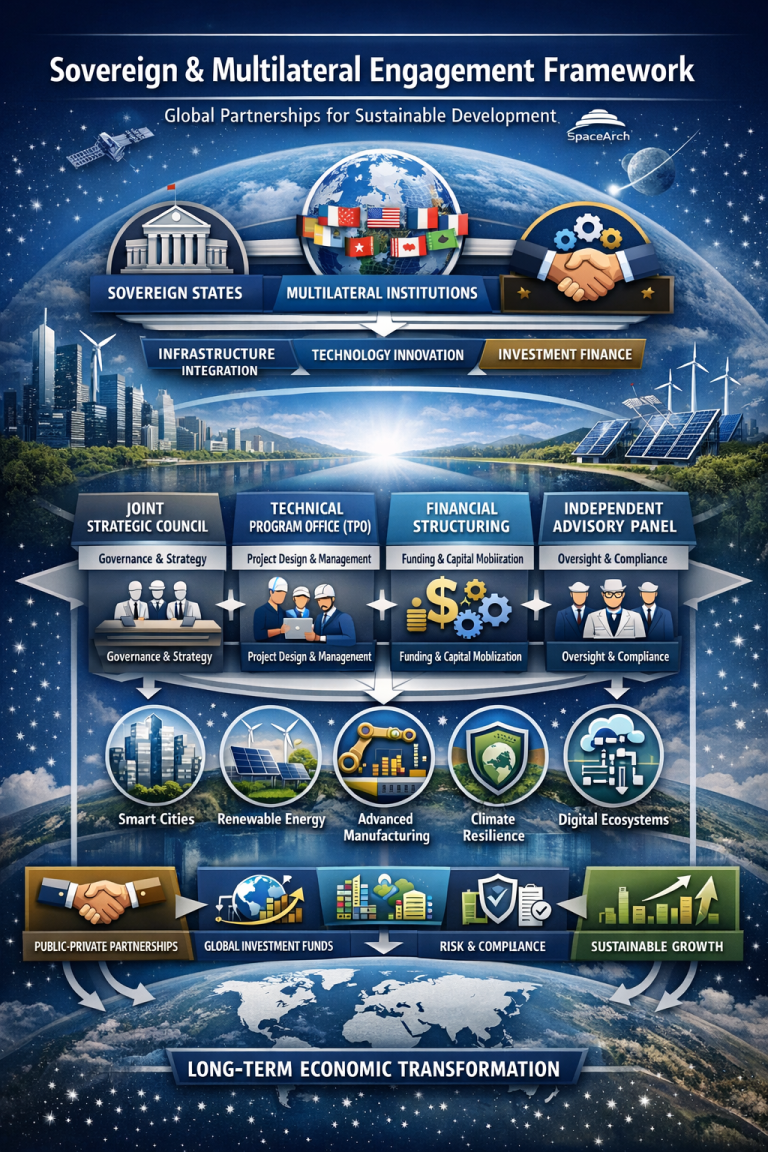
Sovereign & Multilateral Engagement
7.8 Planetary Infrastructure Transition Programs
1. Conceptual Definition
Planetary Infrastructure Transition Programs (PITP) refer to large-scale, coordinated global initiatives aimed at transforming the physical, technological, and energy infrastructures of modern civilization in order to achieve climate stability, ecological sustainability, and long-term economic resilience.
Within the SpaceArch strategic framework, Planetary Infrastructure Transition Programs represent a systemic transformation model, integrating infrastructure development, technological innovation, climate adaptation, and environmental restoration into a coherent global development architecture.
Unlike conventional infrastructure programs that focus primarily on national development goals, PITP operates at a planetary scale, recognizing that climate change, environmental degradation, and energy transition challenges transcend national boundaries.
The objective of PITP is to coordinate infrastructure transformation across multiple sectors simultaneously, including:
- global energy systems
- transportation networks
- urban infrastructure
- water management systems
- digital infrastructure
- environmental restoration projects
Through coordinated planning and financing mechanisms, these programs aim to accelerate the global transition toward a low-carbon and climate-resilient economic system.
2. Strategic Context
The Infrastructure Transformation Imperative
Modern civilization relies on infrastructure systems that were largely developed during the industrial expansion of the 19th and 20th centuries.
Many of these systems are:
- carbon-intensive
- energy-inefficient
- environmentally unsustainable
- vulnerable to climate-related disruptions
As climate change accelerates, existing infrastructure systems face increasing stress from:
- extreme weather events
- sea level rise
- water scarcity
- ecosystem degradation
- energy system instability
Planetary Infrastructure Transition Programs aim to address these challenges through coordinated infrastructure modernization at global scale.
3. Core Program Domains
PITP integrates transformation initiatives across several major infrastructure domains.
3.1 Global Energy System Transition
One of the central objectives of PITP is the transformation of global energy systems from fossil-fuel-based infrastructure toward low-carbon and renewable energy sources.
Key components include:
- large-scale solar and wind energy deployment
- advanced nuclear energy systems
- geothermal energy infrastructure
- energy storage technologies
- smart electrical grid systems
This transition supports the decarbonization of global energy supply while maintaining energy security.
3.2 Sustainable Urban Infrastructure
Urban areas represent a major concentration of global energy consumption and emissions.
Planetary Infrastructure Transition Programs promote the development of sustainable urban ecosystems, including:
- smart city infrastructure
- energy-efficient buildings
- electrified transportation networks
- integrated digital services
- green public spaces and urban forestry
Such systems improve urban resilience while reducing environmental impact.
3.3 Water Infrastructure Transformation
Climate change is increasingly affecting global water systems.
Key infrastructure initiatives may include:
- large-scale desalination systems
- water recycling and purification networks
- climate-resilient irrigation systems
- integrated watershed management programs
These systems help ensure long-term water security in vulnerable regions.
3.4 Global Ecological Restoration
Planetary infrastructure transformation must also include restoration of natural ecosystems, which provide critical climate regulation services.
Programs may include:
- reforestation and afforestation initiatives
- restoration of degraded ecosystems
- coastal and wetland restoration
- biodiversity protection programs
Large-scale reforestation initiatives, including the planting of billions of trees annually, can significantly enhance carbon sequestration capacity.
4. Implementation Architecture
Planetary Infrastructure Transition Programs require coordinated international implementation mechanisms.
Key components include:
- sovereign government participation
- multilateral institutional coordination
- international development financing
- technological innovation partnerships
- global environmental monitoring systems
This architecture enables the synchronization of infrastructure transformation efforts across different regions and economic systems.
5. Financial Requirements
The scale of infrastructure transformation required for climate stabilization is unprecedented.
Global studies indicate that trillions of dollars of investment per year may be required to modernize infrastructure systems and support climate transition initiatives.
Funding mechanisms may include:
- global infrastructure investment funds
- green bond markets
- sovereign climate investment programs
- multilateral development financing
- private-sector capital markets
By coordinating these financing channels, PITP can mobilize the capital necessary for large-scale infrastructure transformation.
6. Governance Framework
Planetary Infrastructure Transition Programs operate through multi-level governance systems.
Global Strategic Coordination Bodies
These entities provide high-level strategic oversight and policy coordination.
Regional Implementation Platforms
Regional platforms coordinate project deployment across geographic areas.
Technical Advisory Panels
Expert groups provide scientific and technical guidance regarding infrastructure design and environmental sustainability.
7. Comparative Model
| Dimension | Conventional Infrastructure Development | Planetary Infrastructure Transition Programs |
|---|---|---|
| Scale | National or regional | Global and systemic |
| Planning Horizon | Short-term | Multi-decade transformation |
| Environmental Integration | Limited | Core design principle |
| Institutional Coordination | Fragmented | Integrated global governance |
| Impact | Incremental | Structural transformation |
8. Strategic Impact
Planetary Infrastructure Transition Programs may generate significant long-term benefits.
These include:
- rapid reduction in global greenhouse gas emissions
- increased resilience of infrastructure systems
- enhanced energy security
- restoration of ecological systems
- sustainable economic development
Such programs provide a pathway toward sustainable global development compatible with climate stabilization objectives.
9. Long-Term Vision
Planetary Infrastructure Transition Programs represent a strategic response to the infrastructure and environmental challenges of the 21st century.
By coordinating technological innovation, global investment capital, and environmental policy, PITP creates a framework capable of transforming the foundational infrastructure of modern civilization in a sustainable and resilient direction.
7.9 Global Climate Stability Investment Mechanism
1. Conceptual Definition
The Global Climate Stability Investment Mechanism (GCSIM) is a financial architecture designed to mobilize and allocate large-scale capital toward initiatives that directly support global climate stabilization and environmental sustainability.
Within the SpaceArch strategic ecosystem, GCSIM functions as the financial engine that enables planetary-scale climate transition programs, integrating public-sector funding, institutional investment, and private capital markets into a coordinated investment framework.
The mechanism is designed to support projects that contribute directly to climate stability, including:
- renewable energy deployment
- large-scale reforestation programs
- climate adaptation infrastructure
- sustainable agriculture systems
- low-carbon industrial technologies
By aligning investment incentives with environmental outcomes, the mechanism creates a financial environment where climate stability becomes economically viable and scalable.
2. Strategic Rationale
Climate change represents one of the most significant systemic risks facing the global economy.
Without large-scale investment in climate transition initiatives, the long-term economic consequences may include:
- infrastructure damage from extreme climate events
- agricultural productivity losses
- disruptions to global supply chains
- financial market instability
The Global Climate Stability Investment Mechanism aims to address these risks by redirecting global capital flows toward projects that enhance climate resilience and environmental sustainability.
3. Capital Mobilization Structure
The GCSIM architecture aggregates capital from multiple financial sources.
These include:
Sovereign Investment Programs
Governments may allocate resources through national climate investment strategies.
Institutional Investors
Large institutional investors, including pension funds and insurance companies, may participate in climate investment portfolios.
Multilateral Development Institutions
International financial organizations can provide loans, guarantees, and co-investment mechanisms.
Private Capital Markets
Private investors may participate through climate-focused investment funds and green financial instruments.
4. Financial Instruments
The Global Climate Stability Investment Mechanism utilizes a diverse portfolio of financial instruments.
These may include:
- green bonds
- climate infrastructure funds
- carbon credit investment platforms
- sustainability-linked financial instruments
- climate transition investment funds
Such instruments enable investors to participate in climate transition programs while generating long-term financial returns.
5. Risk Mitigation
Climate investment programs must address multiple risk factors.
These include:
- political risk
- regulatory risk
- technological risk
- market volatility
The GCSIM framework incorporates risk mitigation mechanisms such as:
- sovereign guarantees
- insurance instruments
- diversified investment portfolios
- regulatory coordination frameworks
These mechanisms improve the stability and attractiveness of climate investments.
6. Monitoring and Impact Evaluation
Transparent monitoring systems ensure that climate investments produce measurable environmental outcomes.
Key evaluation metrics may include:
- carbon emissions reductions
- renewable energy capacity expansion
- ecosystem restoration progress
- climate resilience improvements
Independent verification mechanisms may be used to validate environmental performance.
7. Comparative Model
| Dimension | Traditional Environmental Funding | Global Climate Stability Investment Mechanism |
|---|---|---|
| Capital Scale | Limited grant funding | Large-scale investment capital |
| Financial Incentives | Subsidy-driven | Market-integrated investment |
| Investor Participation | Limited | Global institutional investors |
| Environmental Monitoring | Fragmented | Structured impact evaluation |
| Economic Integration | Peripheral | Central economic strategy |
8. Strategic Impact
The Global Climate Stability Investment Mechanism can support multiple transformative outcomes.
These include:
- accelerated global decarbonization
- increased climate resilience
- technological innovation in clean energy systems
- large-scale environmental restoration
By aligning global financial systems with environmental objectives, the mechanism enables sustainable economic development compatible with planetary ecological limits.
9. Long-Term Vision
The Global Climate Stability Investment Mechanism represents a new paradigm in climate finance, where environmental sustainability and economic development are integrated within a coherent financial architecture.
Through coordinated global investment, the mechanism aims to create a financial ecosystem capable of supporting the long-term stabilization of Earth’s climate system while sustaining global economic prosperity.