

1. Conceptual Definition
ESG & Rating Agencies Integration refers to the structured alignment between SpaceArch development platforms, sovereign infrastructure programs, and international Environmental, Social, and Governance (ESG) evaluation frameworks, combined with the interaction with global credit rating and sustainability assessment agencies.
Within the SpaceArch institutional architecture, this integration represents the governance and credibility layer that ensures that large-scale development programs comply with internationally recognized sustainability standards, transparency mechanisms, and investment-grade evaluation criteria.
The objective is to ensure that infrastructure projects, climate transition initiatives, and development financing mechanisms implemented within the SpaceArch ecosystem can be evaluated through recognized ESG metrics and obtain favorable sustainability and credit ratings that facilitate access to global institutional capital.
This alignment is essential because large global investors—including pension funds, sovereign wealth funds, and insurance companies—are increasingly required by regulatory frameworks and internal governance policies to allocate capital primarily toward investments that meet ESG compliance standards and maintain credible credit ratings.
Therefore, ESG & Rating Agencies integration functions as a critical bridge between global financial markets and sustainable infrastructure investment platforms.
2. Strategic Context
The Rise of ESG-Oriented Capital Markets
Over the past two decades, financial markets have increasingly incorporated ESG criteria into investment decision-making.
This transformation has been driven by several factors:
- growing awareness of climate change risks
- regulatory pressure for sustainable investment disclosure
- institutional investor mandates for responsible investment
- reputational and governance risk management
As a result, ESG-oriented investment strategies now represent trillions of dollars in global assets under management.
Infrastructure projects and development programs that do not align with ESG standards face increasing difficulty accessing global capital markets.
Consequently, ESG integration has become a strategic prerequisite for large-scale infrastructure financing and development investment platforms.
3. Core Objectives of ESG Integration
The ESG & Rating Agencies framework within the SpaceArch system pursues several key objectives.
3.1 Enhancing Investor Confidence
Alignment with recognized ESG frameworks increases the credibility of development projects among global institutional investors.
3.2 Facilitating Access to Global Capital Markets
Projects with strong ESG ratings are more attractive to long-term investors such as pension funds and sovereign wealth funds.
3.3 Improving Risk Management
ESG frameworks provide structured methodologies for evaluating environmental, social, and governance risks associated with infrastructure projects.
3.4 Strengthening Institutional Transparency
Adherence to ESG standards enhances reporting transparency and accountability.
4. ESG Framework Components
The ESG evaluation model is based on three core dimensions.
4.1 Environmental Criteria
Environmental performance indicators evaluate the ecological impact of development projects.
Typical metrics include:
- greenhouse gas emissions levels
- energy efficiency performance
- renewable energy integration
- ecosystem protection measures
- water resource management
Projects demonstrating strong environmental performance may qualify for green financing instruments and sustainability-linked investment products.
4.2 Social Criteria
The social dimension evaluates how projects affect communities and human welfare.
Key indicators include:
- job creation and workforce development
- community engagement and consultation
- labor standards compliance
- public health and safety considerations
- equitable access to infrastructure services
Social impact assessment ensures that infrastructure development contributes to inclusive and sustainable economic growth.
4.3 Governance Criteria
Governance standards evaluate the quality of institutional management and oversight mechanisms.
Typical governance indicators include:
- financial transparency
- anti-corruption safeguards
- regulatory compliance
- board oversight structures
- independent auditing procedures
Strong governance frameworks significantly reduce investment risk and increase investor confidence.
5. Role of Rating Agencies
Rating agencies play a critical role in the global financial ecosystem by providing independent evaluations of financial stability, creditworthiness, and sustainability performance.
Within the SpaceArch ecosystem, rating agencies may perform several functions.
Credit Rating Evaluation
Infrastructure investment vehicles and development financing programs may be assessed by credit rating agencies to determine their financial risk profile.
Higher ratings improve access to global capital markets and reduce financing costs.
ESG Rating Assessment
Specialized sustainability rating agencies evaluate environmental and social performance indicators associated with projects and financial instruments.
These ratings are increasingly used by investors to guide capital allocation decisions.
Project Risk Analysis
Rating agencies may provide independent risk assessments covering:
- operational risk
- financial risk
- environmental risk
- governance risk
These evaluations help investors understand the risk-return profile of infrastructure investments.
6. ESG Reporting and Disclosure Systems
Transparent reporting mechanisms are essential for maintaining credibility within ESG-oriented capital markets.
Key reporting tools include:
- sustainability reporting frameworks
- climate risk disclosure standards
- environmental impact assessments
- independent ESG audits
Digital data platforms may be used to provide real-time sustainability performance monitoring and reporting.
7. ESG Integration within Infrastructure Development
Infrastructure projects developed within the SpaceArch ecosystem incorporate ESG criteria from the earliest design stages.
This includes:
- sustainable architectural design
- energy-efficient infrastructure systems
- circular economy construction practices
- environmental impact mitigation measures
By embedding ESG principles into project design, infrastructure systems can achieve higher sustainability performance and stronger long-term investment value.
8. Comparative Analysis
| Dimension | Conventional Infrastructure Development | ESG-Aligned Infrastructure Development |
|---|---|---|
| Environmental Impact | Often secondary consideration | Integrated sustainability criteria |
| Investor Base | Traditional infrastructure investors | Global ESG-focused institutional investors |
| Transparency | Limited disclosure | Structured sustainability reporting |
| Risk Management | Financial risk only | Environmental and governance risk integrated |
| Capital Access | Restricted | Expanded through ESG investment funds |
ESG integration therefore significantly enhances the attractiveness of infrastructure investments to global capital markets.
9. Strategic Benefits
The integration of ESG standards and rating agency evaluation produces multiple strategic advantages.
Improved Financing Conditions
Projects with strong ESG credentials may obtain financing at lower interest rates through green financial instruments.
Increased Institutional Participation
Large institutional investors increasingly prioritize ESG-compliant investment opportunities.
Reduced Regulatory Risk
Compliance with sustainability standards reduces the likelihood of regulatory or environmental disputes.
Long-Term Economic Value
Infrastructure designed according to ESG principles tends to demonstrate greater long-term resilience and operational sustainability.
10. Long-Term Vision
The ESG & Rating Agencies integration framework represents a key governance component of the SpaceArch global development ecosystem, ensuring that large-scale infrastructure investment programs operate according to internationally recognized sustainability and transparency standards.
By combining ESG compliance mechanisms with independent rating agency evaluations, the framework strengthens the credibility, financial attractiveness, and long-term sustainability of infrastructure projects implemented within the SpaceArch system.
Ultimately, ESG integration enables the creation of development platforms where economic growth, environmental sustainability, and responsible governance operate in coordinated synergy, attracting global institutional capital while supporting sustainable planetary development.
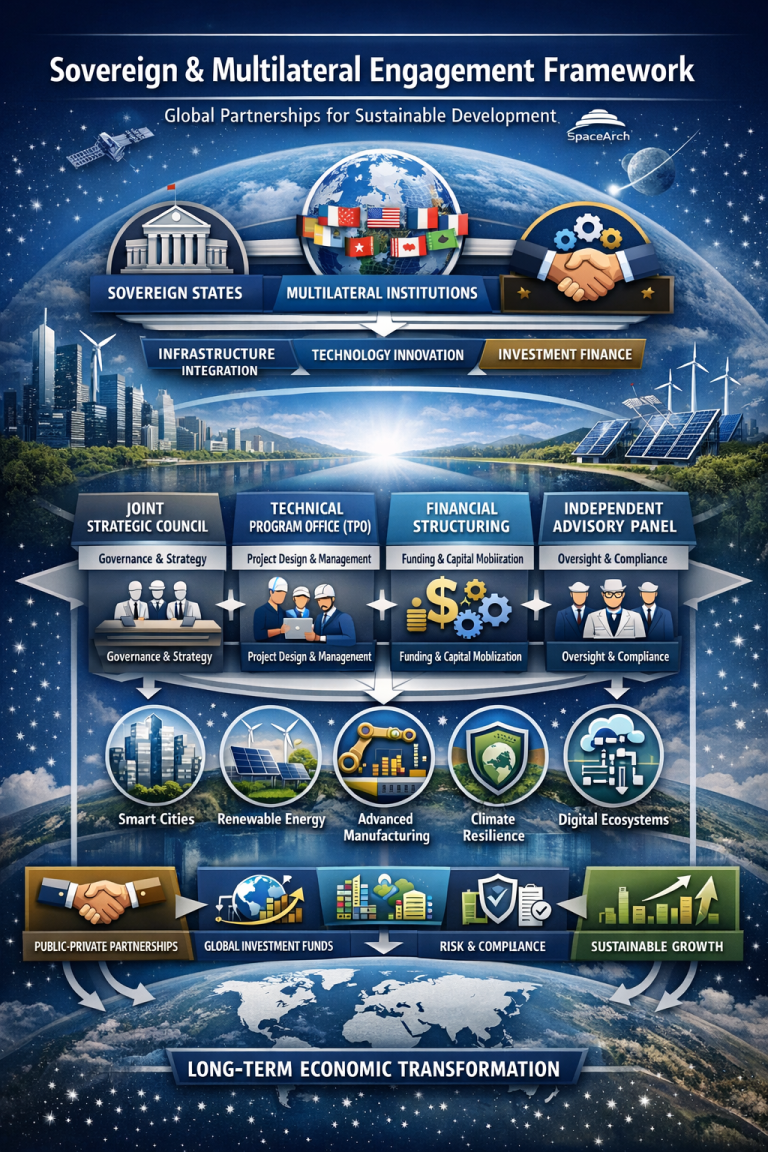
Sovereign & Multilateral Engagement
7.11 Global Transparency & Anti-Corruption Architecture
1. Conceptual Definition
The Global Transparency & Anti-Corruption Architecture (GTACA) refers to the institutional, technological, regulatory, and governance framework designed to ensure integrity, accountability, and transparency in the design, financing, and implementation of large-scale infrastructure, development, and climate transition programs.
Within the SpaceArch institutional ecosystem, the Global Transparency & Anti-Corruption Architecture represents a foundational governance layer that protects the credibility, financial sustainability, and operational legitimacy of development initiatives involving sovereign governments, international investors, and multilateral organizations.
The architecture establishes structured mechanisms to prevent, detect, and address corruption risks while promoting transparent financial management, responsible public-private partnerships, and independent oversight.
The objective is to ensure that infrastructure development and global investment platforms operate under strict governance standards aligned with international best practices in financial transparency, regulatory compliance, and ethical institutional conduct.
2. Strategic Context
Governance Risks in Large-Scale Infrastructure Development
Infrastructure investment programs—particularly those involving large financial commitments and multi-level institutional participation—are historically vulnerable to governance risks.
Typical risks include:
- procurement irregularities
- misallocation of financial resources
- conflicts of interest
- opaque contracting processes
- regulatory capture
Such governance failures can undermine project effectiveness, increase costs, erode public trust, and discourage international investment participation.
Global Transparency & Anti-Corruption Architecture addresses these risks by integrating systemic transparency mechanisms and independent oversight structures into the development process.
3. Core Objectives
The Global Transparency & Anti-Corruption Architecture pursues several strategic objectives.
3.1 Ensuring Financial Integrity
All capital flows, investment transactions, and project expenditures are subject to transparent accounting and verification systems.
3.2 Preventing Corruption and Fraud
Structured compliance frameworks reduce the risk of bribery, illicit financial practices, and procurement manipulation.
3.3 Strengthening Institutional Accountability
Clear governance procedures define the responsibilities and oversight obligations of participating institutions.
3.4 Enhancing Investor Confidence
Transparent governance mechanisms significantly increase the willingness of international investors to participate in development projects.
4. Governance Framework Components
The Global Transparency & Anti-Corruption Architecture is composed of several integrated governance mechanisms.
4.1 Transparent Procurement Systems
Public procurement processes are one of the most critical areas vulnerable to corruption.
The architecture promotes the use of transparent procurement frameworks including:
- competitive bidding procedures
- standardized contracting models
- digital procurement platforms
- public disclosure of contract awards
These systems reduce discretionary decision-making and promote fair competition among contractors.
4.2 Financial Transparency and Audit Systems
Financial accountability is maintained through structured monitoring and auditing procedures.
Key mechanisms include:
- real-time financial reporting systems
- independent external auditing
- standardized financial disclosure protocols
- digital financial tracking tools
These mechanisms ensure that project financing is used according to approved objectives.
4.3 Compliance and Ethics Programs
Participating institutions must adhere to strict compliance standards designed to prevent unethical practices.
Compliance frameworks typically include:
- anti-bribery regulations
- conflict-of-interest policies
- whistleblower protection mechanisms
- ethical conduct guidelines
Compliance officers and independent monitoring bodies oversee adherence to these standards.
5. Digital Transparency Technologies
Advances in digital technology enable new forms of transparency and governance.
The architecture may incorporate digital tools such as:
- blockchain-based financial ledgers
- digital contract management systems
- automated compliance monitoring platforms
- real-time project data dashboards
These technologies enhance transparency by creating tamper-resistant records of financial and operational activities.
6. Independent Oversight Institutions
To maintain credibility, large development programs require independent supervision.
Oversight mechanisms may include:
- independent audit committees
- civil society monitoring initiatives
- multilateral institutional supervision
- academic and technical advisory panels
These bodies provide external validation of governance practices and financial integrity.
7. Regulatory Alignment
Global Transparency & Anti-Corruption Architecture operates within the framework of international regulatory standards and governance principles.
These may include:
- international anti-corruption conventions
- financial transparency regulations
- public procurement standards
- international financial reporting frameworks
Alignment with these standards ensures that development programs operate according to globally recognized governance norms.
8. Risk Prevention and Detection Systems
Preventive mechanisms are critical for reducing corruption risk.
Key strategies include:
- systematic risk assessment of procurement processes
- financial anomaly detection systems
- compliance monitoring protocols
- transparent reporting channels
These systems allow institutions to identify and address governance risks before they escalate into systemic problems.
9. Comparative Analysis
| Dimension | Conventional Infrastructure Governance | Global Transparency & Anti-Corruption Architecture |
|---|---|---|
| Transparency | Limited disclosure | System-wide financial transparency |
| Oversight | Internal supervision | Independent multi-layer oversight |
| Procurement | Opaque or fragmented | Transparent digital procurement systems |
| Risk Detection | Reactive investigation | Proactive monitoring systems |
| Investor Confidence | Moderate | High due to governance safeguards |
The architecture significantly improves the credibility and operational reliability of large-scale development initiatives.
10. Strategic Impact
The implementation of Global Transparency & Anti-Corruption Architecture can produce several important outcomes.
Improved Investment Climate
Transparent governance frameworks increase investor confidence and facilitate international capital participation.
Reduced Financial Leakage
Strong anti-corruption safeguards prevent misuse of development funds.
Enhanced Public Trust
Transparent governance strengthens the legitimacy of infrastructure programs among citizens and stakeholders.
Greater Project Efficiency
Reduced corruption risk improves cost efficiency and project execution quality.
11. Long-Term Vision
The Global Transparency & Anti-Corruption Architecture represents a fundamental governance pillar for sustainable global development platforms, ensuring that large-scale infrastructure and climate transition initiatives operate according to the highest standards of institutional integrity.
Within the SpaceArch strategic ecosystem, this architecture contributes to the creation of development environments characterized by transparency, accountability, and ethical governance, enabling long-term cooperation between sovereign governments, international financial institutions, and global capital markets.
By embedding transparency and anti-corruption safeguards at every level of project implementation, the framework helps ensure that development investments generate maximum economic, social, and environmental value while maintaining the trust of all participating stakeholders.
Sovereign & Multilateral Engagement
7.12 Global Development Governance Framework
1. Conceptual Definition
The Global Development Governance Framework (GDGF) represents the integrated institutional architecture that coordinates the strategic, financial, regulatory, and operational dimensions of large-scale development initiatives implemented through the SpaceArch ecosystem.
This framework provides the organizational and governance infrastructure required to manage complex, multi-sector development programs involving sovereign governments, international financial institutions, private investors, and technological partners.
The Global Development Governance Framework functions as the systemic coordination layer that integrates all previously defined institutional components, including:
- sovereign partnership mechanisms
- central bank coordination systems
- digital financial infrastructure
- global investment platforms
- climate transition financing mechanisms
- ESG compliance systems
- transparency and anti-corruption safeguards
Through this integrated governance model, the framework ensures that large-scale development initiatives are executed according to coherent strategic planning, transparent institutional oversight, and responsible financial management principles.
2. Strategic Context
Complexity of 21st Century Development Systems
Modern development initiatives increasingly involve complex interactions between multiple sectors and institutions, including:
- national governments
- regional economic organizations
- multilateral development banks
- institutional investors
- technology providers
- infrastructure operators
The scale and complexity of contemporary infrastructure and climate transition programs require governance systems capable of coordinating diverse institutional actors across multiple jurisdictions and regulatory environments.
Traditional governance structures designed for single-sector or nationally limited programs are often insufficient for managing multi-trillion-dollar global development initiatives.
The Global Development Governance Framework addresses this challenge by providing a multi-layer governance architecture capable of coordinating large-scale development ecosystems.
3. Structural Architecture of the Framework
The Global Development Governance Framework is organized around four core governance layers.
3.1 Strategic Governance Layer
The strategic governance layer defines the long-term objectives and priorities of development programs.
Responsibilities include:
- defining strategic development goals
- aligning programs with climate transition objectives
- coordinating cross-sector infrastructure initiatives
- establishing investment priorities
This layer ensures that development programs operate according to long-term strategic planning rather than short-term operational decisions.
3.2 Institutional Coordination Layer
The institutional coordination layer facilitates cooperation between participating entities.
Key actors may include:
- sovereign governments
- central banks
- regulatory authorities
- development finance institutions
- private sector investment partners
Coordination mechanisms ensure that all participants operate within a common institutional framework that promotes transparency, accountability, and operational efficiency.
3.3 Financial Governance Layer
The financial governance layer manages the allocation, monitoring, and accountability of capital deployed through development programs.
Key functions include:
- capital mobilization coordination
- financial risk management
- investment portfolio oversight
- compliance with financial reporting standards
Through these mechanisms, the framework ensures that financial resources are managed in accordance with international best practices in investment governance and financial transparency.
3.4 Operational Implementation Layer
The operational layer is responsible for the execution of development projects and infrastructure programs.
Core responsibilities include:
- project planning and engineering coordination
- procurement and contracting management
- technological system deployment
- infrastructure construction and operation
Operational activities are continuously monitored through performance evaluation systems to ensure that projects achieve economic, environmental, and social objectives.
4. Governance Institutions
The Global Development Governance Framework may include several institutional bodies responsible for coordinating different aspects of development programs.
Global Strategic Council
A high-level policy body responsible for defining long-term development priorities and coordinating international cooperation.
Participants may include:
- government representatives
- international financial institutions
- development agencies
- institutional investors
Infrastructure Investment Committee
Responsible for evaluating and approving major infrastructure investment programs.
This committee ensures that projects meet technical, financial, and sustainability criteria.
Financial Oversight Board
The Financial Oversight Board supervises capital allocation and financial risk management across development programs.
Responsibilities include:
- monitoring financial performance
- ensuring compliance with financial regulations
- evaluating investment risk exposure
Technical Advisory Panels
Independent panels composed of engineers, economists, scientists, and policy experts provide technical evaluation of project proposals.
These panels ensure that development initiatives are based on scientific evidence and technical feasibility assessments.
5. Policy Alignment Mechanisms
Large-scale development initiatives must align with a wide range of policy objectives.
Key areas of alignment include:
- climate transition commitments
- national economic development strategies
- international sustainability frameworks
- financial regulatory requirements
The governance framework ensures that development programs remain consistent with these policy environments.
6. Transparency and Accountability Systems
Accountability mechanisms are essential for maintaining the credibility of development programs.
The Global Development Governance Framework incorporates several transparency tools:
- public reporting systems
- independent auditing mechanisms
- financial disclosure protocols
- stakeholder consultation procedures
These mechanisms strengthen institutional legitimacy and promote responsible governance.
7. Performance Monitoring and Evaluation
Development initiatives require continuous evaluation to ensure effective outcomes.
Performance monitoring systems may include:
- economic impact indicators
- environmental sustainability metrics
- infrastructure performance benchmarks
- financial return assessments
Regular evaluations enable decision-makers to adjust strategies and improve program effectiveness.
8. Comparative Governance Models
| Dimension | Traditional Development Governance | Global Development Governance Framework |
|---|---|---|
| Institutional Coordination | Fragmented | Integrated multi-layer governance |
| Financial Oversight | Project-specific | System-wide financial governance |
| Policy Alignment | Limited | Structured policy integration |
| Transparency | Variable | Systematic transparency mechanisms |
| Scale | National | Global multi-sector coordination |
This governance architecture allows development programs to operate with greater strategic coherence and institutional efficiency.
9. Strategic Benefits
The Global Development Governance Framework generates multiple long-term advantages.
Enhanced Institutional Coordination
Integrated governance mechanisms improve cooperation between public institutions, investors, and technical partners.
Improved Investment Efficiency
Transparent governance and risk management attract greater participation from global capital markets.
Greater Policy Coherence
Alignment between infrastructure development, economic policy, and climate transition strategies improves long-term development outcomes.
Increased Public Trust
Transparent governance structures enhance the credibility of development programs among citizens and stakeholders.
10. Long-Term Vision
The Global Development Governance Framework represents a next-generation institutional architecture designed to manage the complexity of global infrastructure transformation and climate transition programs.
By integrating strategic planning, financial governance, operational coordination, and transparency mechanisms into a unified institutional system, the framework enables large-scale development initiatives capable of addressing the major economic and environmental challenges of the 21st century.
Within the SpaceArch ecosystem, this framework establishes the governance foundation for coordinated global development platforms that combine technological innovation, financial investment, and sustainable infrastructure transformation.
Ultimately, the Global Development Governance Framework supports the creation of stable, transparent, and scalable institutional environments capable of driving long-term economic progress and planetary sustainability.