

1. Conceptual Definition
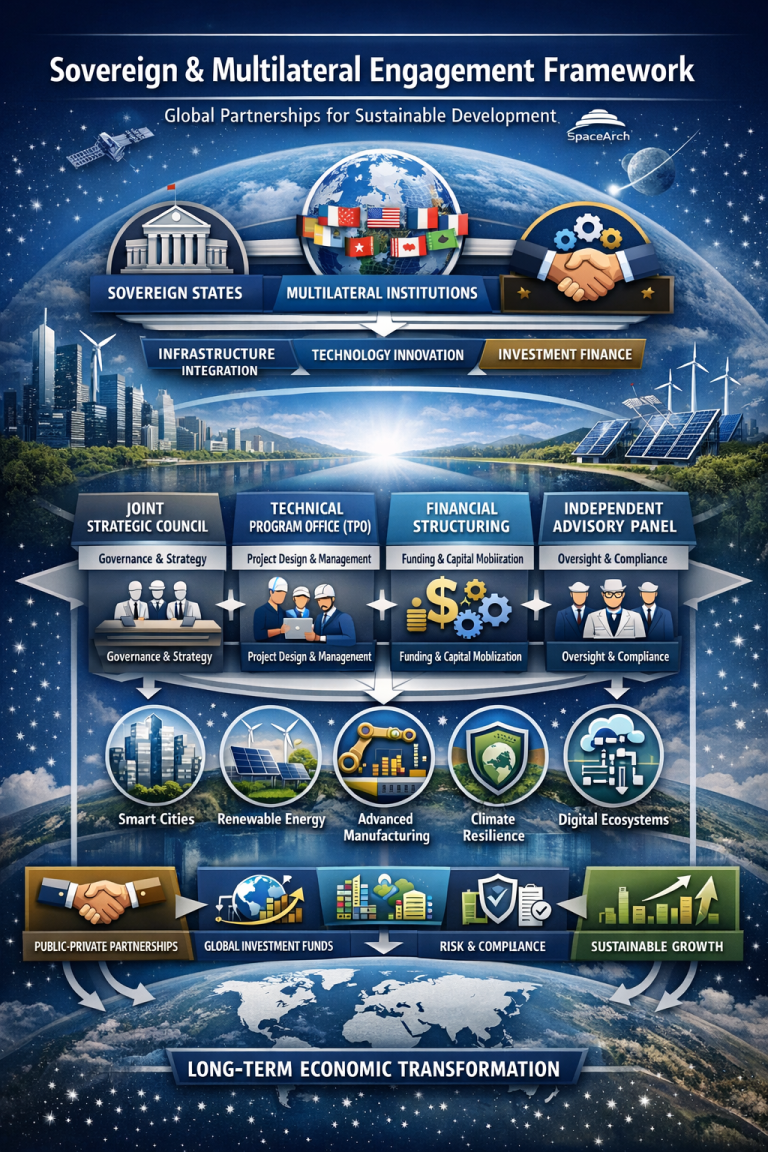
G20 / Multilateral Positioning refers to the strategic institutional alignment of the SpaceArch ecosystem with the policy priorities, financial frameworks, and development agendas promoted by major multilateral institutions and global economic coordination forums, particularly those operating within the sphere of the G20 international governance architecture.
Within the SpaceArch strategic framework, G20 / Multilateral Positioning functions as the international policy interface through which infrastructure development platforms, climate transition initiatives, and financial innovation mechanisms are harmonized with global economic governance systems.
This positioning enables SpaceArch development initiatives to operate within a context of international legitimacy, regulatory compatibility, and institutional collaboration, facilitating engagement with sovereign governments, development banks, and global investment institutions.
The objective is not institutional representation within the G20 itself, but rather strategic alignment with the multilateral policy frameworks and economic priorities that shape global infrastructure investment, climate finance, and technological development.
2. Strategic Context
Global Economic Governance and Development Platforms
Modern development initiatives increasingly operate within a multilateral policy environment where global economic governance institutions influence the regulatory and financial conditions under which infrastructure and investment programs are implemented.
Key multilateral actors include:
- international economic coordination forums
- development banks
- financial stability institutions
- climate finance mechanisms
- international regulatory bodies
These institutions shape global frameworks in areas such as:
- infrastructure investment
- sustainable finance
- climate transition policies
- financial stability standards
- cross-border capital flows
Positioning development initiatives within these frameworks improves their institutional compatibility and global investment credibility.
3. Role of the G20 in Global Development Governance
The Group of Twenty (G20) has emerged as one of the most influential global economic coordination platforms.
Its policy initiatives frequently influence:
- international infrastructure investment strategies
- climate transition financing mechanisms
- global financial regulation
- sustainable development frameworks
The G20 has supported initiatives such as:
- global infrastructure investment programs
- sustainable finance frameworks
- climate finance coordination mechanisms
- cross-border financial stability standards
For development platforms operating at international scale, alignment with G20 policy priorities can significantly enhance institutional recognition and investment access.
4. Strategic Objectives of Multilateral Positioning
The G20 / Multilateral Positioning strategy within the SpaceArch ecosystem pursues several key objectives.
4.1 Institutional Legitimacy
Alignment with internationally recognized policy frameworks enhances the credibility of development programs among governments and global investors.
4.2 Access to Global Financing Networks
Multilateral positioning improves opportunities for collaboration with international development banks and global infrastructure investment funds.
4.3 Policy Compatibility
Development initiatives aligned with global governance frameworks are more easily integrated into national and international regulatory environments.
4.4 International Collaboration
Multilateral engagement encourages cooperation with international research institutions, financial organizations, and technological partners.
5. Multilateral Institutional Ecosystem
SpaceArch development initiatives may interact with a wide range of international institutions operating within the global governance ecosystem.
These institutions include:
Multilateral Development Banks
Organizations that finance infrastructure and development projects across multiple regions.
Global Financial Institutions
Entities that influence financial stability and capital market regulations.
Climate Finance Institutions
Organizations dedicated to supporting climate transition investments.
International Policy Platforms
Forums where governments coordinate economic policy and development strategies.
Collaboration with these institutions enables the creation of integrated development ecosystems supported by global expertise and financial resources.
6. Policy Alignment Domains
The G20 / Multilateral Positioning strategy aligns SpaceArch initiatives with major international policy priorities.
Infrastructure Development
Global economic institutions increasingly promote infrastructure investment as a driver of economic growth and productivity.
Development platforms aligned with these priorities are more likely to attract international investment support.
Sustainable Finance
Global financial institutions are promoting financial frameworks that incorporate sustainability criteria into investment decisions.
Alignment with sustainable finance principles enhances the attractiveness of infrastructure projects for ESG-oriented investors.
Climate Transition
Climate transition policies are a central focus of global governance frameworks.
Infrastructure development platforms that contribute to decarbonization and environmental sustainability align closely with these international policy priorities.
Digital Transformation
Digital infrastructure and technological innovation are increasingly recognized as critical components of economic development.
Development initiatives that incorporate advanced digital systems can contribute to global digital transformation strategies.
7. Institutional Engagement Mechanisms
Multilateral positioning may involve several forms of institutional engagement.
These include:
- participation in international policy dialogues
- collaboration with research institutions
- partnerships with development banks
- cooperation with international technology platforms
Such engagement allows development initiatives to remain aligned with emerging global policy trends and best practices.
8. Governance Compatibility
Alignment with multilateral frameworks requires adherence to internationally recognized governance standards.
These standards typically include:
- financial transparency mechanisms
- environmental sustainability criteria
- social impact safeguards
- regulatory compliance systems
Adherence to these principles improves the credibility of development platforms within international institutional environments.
9. Comparative Analysis
| Dimension | Isolated Development Initiatives | Multilateral-Aligned Development Platforms |
|---|---|---|
| Institutional Legitimacy | Limited | High due to multilateral alignment |
| Investment Access | Restricted | Expanded through global financing networks |
| Policy Compatibility | Variable | Structured alignment with global standards |
| International Collaboration | Limited | Strong multilateral partnerships |
| Strategic Impact | Local or national | Global and systemic |
Multilateral positioning significantly strengthens the institutional ecosystem supporting development programs.
10. Strategic Impact
The integration of development platforms within multilateral policy frameworks produces several strategic benefits.
Improved Access to International Capital
Global financial institutions and development banks are more likely to support projects aligned with international policy priorities.
Enhanced Institutional Credibility
Alignment with global governance frameworks increases trust among investors and governments.
Policy Coherence
Development initiatives can be coordinated with international economic and environmental policies.
Greater Global Collaboration
Multilateral positioning facilitates collaboration with international research networks, technology providers, and financial institutions.
11. Long-Term Vision
G20 / Multilateral Positioning represents an essential component of global development platform strategy, ensuring that infrastructure investment, technological innovation, and climate transition initiatives operate within internationally recognized governance frameworks.
Within the SpaceArch ecosystem, this positioning supports the creation of globally integrated development platforms capable of mobilizing international investment capital, fostering technological cooperation, and contributing to sustainable economic growth at planetary scale.
By aligning development initiatives with the strategic priorities of multilateral institutions and global economic governance systems, the framework helps establish a stable institutional environment in which large-scale infrastructure and climate transition programs can be implemented effectively and responsibly.