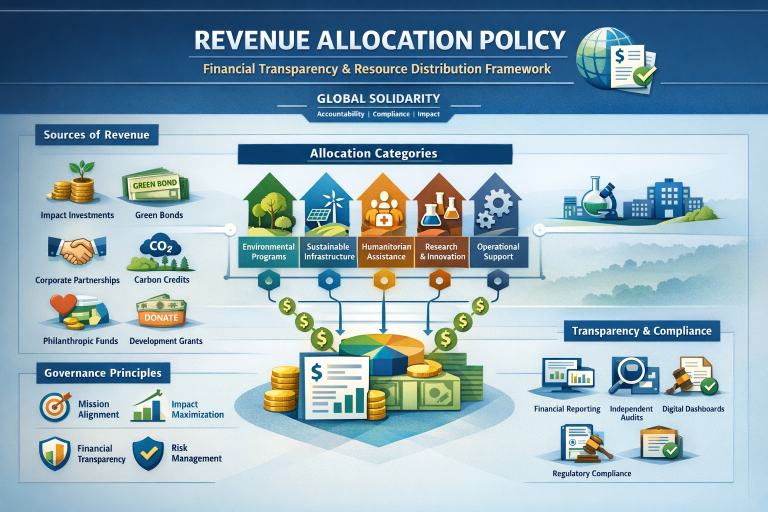


Independent Oversight and Integrity Assurance Framework
1. Conceptual Definition
The Audit & Verification Framework establishes the institutional mechanisms through which the financial operations, project performance, environmental outcomes, and governance procedures of the Global Solidarity platform are independently reviewed and verified.
The objective of this framework is to ensure that all activities carried out within the Global Solidarity ecosystem comply with the highest standards of:
• financial integrity
• operational transparency
• environmental accountability
• institutional governance
The audit system provides structured verification of both financial and non-financial data, including environmental and social impact indicators.
Through systematic auditing and verification processes, Global Solidarity seeks to maintain institutional credibility and ensure responsible management of resources.
2. Strategic Hypothesis
The Audit & Verification framework is based on several principles of institutional governance and financial accountability.
- Independent oversight strengthens institutional credibility.
- Transparent verification mechanisms increase investor confidence.
- Regular auditing improves operational discipline and governance compliance.
- Environmental impact verification ensures the authenticity of sustainability initiatives.
- External evaluation reduces the risk of financial mismanagement or operational inefficiencies.
- Data verification enhances the reliability of sustainability reporting.
- Institutional accountability improves collaboration with governments and multilateral institutions.
- Transparent auditing frameworks support long-term financial sustainability.
Under this framework, auditing and verification function as core institutional safeguards supporting responsible governance and transparency.
3. Scope of Audit and Verification
The Audit & Verification framework covers multiple operational dimensions of the Global Solidarity platform.
These include:
• financial operations and capital flows
• project implementation and expenditure
• environmental and sustainability outcomes
• governance and compliance procedures
• risk management processes
Comprehensive auditing ensures that both financial integrity and operational effectiveness are systematically evaluated.
4. Financial Auditing
Financial auditing evaluates the management and allocation of financial resources within the Global Solidarity system.
Key aspects of financial auditing include:
• verification of revenue sources
• review of financial allocation policies
• examination of accounting procedures
• confirmation of compliance with financial regulations
Financial audits ensure that all financial activities are conducted responsibly and transparently.
5. Operational Audit
Operational audits evaluate the effectiveness and efficiency of project implementation and organizational management.
These audits may examine:
• project execution processes
• resource utilization efficiency
• program management structures
• operational risk management procedures
Operational audits help identify areas for improvement in program execution.
6. Environmental Impact Verification
Given the sustainability mission of Global Solidarity, environmental outcomes must be independently verified.
Environmental verification may include:
• validation of carbon sequestration metrics
• verification of ecosystem restoration outcomes
• biodiversity impact assessment
• monitoring of environmental protection initiatives
Independent verification ensures that environmental claims are supported by measurable evidence.
7. Social Impact Verification
Humanitarian and social programs also require evaluation to ensure that they achieve intended outcomes.
Verification may include assessment of:
• community support programs
• humanitarian assistance initiatives
• disaster response effectiveness
• social resilience projects
Social impact verification ensures that programs generate meaningful benefits for participating communities.
8. Independent External Auditors
The Audit & Verification framework incorporates independent external auditing bodies responsible for conducting periodic evaluations.
External auditors may include:
• international accounting firms
• sustainability auditing organizations
• ESG certification institutions
• environmental impact assessment experts
Independent auditors provide impartial evaluations of financial and operational performance.
9. Internal Audit Mechanisms
In addition to external auditing, the Global Solidarity platform may maintain internal audit systems designed to monitor ongoing activities.
Internal audit functions may include:
• continuous monitoring of financial transactions
• evaluation of compliance with governance policies
• early detection of operational risks
• internal reporting on financial integrity
Internal auditing strengthens operational oversight between external audit cycles.
10. Verification Methodologies
Audit and verification procedures rely on standardized methodologies commonly used in institutional governance.
These methodologies may include:
• financial reconciliation procedures
• environmental monitoring protocols
• project performance audits
• documentation verification processes
Standardized verification methods ensure reliability and comparability of results.
11. Digital Audit Infrastructure
Digital technologies may support the audit and verification process through advanced monitoring systems.
Examples include:
• financial tracking platforms
• blockchain-based transaction verification systems
• environmental monitoring databases
• digital transparency dashboards
Technology enhances the accuracy and efficiency of auditing procedures.
12. Compliance and Regulatory Alignment
Audit and verification procedures are designed to comply with relevant international standards governing financial and institutional accountability.
These may include:
• international financial reporting standards
• ESG verification frameworks
• environmental compliance standards
• anti-corruption governance guidelines
Compliance ensures alignment with recognized global governance practices.
13. Reporting and Disclosure
Audit findings are documented through structured reporting mechanisms.
Reports may include:
• financial audit reports
• environmental verification reports
• operational audit summaries
• compliance review documents
These reports contribute to the transparency and accountability of Global Solidarity operations.
14. Stakeholder Accountability
The Audit & Verification framework ensures accountability to key stakeholders including:
• institutional investors
• multilateral organizations
• corporate partners
• participating NGOs
• local communities
Transparent verification processes strengthen stakeholder confidence in the integrity of the platform.
15. Comparative Governance Perspective
Traditional sustainability initiatives often rely primarily on financial auditing while providing limited verification of environmental outcomes.
The Global Solidarity Audit & Verification framework differs by integrating:
• financial auditing
• operational auditing
• environmental impact verification
• social impact evaluation
This integrated approach provides a more comprehensive evaluation of program performance.
16. Risk Mitigation Through Auditing
Auditing and verification contribute significantly to risk mitigation by identifying potential issues related to:
• financial management
• operational efficiency
• environmental claims
• governance compliance
Early detection of such risks enables corrective action and strengthens institutional resilience.
17. Long-Term Strategic Objective
The long-term objective of the Audit & Verification framework is to establish a governance model capable of maintaining the highest standards of transparency and accountability within large-scale sustainability initiatives.
Through independent oversight, standardized verification procedures, and transparent reporting systems, Global Solidarity aims to ensure that its activities consistently align with its environmental, humanitarian, and institutional objectives.
18. Strategic Conclusion
The Audit & Verification framework represents a critical pillar of the Transparency, Risk & Compliance architecture of the Global Solidarity platform.
By combining independent financial auditing, environmental impact verification, operational evaluation, and digital transparency systems, the framework ensures that all activities are conducted with integrity, accountability, and measurable performance.
This governance approach strengthens institutional credibility and supports the long-term sustainability of Global Solidarity initiatives.