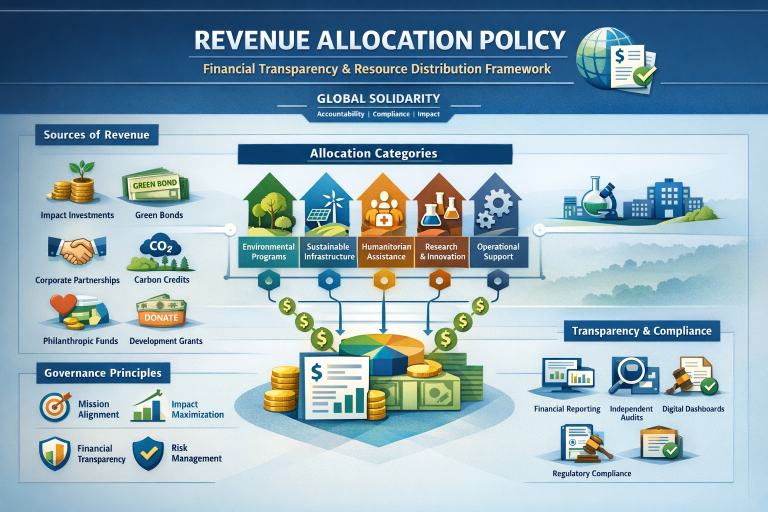


Transparency and Accountability Framework for Financial Reporting
1. Conceptual Definition
The Financial Disclosure Framework establishes the policies, procedures, and reporting mechanisms through which Global Solidarity communicates financial information to stakeholders.
Its objective is to ensure that all financial activities associated with the platform are documented, reported, and verified according to internationally recognized standards of transparency and accountability.
The framework governs the disclosure of:
• revenue sources
• financial allocations
• operational expenditures
• investment flows
• project-level financial performance
Through systematic disclosure mechanisms, Global Solidarity aims to maintain full transparency regarding the management and use of financial resources.
2. Strategic Hypothesis
The Financial Disclosure framework is based on several principles of financial governance and institutional accountability.
- Transparent financial reporting strengthens stakeholder trust.
- Clear disclosure of financial information improves institutional credibility.
- Independent verification of financial data increases investor confidence.
- Structured financial reporting enables effective risk management.
- Public disclosure supports accountability to participating communities and institutions.
- Transparent financial governance reduces the risk of financial mismanagement.
- Data accessibility improves collaboration with institutional partners.
- Standardized reporting facilitates regulatory compliance.
Under this framework, financial transparency becomes an essential component of responsible institutional governance.
3. Scope of Financial Disclosure
The Financial Disclosure framework covers several categories of financial information relevant to the operation of Global Solidarity.
These categories include:
• revenue generation mechanisms
• capital mobilization activities
• financial allocation across operational programs
• administrative and operational costs
• project-level financial flows
Comprehensive disclosure ensures that stakeholders can evaluate the financial performance and integrity of the platform.
4. Revenue Disclosure
Revenue disclosure includes the transparent reporting of all financial resources entering the Global Solidarity system.
Sources may include:
• impact investment capital
• green financial instruments such as bonds
• institutional funding and grants
• corporate ESG partnerships
• philanthropic contributions
• environmental finance mechanisms such as carbon markets
Each category of revenue is documented and categorized to provide a clear understanding of financial inflows.
5. Expenditure Reporting
Financial disclosure also includes detailed reporting of expenditures associated with Global Solidarity initiatives.
Expenditure reporting may include:
• environmental restoration programs
• sustainable infrastructure development
• humanitarian assistance initiatives
• research and technological development
• operational and administrative functions
Clear expenditure reporting ensures that stakeholders understand how financial resources are utilized.
6. Project-Level Financial Reporting
Each major project supported by Global Solidarity may include dedicated financial reporting mechanisms.
These mechanisms may track:
• project budgets
• funding sources
• implementation expenditures
• financial performance indicators
Project-level transparency enables stakeholders to evaluate the effectiveness of specific initiatives.
7. Reporting Standards
Financial disclosure follows recognized reporting standards commonly used in international financial governance.
These may include principles such as:
• standardized accounting methodologies
• structured financial statements
• impact investment reporting frameworks
• sustainability reporting standards
Adherence to established reporting frameworks ensures comparability and credibility.
8. Frequency of Financial Reporting
Financial disclosure is conducted on a periodic basis to ensure timely communication with stakeholders.
Typical reporting intervals may include:
• quarterly financial summaries
• annual financial reports
• project-level financial updates
• special disclosures related to major investments
Regular reporting improves financial oversight and accountability.
9. Independent Auditing
The Financial Disclosure framework incorporates independent auditing procedures designed to verify financial accuracy.
External audits may evaluate:
• financial statements
• accounting procedures
• compliance with governance policies
• accuracy of financial reporting
Independent audits provide an additional layer of institutional oversight.
10. Digital Transparency Platforms
Financial disclosure may be supported by digital transparency tools providing accessible financial data.
Examples include:
• financial transparency dashboards
• project expenditure tracking systems
• data visualization platforms for financial reporting
Digital transparency systems enable stakeholders to access relevant financial information efficiently.
11. Compliance with Regulatory Standards
The Financial Disclosure framework aligns with relevant regulatory standards governing financial reporting and institutional accountability.
These standards may include:
• international accounting principles
• anti-money laundering (AML) compliance
• financial regulatory reporting requirements
• sustainability disclosure standards
Regulatory alignment ensures responsible financial governance.
12. Stakeholder Access to Information
The Financial Disclosure framework ensures that relevant financial information is accessible to key stakeholders.
Stakeholders may include:
• investors
• institutional partners
• multilateral organizations
• donors
• participating communities
Access to financial information supports accountability and transparency.
13. Comparative Governance Perspective
Many organizations involved in sustainability initiatives provide limited financial disclosure, often restricted to annual reports.
The Global Solidarity Financial Disclosure framework differs by promoting:
• continuous transparency
• structured financial reporting
• digital access to financial information
• independent verification mechanisms
This approach strengthens institutional credibility and investor confidence.
14. Risk Reduction Through Transparency
Financial transparency contributes to risk mitigation by enabling early detection of potential governance or financial management issues.
Transparent reporting allows stakeholders to monitor:
• financial performance
• allocation efficiency
• compliance with governance policies
Such oversight supports long-term financial stability.
15. Long-Term Strategic Objective
The long-term objective of the Financial Disclosure framework is to establish a financial transparency model capable of supporting large-scale sustainability initiatives while maintaining the highest standards of institutional accountability.
Through systematic disclosure, independent verification, and digital transparency systems, Global Solidarity seeks to build a governance model that fosters trust among investors, institutions, and participating communities.
16. Strategic Conclusion
The Financial Disclosure framework represents a critical component of the Transparency, Risk & Compliance architecture of the Global Solidarity platform.
By implementing structured reporting mechanisms, independent auditing procedures, and accessible financial information systems, the platform ensures that financial resources are managed responsibly and transparently.
This governance approach strengthens institutional credibility and supports the long-term sustainability of Global Solidarity initiatives.