

Revenue Allocation Policy
Financial Transparency and Resource Distribution Framework
1. Conceptual Definition
The Revenue Allocation Policy defines the structured methodology through which financial resources generated or mobilized by the Global Solidarity platform are distributed across environmental, humanitarian, operational, and institutional functions.
The objective of the policy is to ensure that financial flows are allocated in a transparent, accountable, and strategically coherent manner aligned with the mission of Global Solidarity.
The policy establishes:
• clear allocation priorities
• predefined distribution ratios
• financial governance controls
• transparency reporting mechanisms
By defining structured allocation rules, the platform seeks to minimize discretionary decision-making and ensure that financial resources consistently support the organization’s core objectives.
2. Strategic Hypothesis
The Revenue Allocation Policy is based on several governance and financial management principles.
- Transparent allocation frameworks increase institutional credibility.
- Clear financial distribution rules reduce governance risks.
- Structured allocation improves long-term planning and operational stability.
- Impact-oriented resource distribution maximizes environmental and social outcomes.
- Financial transparency strengthens stakeholder trust.
- Predictable allocation mechanisms facilitate investor participation.
- Data-driven financial management improves organizational efficiency.
- Transparent governance reduces the risk of financial misuse.
Under this framework, revenue allocation becomes a governance instrument designed to guarantee mission alignment and institutional accountability.
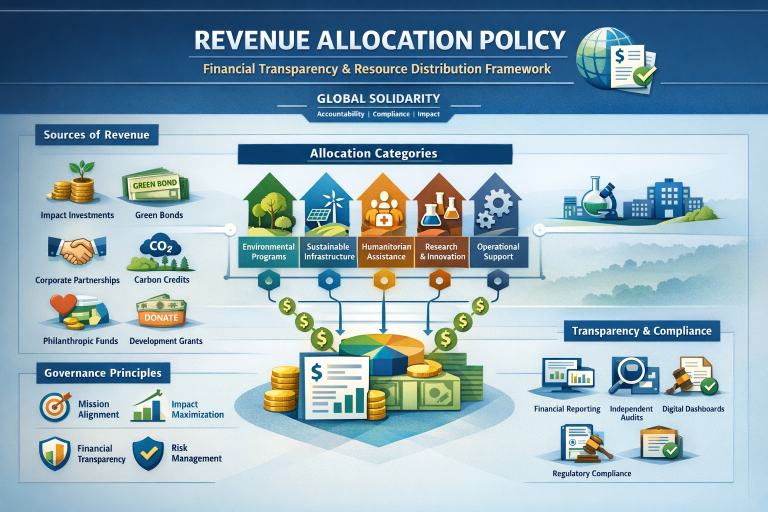
3. Sources of Revenue
Financial resources supporting Global Solidarity initiatives may originate from multiple sources.
These include:
• impact investment funds
• green bonds and structured financial instruments
• institutional investment channels
• corporate ESG partnerships
• philanthropic contributions
• environmental finance mechanisms such as carbon credits
• micro-contribution systems such as Forest Card
The diversification of revenue sources increases financial resilience and operational sustainability.
4. Allocation Structure
Financial resources are distributed across several major categories designed to support the operational ecosystem of Global Solidarity.
Environmental Programs
A significant portion of revenue is allocated to environmental restoration and climate stability initiatives.
Examples include:
• reforestation programs
• biodiversity conservation initiatives
• ecosystem restoration projects
• climate mitigation systems
These programs directly address environmental degradation and climate risks.
Sustainable Infrastructure Projects
Financial resources also support the development of sustainable infrastructure systems.
Examples include:
• renewable energy installations
• water infrastructure and desalination systems
• sustainable urban infrastructure
• climate-resilient housing systems
Infrastructure investments generate long-term environmental and social benefits.
Humanitarian Assistance Systems
Part of the revenue supports humanitarian programs addressing urgent social needs.
These initiatives may include:
• emergency response operations
• disaster recovery programs
• climate migration assistance
• community stabilization initiatives
Humanitarian programs enhance resilience in vulnerable regions.
Research and Innovation
Resources are also allocated to research and technological innovation supporting sustainability initiatives.
Examples include:
• environmental monitoring technologies
• climate modeling systems
• sustainability innovation research
• data analysis platforms
Research investments improve the long-term effectiveness of sustainability strategies.
Operational Infrastructure
A portion of revenue supports the operational functions necessary to manage Global Solidarity programs.
Operational costs may include:
• administrative coordination
• digital infrastructure management
• monitoring and evaluation systems
• governance and compliance operations
Operational funding ensures the effective functioning of the platform.
5. Allocation Principles
The Revenue Allocation Policy is guided by several financial governance principles.
Mission Alignment
All allocations must support environmental restoration, humanitarian resilience, or sustainability infrastructure.
Financial Transparency
All financial allocations are recorded and monitored through structured reporting systems.
Impact Maximization
Priority is given to initiatives capable of generating measurable environmental or social outcomes.
Operational Efficiency
Administrative costs are managed carefully to ensure that the majority of financial resources support programmatic initiatives.
6. Revenue Allocation Ratios
The platform may define indicative allocation ranges across operational categories.
Although ratios may evolve depending on project pipelines and financial conditions, typical allocations may prioritize:
• environmental restoration programs
• infrastructure development projects
• humanitarian assistance initiatives
• research and innovation programs
• operational and governance support
These ratios ensure balanced resource distribution.
7. Financial Transparency Mechanisms
Financial transparency is ensured through several institutional mechanisms.
These include:
• standardized financial reporting
• digital transparency dashboards
• independent financial audits
• project-level financial tracking systems
Such mechanisms enable stakeholders to monitor the use of financial resources.
8. Compliance and Regulatory Alignment
All financial operations follow relevant financial compliance standards.
This includes alignment with:
• international financial regulations
• anti-money laundering (AML) frameworks
• environmental finance standards
• institutional reporting requirements
Compliance ensures responsible financial governance.
9. Risk Management Integration
Revenue allocation decisions incorporate risk management procedures designed to ensure financial stability.
These procedures include:
• financial risk assessments
• environmental risk evaluation
• operational feasibility analysis
• governance oversight review
Risk management contributes to sustainable financial operations.
10. Comparative Governance Perspective
Traditional non-profit organizations often rely on discretionary allocation decisions without clearly defined financial distribution frameworks.
The Global Solidarity Revenue Allocation Policy differs by establishing:
• predefined allocation structures
• measurable impact criteria
• transparent reporting systems
This structured approach improves governance quality and institutional credibility.
11. Stakeholder Accountability
The Revenue Allocation Policy ensures accountability to key stakeholders including:
• investors
• institutional partners
• donors
• multilateral organizations
• participating communities
Transparent financial management strengthens long-term institutional relationships.
12. Long-Term Strategic Objective
The long-term objective of the Revenue Allocation Policy is to create a financial governance framework capable of supporting large-scale sustainability initiatives while maintaining transparency, efficiency, and institutional accountability.
Through structured resource allocation and transparent reporting mechanisms, the platform seeks to ensure that financial resources consistently support environmental restoration, humanitarian resilience, and sustainable development.
13. Strategic Conclusion
The Revenue Allocation Policy represents a key component of the Transparency, Risk & Compliance architecture of Global Solidarity.
By establishing clear financial allocation rules, transparent reporting mechanisms, and structured governance procedures, the policy ensures that financial resources are used responsibly and effectively in support of the platform’s mission.
This structured financial governance framework strengthens the institutional credibility of Global Solidarity and supports its capacity to mobilize capital for large-scale sustainability initiatives.