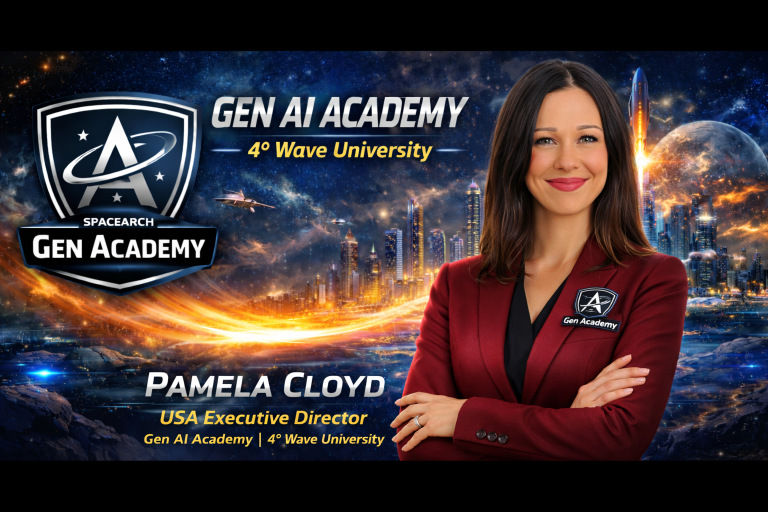



Business Model – SpaceArch Solutions International, LLC
1. 📌 EXECUTIVE SUMMARY
Gen Academy 4th Wave University is a global platform for education, monetization, and economic activation based on a hybrid model that integrates:
- Premium digital education
- Automated marketing and sales
- Scalable content production
- Direct integration with business ecosystems
- Multilingual international expansion
Unlike traditional educational models, Gen Academy does not simply train students:
it transforms education into revenue, talent into operational structure, and knowledge into scalable assets.
👉 It simultaneously operates as:
- A digital university
- A global acquisition platform
- A cash flow generation system
- A recruitment and expansion engine for SpaceArch
2. 🧠 FOUNDATION: EDUCATION AS AN ECONOMIC ENGINE
Traditional model (obsolete)
- Education = cost
- Student = passive consumer
- Uncertain job outcomes
- Weak connection to real markets
Gen Academy model (4th Wave)
- Education = direct income
- Student = active economic operator
- Immediate integration into production systems
- Direct connection with real business opportunities
📌 Result:
Education ceases to be an expense and becomes a revenue-generating unit.
3. ⚙️ SYSTEM ARCHITECTURE
Gen Academy operates as a fully integrated modular system:
3.1 Technology Core
- Advanced LMS plugin (Tutor LMS–type)
- WordPress as the base system
- Integrated with:
- memberships
- subscriptions
- newsletters
- CRM (email systems)
- analytics
- manual/digital checkout
👉 This transforms the platform into a complete business infrastructure, not just an educational tool.
3.2 Course Structure (Autonomous Commercial Unit)
Each course functions as an independent micro-business.
Components:
- Optimized landing page (SEO + conversion)
- Video / demo
- Premium content (differentiation layer)
- Downloadable PDF (syllabus + brochure)
- Payment system
- Email marketing integration
- Analytics tracking
- Upsell / cross-sell systems
📌 Key concept:
Each course = an international revenue unit.
3.3 Hybrid Content System
Gen Academy combines multiple content sources:
A. Proprietary production
- Premium written content
- Strategic annexes
- Real-world case studies
- Sales scripts
- Assessments and questionnaires
B. External content (optimized)
- Curated YouTube videos
- Third-party audiovisual materials (e.g., Edutin)
C. Transformation system
External content is not copied—it is reprocessed and upgraded:
- proprietary introduction
- conceptual framework
- premium explanation
- exercises
- real-world application
- monetization integration
👉 Result:
Open content is transformed into high-value structured products.
4. 🌐 GLOBAL SCALABILITY
4.1 Multilingual Strategy
- Native base: Spanish + English
- Expansion: 100+ languages via translation systems
📌 Model:
- native language = premium quality
- translation = expansion and market testing
- validation = localized optimization
👉 Enables global launch with near-zero marginal cost.
4.2 Immediate Internationalization
Without requiring:
- physical offices
- complex infrastructure
- heavy capital investment
Gen Academy can operate from day one as:
🌍 A global education + revenue platform
5. 💰 REVENUE MODEL
5.1 Direct Revenue Streams
- Individual course sales
- Monthly memberships
- Premium programs
- Certifications
5.2 Indirect Revenue (Core Value Driver)
The true power of the system lies here:
- web development services
- hosting services
- AI marketing
- Digital Labs (R&D services)
- coworking
- advertising (OmniStand)
- telesales networks
- SpaceArch franchise models
- integration into verticals (PortsFish, AI Earth, etc.)
📌 Core concept:
The course is not the final product—it is the entry point to a monetization ecosystem.
5.3 Recurring Revenue Model
- active memberships
- newsletter-based offers
- continuous course updates
- community engagement
👉 Generates sustained long-term revenue.
6. 🚀 FULL FUNNEL SYSTEM
The platform operates as a complete funnel:
- Traffic (SEO, social media, portals)
- Course landing page
- PDF download (lead capture)
- Conversion (purchase)
- Student activation
- Upsell (additional courses)
- Service integration
- Continuous monetization
📌 Result:
Gen Academy becomes a global automated conversion engine.
7. 🤝 PARTNERSHIP MODEL (e.g., EDUTIN)
Hybrid Strategy
Gen Academy does not compete directly—it integrates and enhances.
Roles:
- Third parties → audiovisual content
- Gen Academy → structure, premium layer, monetization
Possible models:
A. Premium enhancement
Add high-value content to existing courses
B. Funnel entry model
Free/basic content → paid specialization
C. Hybrid system
Video + premium text + practice + monetization
📌 Strategic rule:
The core asset ALWAYS remains within Gen Academy.
8. 🧩 SPACEARCH INTEGRATION
Gen Academy serves as the entry point to the ecosystem:
- SpaceArch (global structure)
- Expoplanet (commerce)
- OmniStand (advertising)
- AI Earth (technology)
- Digital Labs (R&D)
- Future Fashion
- PortsFish
- coworking nodes (MDQ and beyond)
📌 Result:
Each student can become:
- a client
- a collaborator
- an operator
- a partner
9. 📊 COMPETITIVE ADVANTAGES
Compared to traditional universities:
- speed
- low cost
- practical orientation
- immediate monetization
Compared to platforms like Edutin / Euroinnova:
- higher flexibility
- integration with real business systems
- built-in sales infrastructure
- operational scalability
- ecosystem connectivity
10. ⚡ CORE DIFFERENTIATOR
Gen Academy does not sell courses.
It sells economic activation.
11. 📈 STRATEGIC PROJECTION
Short term:
- 10–20 courses
- market validation
- initial cash flow
Medium term:
- 50–300 courses
- international expansion
- instructor network
Long term:
- distributed global university
- full SpaceArch integration
- thousands of active operators
12. 🧭 CONCLUSION
Gen Academy represents a structural shift in the education paradigm:
- transforms education into income
- transforms students into operators
- transforms content into assets
- transforms a portal into a global network
👉 It is a 4th Wave University, where:
education, business, and technology converge into a single scalable system.
13. 🧠 FINAL DEFINITION
Gen Academy 4th Wave University is:
A global system for education, monetization, and business expansion based on hybrid human-AI intelligence, designed to generate revenue, operational talent, and international growth from day one.
🌍 GEN ACADEMY 4TH WAVE UNIVERSITY
Financial Model – SpaceArch Solutions International, LLC
1. 📊 BASE ASSUMPTIONS (REALISTIC + SCALABLE)
🎓 Initial Offer
- MVP Courses: 12
- Average course price: USD 50
- Premium / integration version: USD 100
👉 Weighted average ticket: USD 65
🌍 Initial Market
- Target: Argentina + Latin America + global expansion
- Estimated initial traffic (organic + direct):
5,000 visits/month - Conservative conversion rate:
2%
👉 Initial monthly sales:
100 students/month
2. 💵 REVENUE – PHASE 1 (REALISTIC MVP)
Monthly revenue
- 100 students × USD 65 = USD 6,500 / month
Annual revenue
- USD 6,500 × 12 = USD 78,000 / year
3. 📈 ORGANIC SCALING (NO HEAVY INVESTMENT REQUIRED)
The system benefits from compounding growth dynamics:
- more courses → more traffic
- more content → stronger SEO
- more students → more referrals
- more data → higher conversion
4. 🚀 PHASE 2 – EXPANSION (3–6 MONTHS)
Assumptions:
- Active courses: 50
- Monthly traffic: 25,000 visits
- Conversion rate: 2.5%
👉 Sales:
- 625 students/month
👉 Revenue:
- 625 × USD 65 = USD 40,625 / month
👉 Annual:
- USD 487,500 / year
5. 🌍 PHASE 3 – INTERNATIONAL SCALE (6–12 MONTHS)
Assumptions:
- Courses: 150
- Traffic: 100,000 visits/month
- Conversion rate: 3%
👉 Sales:
- 3,000 students/month
👉 Revenue:
- 3,000 × USD 65 = USD 195,000 / month
👉 Annual:
- USD 2,340,000 / year
6. ⚡ PHASE 4 – EXPONENTIAL MODEL (12–24 MONTHS)
Assumptions:
- Courses: 300+
- Traffic: 300,000 visits/month
- Conversion rate: 3.5%
👉 Sales:
- 10,500 students/month
👉 Revenue:
- 10,500 × USD 65 = USD 682,500 / month
👉 Annual:
- USD 8,190,000 / year
7. 💎 INDIRECT REVENUE (CORE VALUE DRIVER)
This is the most important component for investors.
Only 5–10% of students convert into higher-value services.
Conservative assumption:
- 5% conversion to services
- Average service ticket: USD 500
Phase 3 example:
- 3,000 students × 5% = 150 clients
- 150 × USD 500 = USD 75,000 additional/month
👉 Total monthly revenue:
- USD 195,000 + USD 75,000 = USD 270,000
👉 Annual:
- USD 3,240,000
Phase 4 example:
- 10,500 students × 7% = 735 clients
- 735 × USD 500 = USD 367,500 additional/month
👉 Total monthly revenue:
- USD 682,500 + USD 367,500 = USD 1,050,000
👉 Annual:
- USD 12,600,000
8. 📦 COST STRUCTURE (ULTRA-LEAN)
Monthly fixed costs (initial phase)
- Hosting + software: USD 200
- Basic marketing: USD 300
- Minimal production: USD 1,000
- Operations (2 people): USD 1,400
👉 Total: USD 2,900 / month
Phase 1 margins:
- Revenue: USD 6,500
- Costs: USD 2,900
👉 Profit: USD 3,600 / month
👉 Margin: 55%
Phase 3 estimated margins:
- Revenue: USD 270,000
- Expanded costs: USD 40,000
👉 Profit: USD 230,000 / month
👉 Margin: 85%
9. 🧠 REINVESTMENT MODEL
The system enables:
- self-funded growth
- scaling without initial external capital
- reinvestment into:
- traffic acquisition
- content production
- team expansion
- international growth
10. 📊 PROJECTED VALUATION
Digital education + SaaS + ecosystem model:
👉 Conservative multiples: 5x to 10x annual revenue
Phase 3:
- Revenue: USD 2.3M – 3.2M
👉 Valuation:
- USD 12M – 30M
Phase 4:
- Revenue: USD 8M – 12M
👉 Valuation:
- USD 40M – 120M
11. 🔥 VALUE MULTIPLIERS
- User database (core asset)
- Scalable content library
- Instructor network
- SpaceArch ecosystem integration
- Multilingual global model
- Near-zero marginal cost
- High recurrence
- Structured cross-selling
12. 🎯 INVESTMENT PROPOSAL
Option 1 – Early Entry
- Ticket: USD 50,000 – 250,000
- Use of funds: marketing + content + expansion
- Suggested equity: 5% – 15%
Option 2 – Growth Capital
- Ticket: USD 500,000 – 2M
- Global scaling
- Automation
- international team
13. 🧭 FINANCIAL CONCLUSION
Gen Academy has a critical strategic advantage:
👉 It does not require heavy capital to launch,
but it can efficiently absorb large capital to scale.
This combination:
- reduces risk
- increases investor attractiveness
- accelerates growth potential
14. 💡 FINAL INVESTOR STATEMENT
“Gen Academy is not a course platform.
It is a global system that converts education into revenue, data into assets, and students into economic operators within a scalable ecosystem.”
In a scenario where governments support and adopt national or international remote work programs, Gen Academy 4th Wave University is positioned to generate a structural impact on workforce transformation and economic productivity. The model redefines the traditional education paradigm by replacing it with an integrated framework of “study, produce, and sell”, where the learning process culminates not in theoretical exams, but in the generation of real economic outcomes. Within this system, students are immediately integrated into the market, either as interassociated operators within the SpaceArch ecosystem or as independent micro-franchise holders. This approach enables the rapid scaling of a highly skilled digital workforce, results-driven and directly connected to the global economy, significantly reducing structural unemployment and accelerating economic development.
🌍 GEN ACADEMY
NATIONAL DEPLOYMENT PLAN
SpaceArch Solutions International, LLC
1. 📌 EXECUTIVE SUMMARY
The Gen Academy National Deployment Plan is a scalable framework designed to transform a country’s workforce into a globally competitive digital economy through a distributed model of education, production, and monetization.
This plan introduces a paradigm shift:
From “study and seek employment”
👉 To “study, produce, and sell”
Under this model, education becomes an immediate economic activity, enabling citizens to generate income while learning and integrating directly into global markets.
2. 🎯 STRATEGIC OBJECTIVES
Primary Goals:
- Reduce structural unemployment
- Enable mass remote work adoption
- Generate foreign currency inflows (USD-based income)
- Build a distributed digital workforce
- Accelerate national economic transformation
Secondary Goals:
- Strengthen SME competitiveness
- Digitize public and private sectors
- Create scalable innovation ecosystems
- Position the country as a global talent hub
3. 🧠 CORE MODEL: STUDY – PRODUCE – SELL
Traditional Education Model:
- Study → Graduate → Seek job → Uncertain outcome
Gen Academy Model:
- Study → Produce → Sell → Scale
📌 Key Principle:
The exam is no longer theoretical.
It is real market performance.
Operational Outcome:
- Students generate income during training
- Immediate integration into economic activity
- Continuous skill development aligned with demand
4. 🏗️ NATIONAL ARCHITECTURE
The system is deployed through three integrated layers:
4.1 DIGITAL INFRASTRUCTURE
- Gen Academy platform (LMS + CRM + analytics)
- National learning portal (multilingual)
- Course marketplace
- Payment systems (local + international)
- Data dashboards for monitoring
4.2 LOCAL MICRO-NODES (PHYSICAL + HYBRID)
Each city deploys SpaceArch MicroNodes:
Functions:
- training centers
- coworking hubs
- digital labs
- telesales units
- content production studios
📌 Characteristics:
- low-cost (<20 m² units possible)
- high flexibility
- rapid replication
4.3 ECONOMIC INTEGRATION LAYER
Participants are connected to:
- global clients
- digital service markets
- SpaceArch verticals
- franchise systems
- public/private sector demand
5. 👥 PARTICIPANT MODEL
Each participant evolves through stages:
Stage 1: Student
- enrolls in courses
- acquires skills
- begins producing
Stage 2: Operator
- executes real tasks
- generates income
- integrates into networks
Stage 3: Interassociated Member
- participates in shared business models
- receives profit shares
- collaborates across verticals
Stage 4: Franchise Holder
- operates local unit
- builds team
- scales revenue
6. 💰 ECONOMIC IMPACT MODEL
Individual Level:
- income generation in USD
- reduced dependency on local employment
City Level:
- activation of micro-economies
- increased productivity
- digital service exports
National Level:
- foreign currency inflow
- reduced unemployment
- increased tax base
- accelerated GDP growth
7. 🚀 IMPLEMENTATION PHASES
Phase 1 – Pilot (0–3 months)
- Deploy Gen Academy platform
- Launch 10–20 courses
- Activate 1–3 micro-nodes
- Recruit first 100–500 participants
Phase 2 – Expansion (3–9 months)
- Scale to 50–100 courses
- Expand to multiple cities
- Activate telesales networks
- Reach 1,000–5,000 participants
Phase 3 – National Scaling (9–18 months)
- Nationwide coverage
- 10,000–50,000 participants
- integration with institutions
- export services at scale
Phase 4 – Global Positioning (18–36 months)
- country as digital workforce hub
- international partnerships
- large-scale service exports
- ecosystem consolidation
8. 🤝 GOVERNMENT ROLE
Governments can support the system through:
- institutional endorsement
- integration with employment programs
- infrastructure support (spaces, connectivity)
- tax incentives for participants
- digital inclusion policies
Optional Integration:
- universities
- technical institutes
- public employment agencies
9. 📊 KEY PERFORMANCE INDICATORS (KPIs)
- number of active participants
- income generated per participant
- total export revenue
- course completion rates
- conversion to operators
- number of active micro-nodes
10. 🔥 COMPETITIVE ADVANTAGE FOR COUNTRIES
Countries adopting this model early will:
- lead in digital workforce exports
- reduce unemployment faster
- attract foreign investment
- build resilient economies
11. 🌐 STRATEGIC POSITIONING
Gen Academy enables countries to transition into:
Distributed Digital Production Economies
Instead of relying on:
- traditional industries
- slow job creation cycles
They leverage:
- global demand
- digital services
- scalable talent
12. 🧭 CONCLUSION
The Gen Academy National Deployment Plan is not an educational reform.
It is a national economic activation system.
13. 💡 FINAL STATEMENT
“By transforming education into production and sales,
Gen Academy converts citizens into economic operators
and nations into globally competitive digital economies.”
🌍 GEN ACADEMY
NATIONAL DIGITAL WORKFORCE DEPLOYMENT PROGRAM
Policy Framework Proposal for the World Bank & Multilateral Institutions
1. 📌 EXECUTIVE SUMMARY
The Gen Academy National Deployment Plan proposes a scalable, self-financed framework for large-scale workforce transformation, enabling countries to transition into distributed digital production economies.
This model integrates:
- Digital education
- Remote work activation
- Economic participation in global markets
- Scalable human capital development
It introduces a paradigm shift:
From education as a preparatory phase
👉 to education as immediate economic participation
2. 🌐 GLOBAL CONTEXT: THE REMOTE WORK ECONOMY
The global remote work and digital services economy is currently estimated at:
USD 3–4 trillion annually, with sustained high-growth projections.
This expansion is driven by:
- digitalization of services
- global talent demand
- platform economies
- AI-augmented productivity
However, access to this market remains uneven, particularly for developing economies.
3. 🧠 STRATEGIC INSIGHT: HUMAN CAPITAL AS THE PRIMARY DRIVER
This framework is based on a key strategic principle:
The central driver of the Fourth Wave economy is not infrastructure alone,
but digitally transformed human capital.
While data centers and artificial intelligence are critical enablers, they are:
- complementary to development
- not the sole determining factor
The gravitational center of value creation lies in:
A workforce reconverted into digital operators,
hybridized with AI capabilities,
and capable of multiplicative (fractal) productivity scaling.
4. ⚙️ CORE MODEL: STUDY – PRODUCE – SELL
The Gen Academy model replaces traditional education systems with an integrated economic framework:
- Study → Acquire skills
- Produce → Execute real tasks
- Sell → Generate income
📌 Key transformation:
The “exam” is no longer academic—it is market performance.
This enables:
- immediate labor market entry
- real-time income generation
- continuous skill-market alignment
5. 💰 SELF-FINANCED ACCESS TO THE FOURTH WAVE ECONOMY
A critical advantage of this model is that it provides:
Self-financed access to the global digital economy
Participants:
- fund their own training through low-cost entry
- generate income during the learning process
- reinvest into skill and productivity growth
This reduces dependency on:
- large public expenditure
- traditional employment pipelines
- external financing constraints
6. 🌍 DEVELOPMENT IMPLICATIONS FOR LOW-INCOME COUNTRIES
This model creates a unique opportunity:
Countries with limited industrial infrastructure can compete globally
through accelerated human capital digitization.
Key implications:
- leapfrogging traditional development stages
- rapid workforce upskilling
- access to global markets without physical export constraints
- increased foreign currency inflows
📌 Strategic determinant:
Economic advancement will depend on:
- the speed of workforce digitalization
- the scale of deployment
- the efficiency of coordination systems
7. 🏗️ OPERATIONAL ARCHITECTURE
7.1 Digital Layer
- Gen Academy platform (education + CRM + analytics)
- global service marketplace integration
- multilingual deployment
7.2 Physical Coordination Layer
SpaceArch MicroNodes provide:
- multifunctional micro-coworking hubs
- Digital Labs capability
- training, coordination, and production environments
📌 Features:
- low-cost deployment
- modular scalability
- high-density productivity
7.3 Workforce Organization Model
The system enables:
Structured, hierarchical “digital work units” (platoons)
These units operate:
- with physical coordination hubs (MicroNodes)
- supported by distributed teleworkers
- connected through cloud-based systems (“just-in-home” operations)
8. ⚡ SWARM PRODUCTION MODEL
Around each MicroNode, a distributed swarm of teleworkers operates:
- remotely connected
- task-oriented
- coordinated in real time
This enables:
- on-demand production
- rapid scaling
- flexible labor allocation
- efficient response to global demand
📌 Result:
A hybrid system combining physical coordination with distributed execution.
9. 📈 ECONOMIC IMPACT
Individual Level:
- income generation in global markets
- upward mobility through skill accumulation
National Level:
- export of digital services
- increased foreign currency inflows
- reduction in unemployment
- improved fiscal base
Global Level:
- more balanced participation in digital economy
- inclusion of emerging economies
- reduction of inequality gaps
10. 🤝 ROLE OF MULTILATERAL INSTITUTIONS
Institutions such as the World Bank can support deployment through:
- pilot program funding
- technical assistance
- policy framework development
- integration with national employment strategies
- digital infrastructure facilitation
11. 🚀 IMPLEMENTATION STRATEGY
Phase 1: Pilot
- limited-scale deployment
- validation of model
- initial workforce activation
Phase 2: Expansion
- multi-city rollout
- scaling of training and operations
Phase 3: National Integration
- institutional partnerships
- large-scale workforce deployment
Phase 4: Global Positioning
- integration into global service markets
- export-driven digital economy
12. 🧭 CONCLUSION
The Gen Academy framework represents:
A structural shift from labor markets to distributed production ecosystems
It redefines:
- education
- employment
- economic participation
🇺🇸 Institutional version
National Program for Remote Work Activation and Digital Economy Integration
The adoption of a training–production–commercialization model, as proposed by Gen Academy in combination with HostWeb, can serve as a complementary public policy to strengthen a country’s international integration through digital services.
In a rapidly expanding global market for remote work and digital services, the large-scale digitalization of human capital enables:
- increased service exports
- foreign currency inflows
- diversification of the productive matrix
- short-term employability gains
This approach does not replace traditional sectors; it complements them with a new layer of digital productivity, grounded in globally applicable skills.
The strategic advantage lies in speed of deployment, quality of training, and alignment with regulatory and financial frameworks that facilitate cross-border operations.
When implemented with appropriate standards, this model can position early adopters as competitive global providers of digital services, generating meaningful and sustainable economic impact.
13. 💡 FINAL STATEMENT
“The future of economic development will not be determined solely by infrastructure or capital,
but by the ability of nations to rapidly transform their human capital into digitally empowered, AI-augmented economic operators integrated into global markets.”