




The Local Operating Centers of PanMENA Hub Cloud
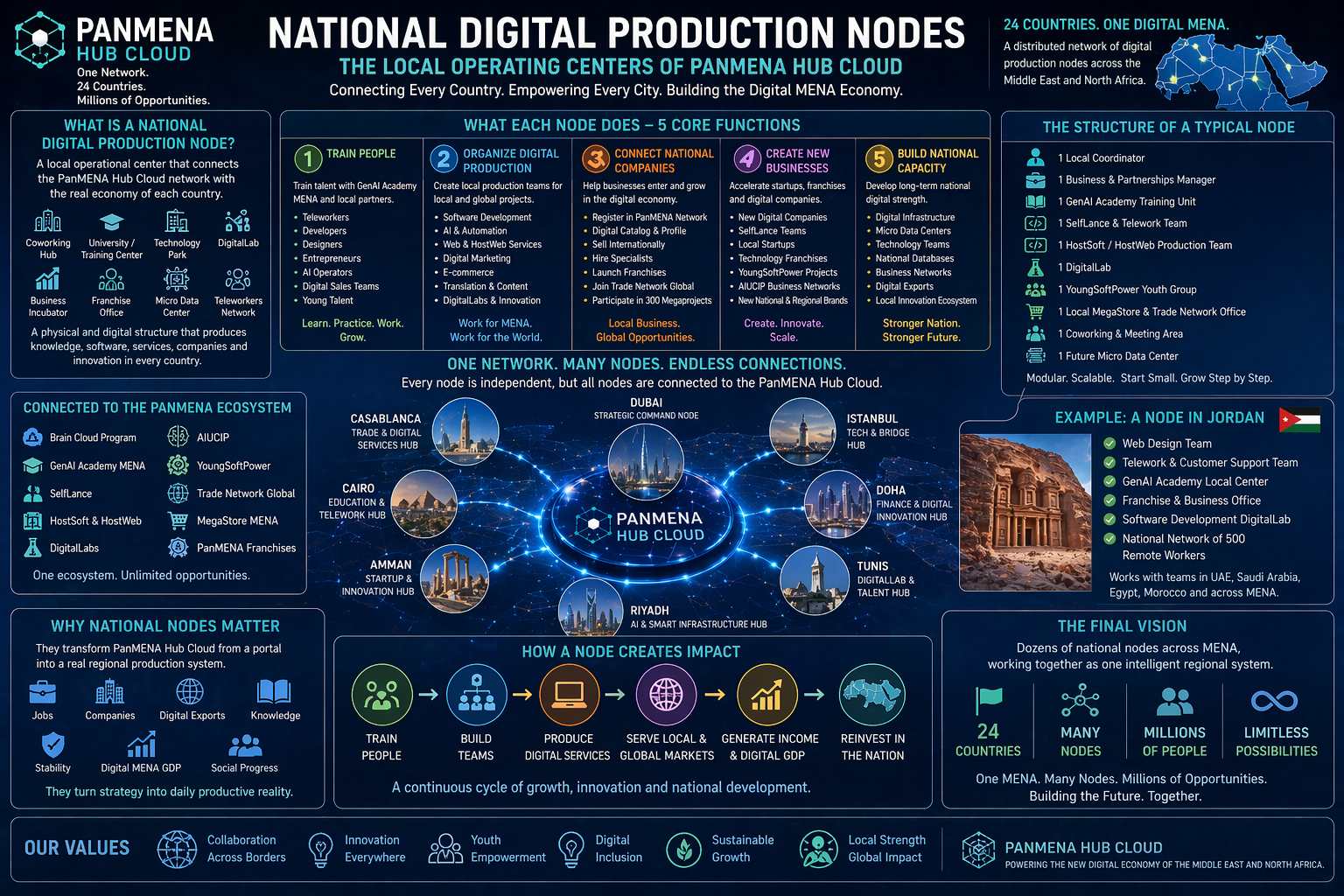
National Digital Production Nodes are the local operational centers of PanMENA Hub Cloud inside each MENA country.
They are the bridge between the regional network and the real economy of each nation.
Instead of concentrating everything in one city or one country, the PanMENA model creates a distributed network of digital production nodes across the 24 countries of the Middle East and North Africa. Each node can operate independently, but at the same time remain connected to the entire regional ecosystem.
A National Digital Production Node can be:
• a coworking hub
• a university or training center
• a technology park
• a DigitalLab
• a business incubator
• a franchise office
• a micro data center
• a shared office in a city
• a distributed network of teleworkers operating remotely
The objective is to create a physical and digital structure capable of producing knowledge, software, services, companies and innovation in every country across MENA.
What Each Node Does
Each National Digital Production Node has five core functions.
1. Train People
The node works with GenAI Academy MENA and local partners to train:
• teleworkers
• developers
• designers
• entrepreneurs
• AI operators
• digital sales teams
• young talent
Courses can be delivered both online and locally, allowing people to learn, practice and begin working quickly.
This makes each node not only a production center, but also a talent-generation center.
2. Organize Digital Production
The node creates local production teams for:
• software and app development
• websites and HostWeb services
• AI and automation projects
• digital marketing
• e-commerce
• translation and content creation
• business support services
• DigitalLabs and innovation projects
Each team can work for local companies, regional clients across MENA, or international clients in Europe, Asia, Africa and the Americas.
This transforms each node into a real economic engine.
3. Connect National Companies
The node helps local businesses enter the digital economy.
Companies can:
• register in the PanMENA network
• create a profile and digital catalog
• sell products and services internationally
• hire teleworkers and specialists
• launch franchises
• join Trade Network Global and MegaStore MENA
• participate in the 300 Megaprojects Program
This allows traditional businesses to modernize and new businesses to scale faster.
4. Create New Businesses
Every node also acts as a startup and franchise accelerator.
The system helps create:
• new digital companies
• SelfLance teams
• local startups
• technology franchises
• YoungSoftPower projects
• AIUCIP business networks
• new national and regional brands
Instead of waiting only for outside capital, each country can begin building its own digital economy from inside the PanMENA network.
5. Build National Capacity
Each node gradually develops its own:
• digital infrastructure
• micro data centers
• technology teams
• national databases
• business networks
• digital exports
• local innovation ecosystem
This creates long-term national strength and reduces dependence on external systems.
The Structure of a Typical National Node
A complete National Digital Production Node may include:
• 1 local coordinator
• 1 business and partnerships manager
• 1 GenAI Academy training unit
• 1 SelfLance and telework team
• 1 HostSoft / HostWeb production team
• 1 DigitalLab
• 1 YoungSoftPower youth group
• 1 local MegaStore and Trade Network office
• 1 small coworking and meeting area
• 1 future micro data center
The model is modular.
A country can begin with a very small team and grow step by step.
That is one of the strengths of the PanMENA system: it does not require full-scale deployment from day one. It can begin with one city, one team and one productive nucleus, then expand.
Example
A node in Jordan could create:
• a web design team
• a telework and customer support team
• a local GenAI Academy center
• a franchise and business development office
• a software development DigitalLab
• a national network of 500 remote workers
At the same time, that node could work together with teams in UAE, Saudi Arabia, Egypt, Morocco or Qatar inside the same PanMENA Hub Cloud network.
The same logic applies to:
• Dubai as a strategic regional command node
• Cairo as an education and telework production center
• Riyadh as an AI and smart infrastructure node
• Casablanca as a trade and digital services hub
• Amman as a startup and innovation node
Why National Nodes Matter
Without local structures, a regional vision remains only an idea.
National Digital Production Nodes make the vision operational.
They transform PanMENA Hub Cloud from a portal into a real regional production system capable of creating:
• jobs
• companies
• digital exports
• knowledge
• stability
• Digital MENA GDP
• social and economic progress
They are the mechanism that converts strategy into daily productive reality.
One Network, Many Nodes
The strength of PanMENA does not come from one giant central office alone.
It comes from dozens, then hundreds, of connected national and city-based nodes working together as one intelligent regional system.
Dubai may act as the strategic brain, but the real power of PanMENA comes from distributed execution.
That is why the node model matters so much.
It creates a system that is:
• scalable
• modular
• lower-cost to launch
• easier to localize
• more resilient
• more attractive to governments, investors and entrepreneurs
Final Vision
PanMENA Hub Cloud grows not only through portals, but through productive local structures.
Each node becomes:
• a school
• a business center
• a production unit
• a startup lab
• a telework engine
• a future micro-infrastructure hub
Together, these nodes create the real operating fabric of Digital MENA.
One MENA.
24 countries.
Many nodes.
Millions of opportunities.