






Executive Overview
The online Artificial Intelligence ecosystem has entered a phase of accelerated expansion characterized by:
- Rapid democratization of AI access
- Massive reduction in entry barriers
- Cross-industry integration
- Consumer-grade usability
- Enterprise-grade scalability
What was once limited to research labs and large corporations is now available to startups, SMEs, independent professionals, and everyday users.
Today, the AI market offers thousands of tools across categories such as:
- Generative AI (text, image, video, audio)
- Business automation
- Analytics & data science
- Coding assistance
- Design & creative production
- Marketing optimization
- Customer support automation
- Productivity enhancement
The key differentiator is no longer access to AI, but rather:
- Integration capability
- Workflow orchestration
- Strategic alignment with ROI
- Operational deployment discipline
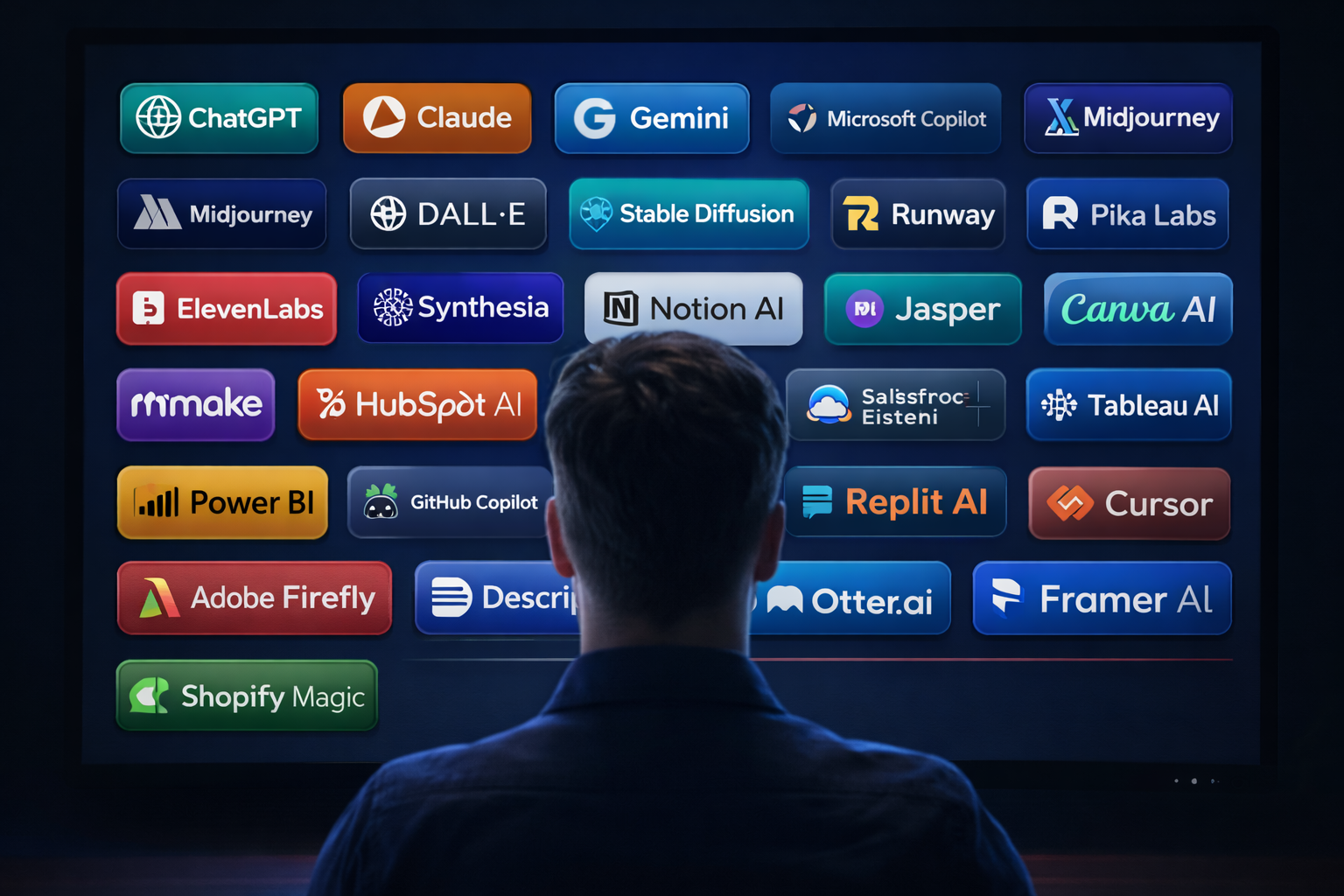
30 Most Powerful and Widely Usable AI Tools (2025 Landscape)
The following list balances:
• Technical power
• Ease of use
• Business applicability
• Cross-industry adaptability
• Accessibility for both advanced users and non-technical individuals
1. ChatGPT (OpenAI)
General-purpose conversational AI, coding, writing, research, business ideation.
2. Claude (Anthropic)
Advanced reasoning, long-document processing, analytical writing.
3. Gemini (Google)
Multimodal AI integrated with Google Workspace.
4. Microsoft Copilot
Enterprise integration with Office, Excel, Teams, and business workflows.
5. Midjourney
High-end AI image generation for professional creatives.
6. DALL·E
Structured AI image generation.
7. Stable Diffusion
Open-source image generation, customizable pipelines.
8. Runway
AI video editing and generative video production.
9. Pika Labs
Text-to-video generative platform.
10. ElevenLabs
AI voice generation and cloning.
11. Synthesia
AI avatar video generation for corporate training and marketing.
12. Notion AI
Knowledge management and AI writing assistant inside workspace.
13. Grammarly AI
AI-enhanced writing improvement.
14. Jasper
Marketing copy generation optimized for conversions.
15. Canva AI
AI-powered design for non-designers.
16. Perplexity AI
AI-powered research assistant with real-time sources.
17. Zapier AI
Automation builder for non-technical users.
18. Make (formerly Integromat)
Advanced workflow automation system.
19. HubSpot AI
CRM automation and marketing AI integration.
20. Salesforce Einstein
Enterprise-grade CRM AI.
21. Tableau AI
Data analytics and visualization with AI augmentation.
22. Power BI with Copilot
Business intelligence powered by AI.
23. GitHub Copilot
AI coding assistant for developers.
24. Cursor
AI-native coding environment.
25. Replit AI
AI-assisted cloud development.
26. Adobe Firefly
Creative AI suite integrated in Adobe ecosystem.
27. Descript
AI-powered audio and video editing.
28. Otter.ai
AI meeting transcription and summaries.
29. Framer AI
AI website generation and rapid prototyping.
30. Shopify Magic
AI e-commerce automation and content generation.
Market Observations
1. AI Is Horizontal, Not Vertical
AI is no longer confined to specific sectors; it cuts across all industries.
2. Ease of Use Has Become Strategic
Interfaces are increasingly designed for non-technical users.
3. Automation Is the Real Multiplier
Standalone AI tools are powerful.
Integrated AI systems are transformational.
4. Enterprise Value = Integration + Governance
The differentiator at enterprise level is:
- Data control
- Infrastructure orchestration
- Workflow integration
- Security architecture
Strategic Conclusion
The AI market is no longer defined by scarcity of tools.
It is defined by:
• System design
• Strategic selection
• Intelligent orchestration
• ROI discipline
The abundance of AI platforms creates opportunity — but also noise.
The real competitive advantage lies not in using AI tools individually,
but in building structured, scalable AI-enabled systems.