







Modular Cognitive Workspace Architecture (MCWA)
From Linear Responses to Structured Cognitive Assembly
One of the observations emerging from the practical use of large language models is that most AI-human interaction remains fundamentally linear.
The user asks a question.
The AI generates a sequential response.
The response is streamed to the screen as it is being produced.
While effective, this model does not fully exploit the potential of distributed AI systems, multi-agent architectures, or cloud-native cognitive environments.
SpaceArch AI Earth proposes a new conceptual framework:
Modular Cognitive Workspace Architecture (MCWA)
The objective is not to create a faster chatbot.
The objective is to create a structured cognitive workspace capable of coordinating multiple specialized reasoning modules before generating the final response.
The Limitation of Linear AI Interfaces
Current conversational systems generally operate as follows:
User Request
↓
Reasoning Process
↓
Sequential Text Output
↓
User Receives Response
This architecture is simple and intuitive, but it presents several limitations:
- Linear output generation.
- Limited specialization.
- Difficulty handling complex multidisciplinary tasks.
- Reduced visibility into response structure.
- Increased probability of repetition.
- Longer response generation for highly complex requests.
Proposed Architecture
Instead of a single reasoning flow, SpaceArch proposes the use of multiple specialized cognitive modules operating simultaneously.
Example:
Module A
Strategic Analysis
Module B
Financial Analysis
Module C
Marketing Analysis
Module D
Technical Feasibility
Module E
Operational Analysis
Module F
Risk Assessment
Each module receives the same problem but analyzes it from a different perspective.
Their outputs are assembled inside a structured cognitive workspace.
A final integration layer then produces the response delivered to the user.
Cognitive Workspace Layer
Rather than generating text directly to the screen, the system first constructs an internal structured document.
Conceptually, this workspace resembles:
- A dynamic document.
- A collaborative whiteboard.
- A cloud-native cognitive notebook.
- A multi-agent drafting environment.
The final response becomes the result of synthesis rather than the result of sequential generation.
Expected Benefits
Faster Perceived Responses
Specialized modules can process information simultaneously.
Better Organization
Responses become naturally structured.
Higher Consistency
Cross-validation between modules reduces contradictions.
Greater Depth
Multiple perspectives are analyzed concurrently.
Better Scalability
Additional specialized agents can be added without redesigning the entire system.
Application to the SpaceArch Ecosystem
The proposal aligns naturally with ongoing SpaceArch developments:
- AIforAIs.
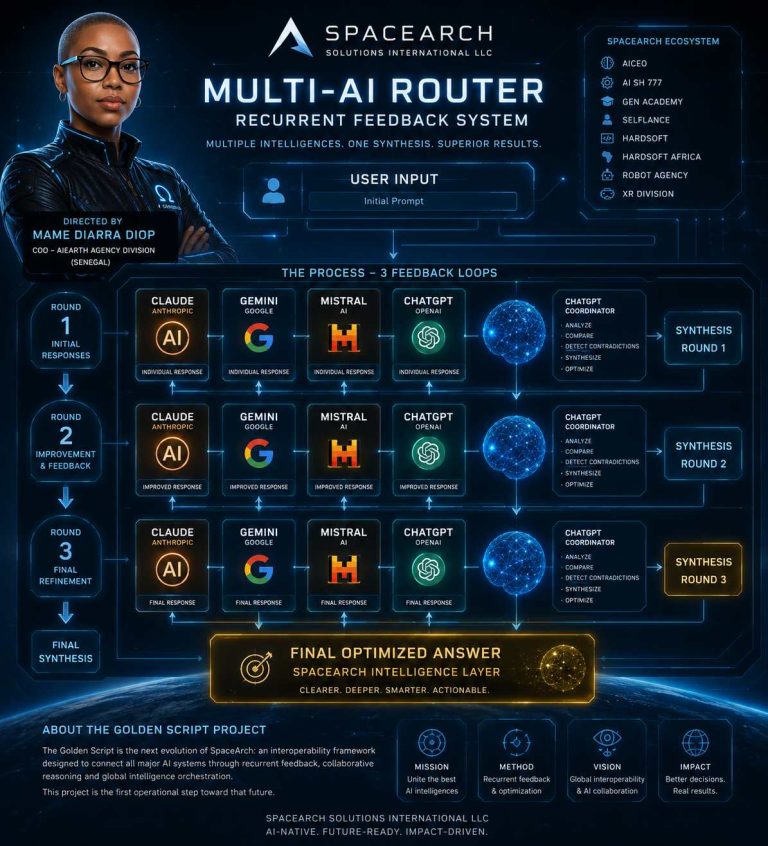
- Multi-AI Router.
- GenAcademy.
- DigitalLabs.
- AI Journalist.
- Startup Activation Systems.
- SpaceArch 100 News Network.
The same architectural principles used to coordinate distributed educational, media, and innovation ecosystems can be applied to AI reasoning itself.
AI Earth Vision
The long-term objective is not merely to build larger models.
The objective is to create coordinated cognitive ecosystems where multiple specialized intelligences collaborate within structured workspaces.
This approach moves beyond the traditional chatbot paradigm toward:
- Cognitive Operating Systems.
- AI Workspaces.
- Multi-Agent Reasoning Environments.
- Distributed Knowledge Networks.
- Cloud-Native Intelligence Architectures.
Conclusion
The future of AI may not be a single increasingly large intelligence.
It may be a coordinated network of specialized intelligences operating inside structured cognitive workspaces.
SpaceArch AI Earth identifies this transition as one of the key opportunities for the next generation of AI-native systems.
The challenge is no longer generating text.
The challenge is orchestrating intelligence.