






Financial
SpaceArch New NASA requires a financial and risk architecture very different from a traditional company. The ecosystem combines AI, Digital Labs, coworkings, cloud infrastructure, education, marketplaces, robotics, XR, New NASA programs and PanAfrica–PanLatam–PanMENA expansion. That means investment decisions cannot be evaluated only with conventional metrics such as CAPEX and annual profit. They must be analyzed as a portfolio of interconnected growth engines.
The objective of SpaceArch financial consulting is therefore not simply to reduce risk, but to maximize strategic ROI while controlling uncertainty and preserving optionality.
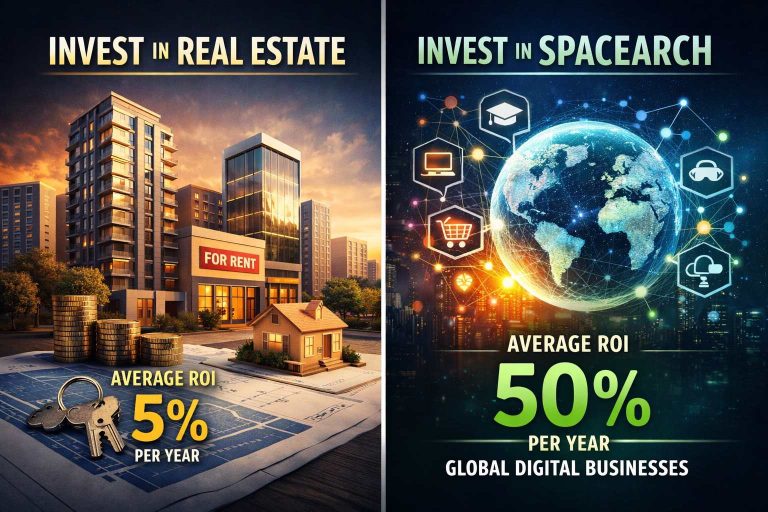
The strongest investment thesis for SpaceArch is that the ecosystem is built around low-cost, cloud-based, cloneable systems capable of scaling exponentially with limited fixed investment.
1. The SpaceArch Financial Logic: Small CAPEX, Large Expansion Potential
Unlike traditional companies that require large factories, offices or heavy infrastructure before generating revenue, SpaceArch begins with:
- Cloud systems
- WordPress portals and subdomains
- Digital Labs
- Coworkings
- AI agents
- Distributed teleworkers
- Franchise structures
- Partnerships
This produces a highly favorable investment equation:
- Low initial capital requirements
- Rapid market entry
- Fast validation of business models
- Possibility of cloning the model internationally
The initial risk is therefore significantly lower than in a conventional industrial project, while the scalability is much greater.
For SpaceArch, the main value is not in the first coworking, first course, first Digital Lab or first portal. The value is in the ability to replicate that same cell hundreds or thousands of times across countries and sectors.
This aligns strongly with your strategy of starting with one operational nucleus and then reproducing it organically through the PanAfrica, PanLatam and PanMENA networks.
2. Portfolio Structure: Three Levels of Investment
The SpaceArch investment model should be divided into three categories:
Tier 1 – Strategic Bets
These are the projects with the highest potential return and strongest impact on future valuation:
- SpaceArch New NASA
- Digital Labs
- SpaceArch XR
- PanAfrica / PanLatam / PanMENA
- AICEO + AI Senior + AI Sales
- M-777 S5K Space Elevator
- Orbital cloud and space-based infrastructure
These projects carry higher risk because they require time, partnerships and technological development. However, they also have the capacity to generate 10x–100x value if successful.
The strategic recommendation is not to finance all Tier 1 projects simultaneously. Instead, SpaceArch should prioritize the projects with:
- The highest symbolic value
- The fastest visible traction
- The greatest ability to attract investors and partners
For example, Digital Labs, Gen Academy and AI-driven coworkings are ideal first strategic bets because they are relatively low-cost but make the larger SpaceArch vision appear credible and operational.
Tier 2 – Fast Cash Flow Engines
These are the projects that generate cash quickly and help finance the larger vision:
- Gen Academy
- Cash Flow Boss
- AI consulting
- Telework programs
- Web design and automation services
- MacroMedia
- Maitreya Music
- SelfLance
- Marketplace services
- Company registration services in Miami, Dubai and MDQ
These projects have lower risk and faster monetization. Their main function is to generate recurring cash flow to reduce dependence on external investors.
The ideal strategy is that Tier 2 projects finance Tier 1 projects progressively.
This perfectly matches your existing “cash flow manda” philosophy and the logic that every new project should help activate the next one.
Tier 3 – Experimental and Long-Term Projects
These include:
- Neurointerfaces
- Biodigital systems
- Quantum energy concepts
- Omnisapiens genetic engineering
- Advanced orbital civilization concepts
- Alpha Centauri B programs
These projects should receive only a small percentage of total investment in the early phases. Their function is not immediate profitability but strategic positioning and intellectual leadership.
The financial rule should be:
- 70–80% of investment → Tier 2 and near-term Tier 1
- 15–20% → long-term Tier 1
- 5–10% → Tier 3 experimental research
This protects the company from excessive speculative exposure while preserving the future upside of the most visionary projects.
3. Main Investment Risks for SpaceArch
Every major investment model has specific risks. For SpaceArch, the key risks are:
Strategic Risk
The ecosystem is so large and ambitious that investors may initially perceive it as too broad or difficult to understand.
The solution is to present SpaceArch as a sequence of phases:
- Gen Academy + coworkings + Digital Labs
- Expansion into PanAfrica / PanLatam / PanMENA
- AI trilogy and cloud ecosystem
- New NASA and advanced projects
This phased presentation reduces perceived risk and makes the model easier to finance.
Execution Risk
The biggest danger is not lack of ideas, but trying to launch too many projects simultaneously.
Your recent decision to advance step by step—starting with Maitreya Music, Gen Academy, PanAfrica and then progressively expanding—is financially correct because it reduces execution risk and improves credibility.
Disconnected pilot projects often create high sunk costs and fail to produce real strategic value.
Financial Risk
SpaceArch may initially face:
- Limited cash flow
- Delays in investor decisions
- Variable revenue from early projects
- Currency and country risk in international expansion
The solution is to maintain:
- Very low fixed costs
- High use of outsourcing
- Telework structures
- Modular subdomains and templates
- Revenue diversification
This reduces the probability that one failed project can destabilize the entire ecosystem.
Concentration Risk
Depending excessively on a single partner, investor, platform or country would create vulnerability.
Therefore SpaceArch should diversify:
- Investors
- Countries
- Technologies
- Cloud providers
- Strategic alliances
For example, your idea of using a mix of Microsoft, AWS, Google Cloud and possibly Apple or NVIDIA is financially more robust than depending on a single provider.
Hybrid and multi-cloud strategies reduce concentration risk and increase long-term flexibility.
4. How SpaceArch Should Measure ROI
Traditional ROI calculations are insufficient for a Fifth Wave ecosystem.
SpaceArch should measure four levels of return:
Financial ROI
- Revenue growth
- Operating margin
- Cash flow
- Return on investment
- Payback period
Strategic ROI
- Number of countries entered
- Number of coworkings and Digital Labs activated
- Number of users and students
- Brand visibility
- Ability to attract investors and alliances
Technological ROI
- Automation percentage
- Reduction in operating costs
- Number of processes handled by AI agents
- Speed of execution
Automation and AI-driven risk management can reduce the cost of core processes by as much as 50%.
Ecosystem ROI
This is the most important metric for SpaceArch.
The true value of SpaceArch comes from how one system strengthens another:
- Gen Academy feeds SelfLance
- SelfLance feeds Digital Labs
- Digital Labs strengthen New NASA
- MacroMedia promotes the entire ecosystem
- PanAfrica increases market size
- AI Sales monetizes the whole network
This means the combined ROI of the ecosystem can be much larger than the ROI of each individual project.
The more interconnected the system becomes, the stronger the overall valuation.
5. Recommended Financial Dashboard for SpaceArch
SpaceArch should build a cloud-based financial command center with real-time indicators.
The dashboard should include:
- Cash flow by project
- ROI by country
- Number of active users
- Cost per acquired client
- Investor pipeline
- Revenue per coworking
- Revenue per course
- Conversion rate by sales team
- Risk alerts
- Probability of project success
- Scenario simulations
The ideal system is to create a digital twin of the company where SpaceArch can simulate:
- What happens if Dubai grows faster than expected
- What happens if PanAfrica expands to 20 countries
- What happens if Gen Academy reaches 100,000 students
- What happens if one country or partner leaves
This converts finance into a predictive system rather than a reactive one.
6. Recommended Investment Strategy for the Next 24 Months
For the next two years, the most financially intelligent sequence appears to be:
Phase 1
- Strengthen Gen Academy
- Reach 50–100 active courses
- Expand PanAfrica and Dubai Brain Cloud
- Launch more Digital Labs and coworkings
- Use MacroMedia and LinkedIn to attract visibility
Phase 2
- Scale the AI trilogy
- Expand SelfLance
- Build the first integrated cloud operating system
- Create the first strong recurring cash flow
Phase 3
- Use those results to attract larger investors
- Present New NASA
- Launch more ambitious projects such as SpaceArch XR, robotics and orbital systems
This sequencing lowers risk dramatically because investors will not be asked to believe only in a future promise. They will see a system already generating cash flow, users and international expansion.
Organizations that combine cloud, AI and financial discipline are already demonstrating significantly higher returns, lower operating costs and stronger investor confidence than traditional models.
7. Final Strategic Conclusion
The greatest risk for SpaceArch is not that the vision is too ambitious.
The greatest risk would be presenting all projects at once without showing the financial sequence that connects them.
Your recent evolution toward:
- One nucleus
- One pilot
- One coworking
- One Digital Lab
- One country
- Then systematic cloning
is exactly the correct financial logic.
It transforms SpaceArch from a visionary idea into an investable system.
In practice, SpaceArch should not be presented to investors as “300 projects.”
It should be presented as:
One cloud-based Fifth Wave operating system capable of creating hundreds of scalable businesses with limited capital and controlled risk.
That is a much stronger and more credible investment narrative.