





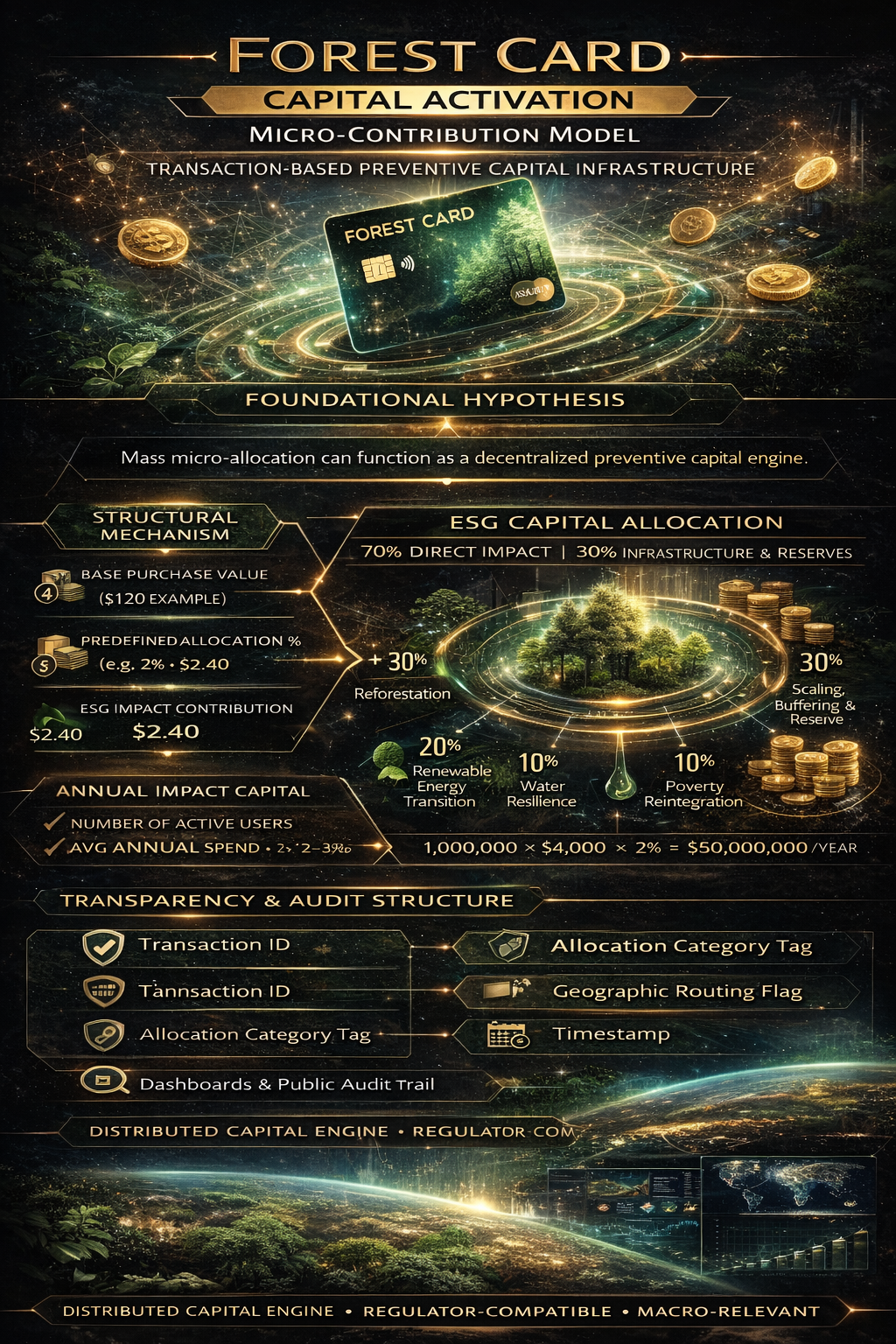
Regulated Financial Overlay & Settlement Architecture
1. Conceptual Definition
Merchant & Banking Integration defines the structured operational and regulatory interface between:
• Merchants
• Acquiring banks
• Issuing banks
• Payment processors
• The Forest Card allocation engine
The system operates as:
A transaction-level capital allocation overlay integrated into existing licensed financial infrastructure.
It does not replace banking rails.
It does not intermediate deposits.
It does not create parallel settlement systems.
It integrates through regulated channels.
2. Foundational Hypothesis
The integration model is based on eight structural premises:
- Financial scale requires regulated infrastructure.
- Merchant adoption depends on operational simplicity.
- Banking participation depends on regulatory clarity.
- Allocation must occur post-authorization, pre-settlement tagging.
- AML/KYC must remain enforced by licensed institutions.
- No monetary function may be replicated.
- Capital segregation must be legally defensible.
- Overlay architecture scales faster than banking replacement models.
Therefore:
Merchant & Banking Integration must function as a compliant routing enhancement layer.
3. Structural Architecture Overview
Integration operates across five primary components:
1️⃣ Merchant Layer
2️⃣ Acquiring Bank Layer
3️⃣ Payment Network Layer
4️⃣ Allocation Routing Engine
5️⃣ Impact Settlement & Segregation Layer
Each layer preserves its regulated function.
4. Merchant Integration Logic
Merchants:
• Maintain existing acquiring bank relationships
• Maintain POS or e-commerce systems
• Maintain pricing control
Integration options:
• API connection
• POS plug-in
• Payment gateway extension
• Affiliate integration
Allocation is embedded without altering merchant accounting logic.
5. Banking Layer Integration
The banking system performs:
• Authorization
• Clearing
• Settlement
• Fraud monitoring
• AML/KYC enforcement
Forest Card operates after authorization:
Transaction authorized → Allocation tagged → Settlement routed → Allocation portion transferred to segregated impact account.
Banks retain:
Full regulatory control over financial flows.
6. Payment Network Compatibility
The model integrates with:
• Card networks
• Debit networks
• Wallet systems
• QR payment frameworks
Forest Card does not:
• Act as a payment processor
• Replace card schemes
• Issue unregulated payment instruments
It is network-compatible.
7. Capital Routing Model
Let:
T = Transaction value
p = Allocation percentage
Impact Allocation (IA):
IA = T × p
Settlement logic:
Merchant receives (T − IA)
Impact account receives IA
Routing occurs via:
Licensed banking rails.
8. Segregation & Legal Ring-Fencing
Allocation funds are:
• Transferred to segregated accounts
• Legally separated from operational accounts
• Isolated via SPIV structures (if required)
• Audit-reconcilable
This prevents:
Commingling
Operational liquidity misuse
Regulatory reclassification
9. Compliance Framework
Merchant & Banking Integration respects:
• AML standards (FATF aligned)
• KYC enforcement
• Sanctions screening
• Consumer protection laws
• Tax reporting requirements
Allocation must:
• Be transparent
• Not distort advertised pricing
• Be disclosed at checkout
Compliance remains under licensed institutions.
10. Risk Containment Matrix
Primary risks:
• Settlement disruption
• Allocation misrouting
• Regulatory misclassification
• Merchant reporting inconsistency
• Fraudulent routing manipulation
Mitigation mechanisms:
• Deterministic routing engine
• Real-time reconciliation
• API audit logs
• Redundant payment rails
• Independent audit compatibility
Risk is compartmentalized.
11. Banking Incentive Structure
Banks may benefit through:
• Increased transaction volume
• ESG-aligned product development
• Green finance positioning
• Sustainable banking branding
• Participation in sovereign climate alignment
No balance-sheet exposure is assumed.
Banks act as infrastructure providers.
12. Central Bank Compatibility
The integration ensures:
• No currency creation
• No deposit holding
• No lending function
• No monetary intermediation
• No shadow banking exposure
The system is:
Monetary-neutral.
Central bank independence remains intact.
13. Cross-Border Integration Potential
The architecture supports:
• Multi-jurisdiction merchant networks
• Cross-border settlement
• International card networks
• Currency conversion via licensed banks
Allocation percentages remain rule-based across jurisdictions.
14. Comparative Structural Model
| Alternative Payment Scheme | Merchant & Banking Integration Model |
|---|---|
| Creates new rails | Uses existing licensed rails |
| Regulatory complexity | Regulator-aligned overlay |
| Deposit exposure | No deposit-taking |
| Settlement risk | Licensed clearing |
| Banking displacement | Banking collaboration |
15. Scalability Model
Merchant & Banking Integration scales through:
• National retail onboarding
• Payment network partnerships
• Banking alliances
• ESG banking products
• Sovereign endorsement
Infrastructure cost grows sub-linearly relative to capital activation volume.
16. Macroeconomic Relevance Hypothesis
At scale, regulated integration:
• Increases preventive environmental capital
• Reduces climate-related fiscal exposure
• Strengthens ESG capital markets
• Enhances sovereign climate alignment
This transforms:
Transactional activity → Structured preventive capital → Macro-financial stabilization potential.
17. Long-Term Structural Objective
The objective is to establish:
A standardized merchant-banking ESG allocation protocol capable of:
• National deployment
• Cross-border replication
• Multilateral climate finance alignment
• Private-public capital convergence
Without:
Monetary disruption
Regulatory conflict
Financial disintermediation
18. Strategic Conclusion
Merchant & Banking Integration is:
Regulator-aligned
Bank-compatible
Settlement-secure
Monetary-neutral
Audit-transparent
Scalable
It enables:
Seamless capital activation
Distributed preventive funding
ESG-aligned banking collaboration
Sovereign-compatible expansion
Without:
Shadow banking exposure
Operational disruption
Balance-sheet distortion