





Community Participation & Strategic Expansion Framework
1. Conceptual Foundation
The Global Solidarity Network is a collaborative international platform designed to mobilize professionals, entrepreneurs, investors, and civil society participants around the development of large-scale sustainable projects and solidarity-driven digital economies.
The initiative operates as a community-anchored expansion system, integrating environmental impact investments, cooperative digital commerce, and fintech infrastructures capable of scaling globally while maintaining strong ethical and social commitments.
Within this framework, all contacts, partners, and friends of Gaia Team are invited to participate in the expansion of the ecosystem, contributing knowledge, professional expertise, operational capacity, and entrepreneurial initiative.
The central hypothesis guiding this initiative is that:
Sustainable planetary transformation becomes viable when ecological action is integrated with profitable economic systems and participatory community structures.
In other words, environmental responsibility, technological innovation, and economic opportunity must operate as a single integrated system rather than as separate initiatives.
2. The Global Solidarity Community Model
The Global Solidarity model is designed to create a distributed international community of collaborators who share a common mission:
• Accelerate the deployment of sustainable infrastructure
• Promote environmentally responsible economic activity
• Facilitate solidarity-driven digital commerce
• Expand access to green financial instruments
• Enable individuals and organizations to participate directly in planetary solutions
Participants within this network may include:
• Engineers and scientists
• Entrepreneurs and startups
• Financial professionals
• Environmental NGOs
• Technology developers
• Social impact investors
• Independent professionals and freelancers
This structure allows the system to evolve as a network-based ecosystem rather than a centralized institution, increasing resilience, adaptability, and scalability.
3. Integration with the SpaceArch Ecosystem
The Global Solidarity Network operates in coordination with the broader SpaceArch economic and technological ecosystem, which provides the operational infrastructure for several strategic sectors:
Sustainable Infrastructure Projects
Large-scale ecological and urban projects designed to address major global challenges, including:
• Climate adaptation infrastructure
• Renewable energy deployment
• Water desalination and water management systems
• Smart ecological cities and regenerative urban planning
• Environmental restoration and biodiversity projects
These initiatives are designed to combine environmental impact with sustainable financial returns, making them attractive to both institutional and private investors.
Solidarity E-Commerce
The platform also promotes the development of solidarity-driven digital commerce networks that combine economic activity with social and environmental objectives.
Key characteristics include:
• Ethical digital marketplaces
• Cooperative commerce models
• Direct-to-consumer sustainable products
• Local-to-global trade corridors
• Distributed digital retail platforms
This approach allows individuals and communities to participate in global markets while maintaining ethical production and environmental responsibility.
Fintech for Environmental and Social Impact
Financial technology tools are being developed to support the ecosystem’s operations and enable scalable funding mechanisms for sustainability initiatives.
These tools may include:
• Green digital payment systems
• Environmental micro-investment platforms
• Impact finance instruments
• Carbon-linked financial mechanisms
• Community-based digital wallets
Fintech infrastructure serves as the financial backbone of the ecosystem, ensuring efficient capital flows toward sustainability initiatives.
4. Franchise Access Model (No Initial Fee)
A distinctive feature of the Global Solidarity Network is its open participation model for ecosystem expansion.
Qualified participants within the Gaia Team community may gain access to operational franchises within the SpaceArch ecosystem without an initial franchise fee.
This policy serves several strategic objectives:
Community Activation
By eliminating the initial financial barrier to entry, the system encourages participation from highly capable individuals who may not have large initial capital but possess valuable expertise and initiative.
Rapid Ecosystem Expansion
The franchise model enables decentralized growth, allowing independent nodes to emerge in multiple geographic regions simultaneously.
Merit-Based Participation
Instead of prioritizing capital alone, the system emphasizes:
• competence
• operational capability
• ethical commitment
• long-term alignment with the mission
This creates a hybrid network combining entrepreneurship with collaborative purpose.
5. Community and Personal Development Synergy
A core philosophical premise of the Global Solidarity initiative is that working to improve the planet must also improve the lives of those participating in the effort.
Participation in the ecosystem offers several personal and professional benefits:
• access to emerging sustainable industries
• participation in innovative global projects
• entrepreneurial opportunities within new markets
• collaboration with international professionals
• long-term financial and professional growth
The model therefore aligns individual prosperity with collective planetary progress.
This alignment represents a shift away from traditional economic paradigms where environmental protection and economic development are often treated as conflicting goals.
6. Chronological Activation Strategy
To maintain operational credibility and avoid speculative or unrealistic projections, the initiative follows a strict chronological activation strategy.
Each component of the ecosystem will be implemented through clearly defined phases:
Phase 1 – Infrastructure and Platform Development
Establishing the digital architecture, operational frameworks, and core institutional structures required for ecosystem deployment.
Phase 2 – Pilot Operations
Launching the first operational nodes and pilot projects in selected regions to validate economic and operational models.
Phase 3 – Controlled Expansion
Scaling successful operational models into additional cities and international regions through the franchise network.
Phase 4 – Global Ecosystem Integration
Connecting local nodes into a fully integrated global network of sustainable projects, commerce platforms, and financial instruments.
7. Transparency and Credibility Principles
The initiative explicitly rejects exaggerated promises or speculative narratives.
Instead, the operational philosophy is based on:
• measurable progress
• verifiable implementation
• gradual expansion
• transparent communication
Announcements will be made only when operational milestones are achieved, ensuring credibility and long-term trust among participants, partners, and investors.
8. Strategic Hypothesis
The Global Solidarity Network is based on a strategic hypothesis regarding the future of planetary development:
Large-scale sustainability transitions will only occur when ecological responsibility becomes economically viable and socially participatory.
This requires integrating:
• environmental science
• technological innovation
• digital economic infrastructure
• collaborative global communities
By combining these elements within a single operational framework, the initiative seeks to accelerate the transition toward a regenerative global economy capable of sustaining both human civilization and the planet’s ecosystems.
Global Solidarity Institutional Framework
Governance Architecture, Operational Nodes & Green Investment System
1. Governance Architecture of Global Solidarity
1.1 Governance Philosophy
The governance architecture of Global Solidarity is designed to combine institutional credibility, operational efficiency, and distributed community participation.
Traditional centralized governance models often suffer from bureaucratic rigidity and limited adaptability. Conversely, purely decentralized networks may lack accountability and operational coherence.
The Global Solidarity governance model therefore adopts a hybrid architecture, integrating:
• Strategic leadership
• Scientific advisory capacity
• decentralized operational nodes
• transparent financial mechanisms
• community participation
This structure enables the ecosystem to scale globally while maintaining strategic coherence and operational accountability.
1.2 Governance Layers
The governance architecture is organized into four functional layers.
Strategic Council
The Strategic Council defines the long-term direction of the ecosystem.
Its responsibilities include:
• defining global strategy
• approving major infrastructure initiatives
• supervising financial architecture
• maintaining mission alignment
Members may include:
• sustainability leaders
• technology entrepreneurs
• institutional investors
• international policy advisors
• representatives from Gaia Team
The Strategic Council operates as the highest level of institutional guidance, ensuring continuity of the mission.
Scientific & Technical Advisory Board
Sustainable development requires continuous interaction with scientific knowledge.
The Scientific and Technical Advisory Board provides expertise in fields such as:
• climate science
• environmental engineering
• renewable energy systems
• artificial intelligence and digital infrastructure
• ecological urban planning
• circular economy models
This advisory structure ensures that the ecosystem maintains scientific rigor and technological relevance.
Operational Executive Directorate
The Executive Directorate manages the day-to-day functioning of the ecosystem.
Its responsibilities include:
• operational coordination
• project deployment
• partnership management
• franchise network supervision
• financial operations
The Executive Directorate transforms strategic vision into practical operational programs.
Community Participation Layer
Global Solidarity also integrates a community participation structure composed of:
• entrepreneurs
• professionals
• NGOs
• local organizations
• impact investors
This layer represents the distributed intelligence of the ecosystem, enabling rapid innovation and adaptation across regions.
2. Operational Nodes & Franchise Structure
2.1 Concept of Operational Nodes
The Global Solidarity ecosystem expands through Operational Nodes, which function as regional implementation hubs.
Each node operates as a local platform for sustainable economic activity, connecting global initiatives with regional opportunities.
Operational Nodes may be established in:
• cities
• technology hubs
• universities
• innovation districts
• coworking ecosystems
Their function is to translate global strategies into local execution.
2.2 Functional Capabilities of Nodes
Each Operational Node may develop several activities depending on local conditions.
Typical functions include:
• sustainable project development
• green infrastructure planning
• digital commerce platforms
• environmental consulting services
• fintech implementation
• community innovation labs
This modular approach allows each node to adapt to regional economic and environmental priorities.
2.3 Franchise Expansion Model
To accelerate global deployment, Global Solidarity adopts a franchise-based expansion strategy.
Unlike traditional franchises focused purely on retail replication, the Global Solidarity franchise model operates as a mission-aligned entrepreneurial framework.
Franchise operators gain access to:
• operational methodologies
• digital infrastructure
• brand ecosystem
• project pipelines
• collaborative global network
This structure allows the ecosystem to expand through distributed entrepreneurship rather than centralized control.
2.4 Zero Initial Franchise Fee Policy
To encourage participation from qualified professionals and entrepreneurs, the ecosystem may grant franchise access without initial franchise fees to selected participants within the Gaia Team network.
This policy is designed to:
• accelerate ecosystem expansion
• prioritize competence over capital
• reduce barriers to entry
• foster community participation
Revenue is instead generated through:
• project commissions
• consulting services
• fintech operations
• digital commerce platforms
• infrastructure development partnerships
This model aligns incentives while maintaining financial sustainability.
2.5 Node Autonomy and Financial Responsibility
Each node operates with a significant degree of operational autonomy, but remains connected to the global governance architecture.
Nodes are expected to:
• generate their own operational revenue
• develop regional partnerships
• identify local investment opportunities
• contribute to ecosystem expansion
This decentralized approach creates an antifragile system, where each successful node strengthens the overall network.
3. Green Investment Instruments Framework
3.1 Purpose of the Financial Architecture
Large-scale sustainability initiatives require significant capital mobilization.
The Green Investment Instruments Framework provides financial mechanisms capable of channeling capital toward environmental and social impact projects while generating economic returns.
The framework integrates traditional finance with innovative digital financial technologies.
3.2 Categories of Investment Instruments
The system may deploy multiple complementary financial instruments.
Green Infrastructure Investment Funds
Dedicated investment vehicles focused on large-scale sustainability projects.
Examples include:
• renewable energy infrastructure
• water desalination systems
• sustainable transportation networks
• regenerative urban developments
• climate adaptation infrastructure
These funds allow institutional investors to participate in long-term ecological infrastructure development.
Impact Investment Platforms
Digital investment platforms enabling participation from smaller investors.
These platforms may allow individuals to invest in:
• ecological projects
• carbon capture initiatives
• sustainable agriculture programs
• reforestation initiatives
By lowering investment thresholds, these platforms democratize access to impact finance.
Green Bonds and Environmental Securities
Green bonds represent one of the most important financial tools for sustainable infrastructure financing.
These instruments enable governments, institutions, and project developers to raise capital specifically for:
• renewable energy systems
• environmental restoration
• climate resilience projects
• sustainable urban infrastructure
Global Solidarity may facilitate the issuance and structuring of such instruments within its ecosystem.
Digital Environmental Finance
The integration of fintech technologies enables new forms of environmental financing.
Examples may include:
• digital environmental wallets
• carbon credit marketplaces
• blockchain-based impact verification
• tokenized green assets
These technologies increase transparency, traceability, and efficiency in environmental investment systems.
3.3 Capital Allocation Principles
Investment decisions within the ecosystem follow several core principles.
Environmental Impact
Projects must demonstrate measurable environmental benefits.
Examples include:
• CO₂ reduction
• ecosystem restoration
• water conservation
• renewable energy generation
Economic Sustainability
Projects must also generate sustainable financial returns to ensure long-term viability.
Environmental action becomes scalable only when it aligns with economic incentives.
Social Inclusion
Projects should contribute to:
• job creation
• community development
• equitable access to resources
This ensures that sustainability initiatives produce broad societal benefits.
4. Integrated Ecosystem Model
The combined interaction of governance, operational nodes, and financial instruments creates a self-reinforcing ecosystem.
The system operates as follows:
- Governance structures define strategic priorities.
- Operational nodes identify regional opportunities.
- Investment instruments mobilize capital.
- Projects are implemented locally.
- Results generate economic and environmental returns.
- Successful models are replicated across new nodes.
This cyclical structure enables continuous expansion while maintaining strategic alignment.
5. Strategic Implications
The Global Solidarity architecture represents an emerging model for planetary-scale sustainability collaboration.
Rather than relying solely on governments or isolated organizations, the system combines:
• distributed entrepreneurship
• technological infrastructure
• global financial mechanisms
• community participation
Through this integrated framework, sustainability transitions can move from isolated initiatives to coordinated global economic systems capable of addressing large-scale environmental challenges.
Impact Measurement & ESG Metrics Model
Global Partnership Strategy
1. Impact Measurement Framework
1.1 Purpose of the Impact Measurement System
For sustainability initiatives to achieve credibility and scalability, environmental and social outcomes must be measurable, verifiable, and comparable across projects and regions.
The Global Solidarity ecosystem therefore incorporates an Impact Measurement System designed to:
• quantify environmental and social outcomes
• evaluate project performance across Operational Nodes
• provide transparency to investors and partners
• support ESG-aligned investment decision making
• enable long-term monitoring of sustainability initiatives
This framework allows projects to be evaluated not only in financial terms but also in terms of their contribution to planetary stability and human development.
2. ESG Metrics Architecture
The system follows internationally recognized ESG (Environmental, Social, and Governance) standards, adapted to the operational characteristics of the Global Solidarity ecosystem.
ESG metrics are organized into three principal dimensions.
2.1 Environmental Metrics
Environmental indicators measure the ecological impact of projects deployed within the ecosystem.
Typical metrics include:
Carbon Reduction
• total CO₂ emissions avoided or captured
• carbon intensity reduction per project
• long-term climate mitigation contribution
Renewable Energy Production
• installed renewable energy capacity (MW)
• annual renewable electricity generation
• fossil fuel displacement
Water Sustainability
• water conservation achieved
• desalination capacity installed
• water recycling and reuse rates
Biodiversity Protection
• ecosystems restored or preserved
• hectares of land reforested or regenerated
• biodiversity recovery indicators
These indicators allow environmental projects to be evaluated based on measurable ecological outcomes rather than abstract commitments.
2.2 Social Impact Metrics
Social metrics measure how projects contribute to human welfare and community development.
Examples include:
Employment Generation
• number of direct jobs created
• number of indirect jobs generated through supply chains
• workforce training programs implemented
Community Development
• infrastructure improvements
• access to essential services such as water and energy
• education and technology access programs
Economic Inclusion
• participation of small businesses and local entrepreneurs
• access to financial tools for underserved populations
• regional economic diversification
These indicators ensure that sustainability initiatives produce broad societal benefits rather than isolated technological solutions.
2.3 Governance Metrics
Governance indicators measure institutional transparency and operational integrity.
Key indicators include:
Transparency
• public disclosure of project performance data
• financial reporting consistency
• auditability of environmental claims
Compliance
• adherence to regulatory frameworks
• environmental and labor standards compliance
• anti-corruption policies
Stakeholder Engagement
• community participation mechanisms
• stakeholder consultation processes
• grievance resolution systems
Governance indicators ensure that the ecosystem operates according to high standards of institutional accountability.
3. Planetary KPI System
Beyond conventional ESG metrics, Global Solidarity incorporates a Planetary KPI System designed to evaluate contributions to large-scale environmental stabilization.
These indicators focus on systemic planetary challenges such as:
• climate stability
• ecosystem regeneration
• sustainable resource management
• long-term human resilience
Examples of planetary KPIs include:
• gigatons of CO₂ mitigation over project lifecycle
• hectares of restored ecosystems
• renewable energy percentage in regional energy mixes
• climate adaptation infrastructure coverage
These indicators allow the ecosystem to evaluate whether its activities contribute meaningfully to global sustainability targets.
4. Data Collection and Monitoring Infrastructure
Accurate impact measurement requires reliable data.
The Global Solidarity ecosystem may integrate multiple technologies for monitoring and verification, including:
• satellite environmental monitoring
• IoT environmental sensors
• digital reporting platforms
• blockchain-based impact verification systems
• AI-driven environmental data analysis
This technological infrastructure ensures real-time monitoring and independent verification of sustainability outcomes.
5. Reporting and Transparency Mechanisms
Impact measurement results will be communicated through structured reporting systems designed for investors, partners, and the public.
These reports may include:
• annual sustainability impact reports
• project-level ESG performance dashboards
• environmental and social progress summaries
• independent verification and auditing reports
Transparent reporting strengthens trust among stakeholders and allows the ecosystem to demonstrate measurable progress toward its objectives.
Global Partnership Strategy
6. Strategic Importance of Partnerships
Addressing planetary challenges requires collaboration across sectors and geographic regions.
The Global Solidarity ecosystem therefore prioritizes strategic partnerships with institutions capable of accelerating sustainable transformation.
These partnerships serve several purposes:
• expanding operational capacity
• mobilizing financial resources
• facilitating technological innovation
• enabling global project deployment
Through partnerships, the ecosystem can operate as a collaborative platform rather than an isolated organization.
7. Categories of Strategic Partners
The Global Solidarity partnership strategy includes multiple categories of collaborators.
7.1 Institutional Partners
Institutional partnerships may involve:
• international organizations
• development banks
• public sector institutions
• multilateral agencies
These institutions provide regulatory alignment, policy coordination, and large-scale funding mechanisms.
7.2 Corporate and Technology Partners
Technology companies and industrial partners play a key role in developing and deploying sustainability solutions.
Potential collaboration areas include:
• renewable energy technologies
• digital infrastructure and artificial intelligence
• sustainable construction systems
• climate monitoring technologies
Corporate partnerships enable the ecosystem to integrate cutting-edge technologies into sustainability projects.
7.3 Financial Sector Partners
Financial institutions are essential for mobilizing capital for sustainability initiatives.
Potential partners include:
• investment funds
• environmental banks
• fintech companies
• institutional investors
Through these partnerships, Global Solidarity can expand access to green finance instruments and impact investment mechanisms.
7.4 Academic and Research Institutions
Universities and research centers contribute scientific knowledge and technological innovation.
Areas of collaboration may include:
• climate research
• ecological engineering
• urban sustainability models
• AI-driven environmental analytics
Academic partnerships ensure that the ecosystem remains aligned with cutting-edge scientific knowledge.
7.5 Civil Society and NGO Networks
Non-governmental organizations provide essential local knowledge and community engagement capabilities.
NGO partnerships facilitate:
• social program implementation
• environmental monitoring
• community participation
These collaborations strengthen the social legitimacy and local integration of sustainability initiatives.
8. Partnership Development Process
Partnerships are established through a structured evaluation process designed to ensure alignment with the ecosystem’s mission.
The process typically includes:
- Initial partner identification
- Strategic alignment assessment
- technical and financial due diligence
- collaboration framework design
- formal partnership agreements
This approach ensures that partnerships contribute to long-term ecosystem stability and mission coherence.
9. Global Network Development
Over time, the partnership strategy aims to create a global network of interconnected organizations working toward common sustainability objectives.
This network may include:
• regional innovation hubs
• research institutions
• financial organizations
• infrastructure developers
• digital platform operators
Such a network enables the ecosystem to operate as a global collaborative infrastructure for sustainability initiatives.
10. Long-Term Strategic Vision
The ultimate objective of the Global Solidarity partnership strategy is to create a coordinated international ecosystem capable of accelerating the transition toward a regenerative global economy.
By integrating:
• scientific knowledge
• technological innovation
• financial capital
• entrepreneurial networks
• community participation
the initiative seeks to transform sustainability from a fragmented set of initiatives into a coherent global economic system aligned with planetary stability and human prosperity.
Global Solidarity Institutional Framework
Impact Measurement, Governance Compliance, Strategic Partnerships and Capital Mobilization
1. Impact Measurement & ESG Metrics Model
1.1 Purpose of the Impact Measurement System
For sustainability initiatives to achieve credibility and scalability, environmental and social outcomes must be measurable, verifiable, and comparable across projects, regions, and time horizons.
The Global Solidarity ecosystem therefore implements a comprehensive Impact Measurement System, designed to evaluate projects according to internationally recognized Environmental, Social, and Governance (ESG) standards, while also integrating broader planetary sustainability indicators.
The objectives of this system include:
• quantifying environmental and social outcomes
• enabling evidence-based investment decisions
• providing transparency for stakeholders and investors
• supporting ESG-aligned financial instruments
• monitoring long-term sustainability performance
This framework allows projects to be evaluated not only according to financial returns but also according to their contribution to planetary stability and human development.
2. ESG Metrics Architecture
The ESG architecture of Global Solidarity integrates three principal dimensions: Environmental, Social, and Governance indicators.
2.1 Environmental Metrics
Environmental indicators measure the ecological impact of sustainability projects.
Key indicators include:
Carbon Impact
• total CO₂ emissions avoided
• carbon sequestration capacity
• lifecycle climate mitigation contribution
Renewable Energy Deployment
• installed renewable energy capacity (MW)
• annual renewable electricity production
• fossil fuel substitution levels
Water Sustainability
• desalination capacity installed
• water recycling systems implemented
• water efficiency improvements
Ecosystem Regeneration
• hectares of restored ecosystems
• biodiversity protection indicators
• reforestation and habitat restoration outcomes
Environmental metrics ensure that projects deliver measurable ecological improvements rather than symbolic commitments.
2.2 Social Impact Metrics
Social indicators measure the contribution of projects to human well-being and economic inclusion.
Typical metrics include:
Employment Creation
• direct jobs generated
• indirect jobs created within supply chains
• workforce training programs
Community Development
• infrastructure improvements
• access to energy, water, and digital connectivity
• regional economic diversification
Inclusive Participation
• participation of small and medium enterprises
• financial inclusion mechanisms
• local entrepreneurship opportunities
These metrics ensure that sustainability initiatives generate broad societal benefits rather than isolated technological improvements.
2.3 Governance Metrics
Governance indicators ensure that the ecosystem operates according to high standards of transparency, accountability, and regulatory compliance.
Key indicators include:
Transparency
• public disclosure of project performance
• standardized financial reporting
• independent environmental verification
Regulatory Compliance
• adherence to environmental regulations
• labor and human rights standards
• anti-corruption frameworks
Stakeholder Engagement
• community consultation processes
• grievance resolution mechanisms
• participatory governance structures
Governance metrics reinforce the institutional credibility of the ecosystem.
3. Planetary KPI System
In addition to ESG indicators, Global Solidarity implements a Planetary KPI Framework designed to evaluate contributions to large-scale environmental stabilization.
Planetary KPIs may include:
• gigatons of CO₂ mitigated across projects
• global renewable energy capacity supported
• ecosystems restored at continental scale
• climate adaptation infrastructure deployed
These indicators allow sustainability initiatives to be evaluated in terms of their systemic impact on planetary ecological balance.
4. Risk Governance & Compliance Architecture
4.1 Institutional Risk Management
Given the global scope of the ecosystem, robust governance mechanisms are required to ensure legal, financial, and operational integrity.
The Global Solidarity governance architecture incorporates a multi-layer compliance framework designed to meet international regulatory standards.
This includes:
• Anti-Money Laundering (AML) protocols
• Know Your Customer (KYC) verification systems
• Environmental and social compliance mechanisms
• ESG auditing standards
4.2 AML / KYC Framework
Financial operations within the ecosystem follow internationally recognized compliance principles designed to prevent financial misuse.
Key components include:
Identity Verification
• digital identity verification systems
• institutional investor due diligence
• partner organization compliance screening
Financial Transaction Monitoring
• real-time monitoring of financial flows
• automated anomaly detection systems
• reporting mechanisms for regulatory authorities
Risk Classification
Participants and financial activities may be classified according to risk categories to ensure appropriate compliance procedures.
These mechanisms protect the ecosystem from financial misconduct while maintaining regulatory credibility.
4.3 ESG Compliance Auditing
All sustainability projects may undergo periodic ESG verification processes that evaluate:
• environmental impact claims
• social responsibility compliance
• governance transparency
Independent auditing processes strengthen investor confidence and prevent greenwashing risks.
5. Global Partnership Strategy
5.1 Strategic Role of Partnerships
Large-scale sustainability transitions require collaboration between multiple sectors.
The Global Solidarity partnership strategy aims to build a multi-sector international network capable of accelerating sustainable development.
Partnership objectives include:
• expanding operational capacity
• mobilizing financial resources
• integrating technological innovation
• enabling global project deployment
5.2 Categories of Strategic Partners
The ecosystem collaborates with several categories of institutional partners.
Institutional and Multilateral Organizations
Partnerships with international institutions enable coordination with global policy frameworks and development programs.
Examples include:
• development banks
• international environmental institutions
• multilateral organizations
These partnerships facilitate access to large-scale sustainability financing mechanisms.
Corporate and Technology Partners
Private sector technology companies play a key role in deploying sustainability solutions.
Potential areas of collaboration include:
• renewable energy systems
• climate monitoring technologies
• digital infrastructure and artificial intelligence
• sustainable construction technologies
Corporate partners accelerate the technological implementation of sustainability projects.
Financial Sector Partners
Financial institutions provide the capital necessary for sustainability initiatives.
Potential partners include:
• environmental investment funds
• green finance banks
• fintech companies
• institutional asset managers
Financial sector collaboration expands access to green investment instruments and impact finance markets.
Academic and Research Institutions
Universities and research centers contribute scientific expertise.
Collaborative research areas may include:
• climate science
• sustainable urban systems
• environmental engineering
• AI-driven environmental monitoring
Academic partnerships ensure that the ecosystem remains aligned with scientific knowledge and technological innovation.
Civil Society and NGO Networks
NGOs provide critical local knowledge and community engagement capabilities.
Their role includes:
• community-based environmental programs
• social inclusion initiatives
• environmental monitoring and advocacy
NGO participation strengthens the social legitimacy of sustainability projects.
6. Capital Mobilization Strategy
6.1 Purpose of Capital Mobilization
Addressing climate change and sustainability challenges requires mobilizing trillions of dollars in long-term capital investment.
Global Solidarity therefore incorporates a financial architecture designed to connect institutional capital with sustainability opportunities.
6.2 Green Investment Instruments
The ecosystem may deploy a range of financial instruments.
Examples include:
Green Infrastructure Funds
Investment vehicles dedicated to financing large-scale ecological infrastructure projects such as renewable energy, water management systems, and sustainable urban development.
Impact Investment Platforms
Digital platforms enabling smaller investors to participate in sustainability investments.
These platforms democratize access to impact finance opportunities.
Green Bonds
Green bonds allow institutions and project developers to raise capital specifically for environmentally beneficial projects.
These instruments are widely used in international climate finance markets.
Digital Environmental Finance
Fintech technologies enable innovative financial mechanisms such as:
• digital environmental wallets
• carbon credit marketplaces
• tokenized green assets
These technologies increase transparency and efficiency in sustainability finance.
7. Data Monitoring and Reporting Infrastructure
Reliable impact measurement requires robust data collection systems.
The ecosystem may integrate:
• satellite environmental monitoring
• IoT environmental sensors
• AI-based environmental analytics
• blockchain-based verification systems
These technologies enable real-time monitoring and transparent reporting of sustainability outcomes.
8. Operational Deployment Roadmap
To ensure credibility and operational feasibility, the ecosystem follows a phased deployment strategy.
Phase 1 — Infrastructure Development
Creation of the digital architecture, governance framework, and financial instruments required to support the ecosystem.
Phase 2 — Pilot Operations
Deployment of initial operational nodes and pilot sustainability projects to validate economic and operational models.
Phase 3 — Controlled Expansion
Expansion of successful models into additional geographic regions through franchise-based operational nodes.
Phase 4 — Global Ecosystem Integration
Integration of regional nodes into a global network capable of supporting large-scale sustainability initiatives.
9. Long-Term Strategic Vision
The Global Solidarity ecosystem represents an emerging model for planetary-scale sustainability collaboration.
By integrating:
• scientific expertise
• technological innovation
• global financial mechanisms
• entrepreneurial networks
• community participation
the initiative seeks to transform sustainability from fragmented initiatives into a coordinated global economic system capable of stabilizing the planetary ecosystem while supporting long-term human prosperity.
Planetary Governance & Civilizational Transition Model
Toward a Regenerative Global Civilization
1. Conceptual Foundation
Human civilization has entered a period characterized by planetary-scale systemic challenges. Climate instability, ecological degradation, economic inequality, technological disruption, and geopolitical fragmentation are converging into what many analysts describe as a polycrisis.
Traditional governance structures—primarily organized around national sovereignty and fragmented institutional frameworks—are increasingly insufficient to address problems whose dynamics operate at a planetary scale.
The Planetary Governance & Civilizational Transition Model proposes an institutional framework capable of coordinating global responses to these systemic challenges while preserving cultural diversity, democratic participation, and economic dynamism.
The central hypothesis of this model is:
A stable and sustainable human civilization requires governance mechanisms capable of operating at the same scale as the systems that affect the planet.
This does not imply the replacement of national governance, but rather the creation of coordinated planetary governance layers capable of addressing transnational challenges.
2. The Need for Planetary Governance
2.1 Structural Limitations of Current Governance Systems
The current global governance architecture evolved during the twentieth century and was designed primarily to manage interstate relations, not planetary ecological systems.
Several structural limitations have become increasingly evident:
• fragmented environmental regulation
• insufficient coordination of climate mitigation policies
• misalignment between financial markets and sustainability goals
• lack of enforceable global environmental standards
• slow multilateral decision-making processes
These limitations create a situation where global problems exceed the decision-making capacity of existing institutions.
2.2 Planetary Systems Perspective
Modern scientific understanding increasingly emphasizes the concept of Earth as a complex planetary system.
This perspective highlights the interdependence of several key subsystems:
• climate systems
• biodiversity networks
• ocean circulation patterns
• atmospheric chemistry
• human economic activity
Human civilization now operates as a major geological force influencing these systems, a phenomenon often referred to as the Anthropocene.
Planetary governance therefore requires the capacity to coordinate human activity with the stability limits of Earth systems.
3. Principles of the Planetary Governance Model
The proposed governance framework is based on several guiding principles.
3.1 Scientific Foundation
Policy decisions must be informed by scientific knowledge and empirical data.
Scientific advisory institutions should play a central role in evaluating the long-term consequences of policy decisions, particularly in areas related to climate stability, ecosystem protection, and technological risk.
3.2 Multi-Level Governance
Effective governance requires coordination between different institutional levels:
• local communities
• regional authorities
• national governments
• international institutions
• planetary governance bodies
This structure allows decision-making to occur at the most appropriate scale for each issue.
3.3 Democratic Participation
Planetary governance must incorporate mechanisms that allow citizens to participate in decision-making processes.
Digital technologies create opportunities for new forms of participatory governance, including digital consultation systems, global civic engagement platforms, and transparent policy evaluation mechanisms.
3.4 Economic Alignment with Sustainability
Economic systems must be aligned with ecological sustainability.
This requires integrating environmental externalities into economic decision-making processes and incentivizing investments that contribute to long-term planetary stability.
3.5 Ethical Responsibility Toward Future Generations
Governance systems must recognize that current decisions influence the living conditions of future generations.
Planetary governance therefore incorporates the concept of intergenerational responsibility, ensuring that long-term environmental stability is preserved.
4. Institutional Architecture of Planetary Governance
The model proposes a layered institutional architecture designed to complement existing international institutions.
4.1 Global Scientific Council
A Global Scientific Council would provide independent scientific evaluation of major planetary risks.
Its functions may include:
• climate risk assessment
• ecosystem monitoring
• technological risk evaluation
• sustainability policy recommendations
This institution ensures that policy decisions remain aligned with scientific evidence.
4.2 Planetary Sustainability Coordination Platform
A coordination platform would facilitate collaboration between governments, institutions, and private sector actors involved in sustainability initiatives.
Functions may include:
• project coordination
• information sharing
• financial resource mobilization
• sustainability technology deployment
Such a platform enables the creation of global cooperation networks for sustainability initiatives.
4.3 Global Sustainability Finance Architecture
Large-scale environmental transformation requires unprecedented levels of investment.
A planetary governance framework must therefore incorporate financial mechanisms capable of mobilizing trillions of dollars for sustainability infrastructure.
Potential instruments include:
• green bonds
• climate investment funds
• environmental impact investment platforms
• international sustainability development banks
These financial structures allow capital markets to become drivers of planetary sustainability rather than contributors to ecological degradation.
5. The Role of Technology in Civilizational Transition
Technological innovation plays a central role in enabling the transition toward a regenerative civilization.
Several key technologies are particularly relevant.
5.1 Artificial Intelligence and Data Systems
AI-driven data analysis allows real-time monitoring of environmental systems and enables more informed policy decisions.
Applications include:
• climate modeling
• biodiversity monitoring
• resource management optimization
• sustainability impact analysis
5.2 Digital Financial Infrastructure
Digital financial technologies enable new forms of global capital mobilization for sustainability initiatives.
Examples include:
• digital environmental finance platforms
• global impact investment networks
• blockchain-based sustainability verification systems
5.3 Renewable Energy Systems
The transition toward renewable energy represents one of the most critical components of civilizational transformation.
This includes:
• solar and wind power deployment
• next-generation energy storage systems
• smart energy grids
• electrified transportation infrastructure
6. Civilizational Transition Toward a Regenerative Economy
The long-term objective of planetary governance is to enable the transition from a resource-extractive economic model to a regenerative economic system.
A regenerative economy aims to:
• restore ecosystems rather than degrade them
• minimize waste through circular production systems
• align economic growth with ecological resilience
• ensure equitable access to resources
Such a transformation requires coordinated action across governments, industries, financial institutions, and civil society.
7. Role of Global Solidarity in the Transition
The Global Solidarity ecosystem contributes to this civilizational transition by functioning as a platform for collaborative sustainability initiatives.
Its activities include:
• developing large-scale sustainability projects
• facilitating green investment mechanisms
• promoting responsible digital commerce
• mobilizing global professional networks
Through these mechanisms, Global Solidarity operates as a practical implementation platform for planetary sustainability initiatives.
8. Long-Term Vision
The Planetary Governance & Civilizational Transition Model envisions a future in which human civilization operates within the ecological boundaries of the planet while maintaining technological innovation and economic prosperity.
In this vision:
• environmental stability becomes a central policy objective
• technological innovation supports ecological resilience
• global cooperation replaces fragmented responses to planetary challenges
• economic systems reward sustainable behavior
By integrating governance reform, technological innovation, financial mechanisms, and global collaboration, humanity can move toward a stable, regenerative, and prosperous planetary civilization.
Global Solidarity Master Framework
Integrated Planetary System for Climate Stabilization, Economic Transformation, and Civilizational Cooperation
1. Strategic Overview
The Global Solidarity Master Framework proposes an integrated system designed to address the structural challenges facing human civilization in the twenty-first century. These challenges include climate instability, ecological degradation, economic inequality, technological disruption, and institutional fragmentation.
The framework introduces a coordinated architecture capable of aligning planetary sustainability, economic development, technological innovation, and global cooperation within a single operational system.
Rather than approaching global challenges through isolated initiatives, the framework seeks to integrate governance structures, financial mechanisms, technological infrastructure, and community participation into a unified platform capable of implementing sustainability transitions at planetary scale.
The central hypothesis of this framework is:
Planetary stability and long-term human prosperity require coordinated systems that integrate environmental stewardship with sustainable economic development and cooperative global governance.
2. Core Objectives of the Framework
The Global Solidarity system is designed to pursue several strategic objectives simultaneously.
Climate Stabilization
Accelerating global climate mitigation and adaptation through the deployment of renewable energy infrastructure, carbon reduction systems, ecosystem restoration, and sustainable resource management.
Economic Transformation
Transitioning the global economy toward models that generate prosperity while respecting ecological limits, including circular economic systems, sustainable infrastructure development, and green finance mechanisms.
Technological Innovation
Leveraging emerging technologies—including artificial intelligence, digital infrastructure, and advanced environmental monitoring systems—to support sustainability initiatives and optimize resource management.
Global Cooperation
Facilitating collaboration between governments, corporations, financial institutions, research organizations, and civil society to coordinate large-scale sustainability efforts.
Social Inclusion
Ensuring that sustainability transitions generate benefits for communities worldwide by creating employment opportunities, improving access to essential services, and supporting inclusive economic participation.
3. Integrated Architecture of the System
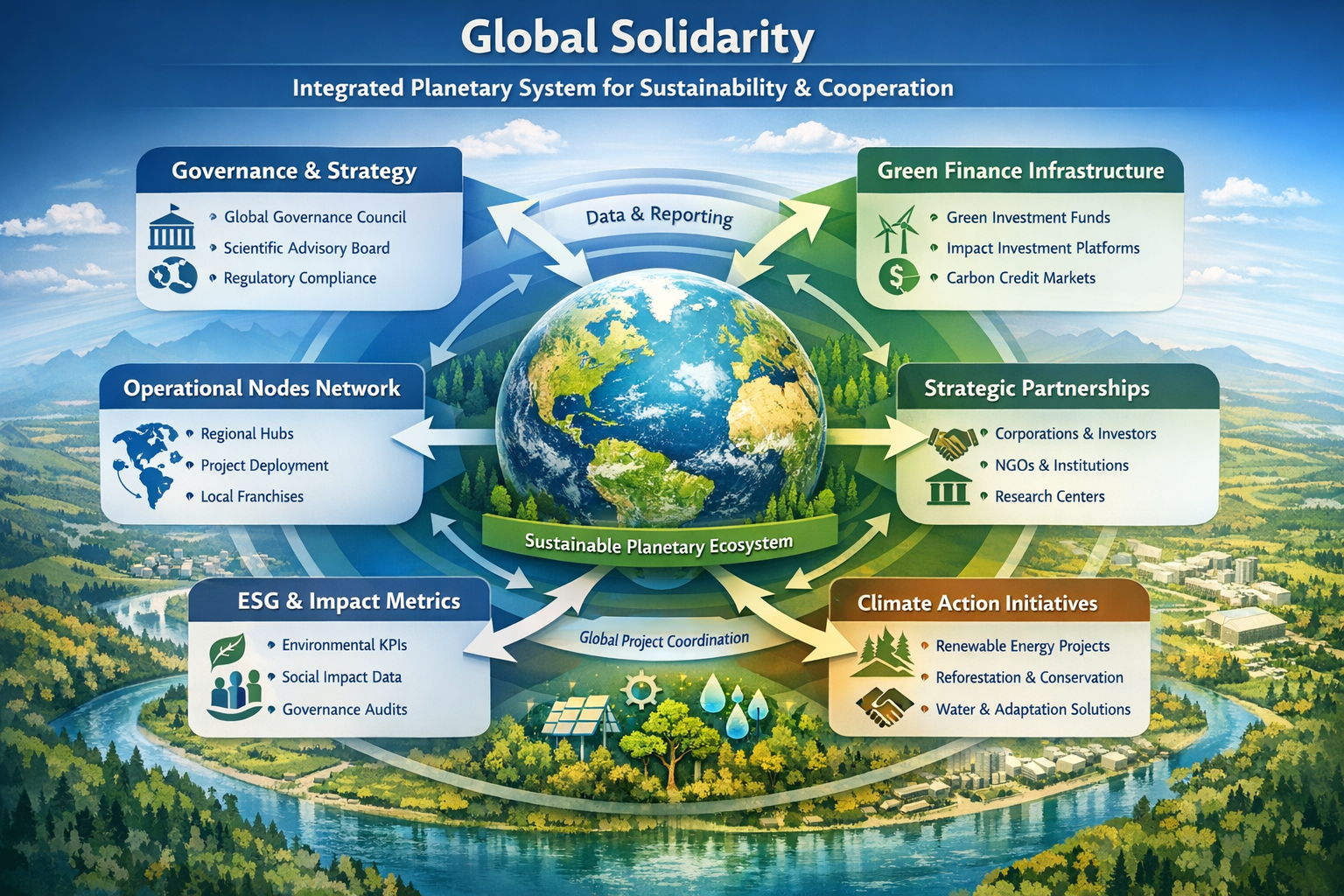
The Global Solidarity Master Framework operates through an interconnected architecture composed of five primary pillars.
3.1 Governance and Institutional Coordination
Effective sustainability transformation requires governance mechanisms capable of operating at global scale while maintaining coordination with local and national institutions.
The governance architecture includes:
• strategic leadership structures
• scientific advisory councils
• multi-stakeholder governance platforms
• transparent decision-making processes
These structures ensure that sustainability initiatives are guided by scientific knowledge, ethical responsibility, and institutional accountability.
3.2 Operational Implementation Network
The practical implementation of sustainability initiatives occurs through a distributed network of Operational Nodes.
Each node functions as a regional hub responsible for:
• identifying sustainability opportunities
• coordinating project development
• mobilizing local partnerships
• facilitating investment flows
This network enables the system to combine global coordination with local execution, ensuring adaptability to regional economic and environmental conditions.
3.3 Green Financial Infrastructure
Large-scale sustainability initiatives require unprecedented capital mobilization.
The framework integrates a financial architecture capable of directing capital toward environmental and social impact projects.
Key financial instruments include:
• green infrastructure investment funds
• impact investment platforms
• sustainability bonds
• environmental fintech systems
These mechanisms allow financial markets to become active participants in sustainability transitions.
3.4 Impact Measurement and ESG Accountability
The framework incorporates a robust Impact Measurement System that evaluates projects according to Environmental, Social, and Governance (ESG) criteria.
Key components include:
• environmental impact indicators
• social development metrics
• governance transparency standards
• planetary sustainability indicators
Through continuous monitoring and reporting, the system ensures that sustainability initiatives generate measurable and verifiable outcomes.
3.5 Strategic Partnership Ecosystem
The success of planetary sustainability initiatives depends on collaboration between diverse institutions.
The Global Solidarity framework therefore establishes a network of strategic partnerships including:
• international organizations
• governmental institutions
• private sector corporations
• financial institutions
• universities and research centers
• civil society organizations
These partnerships create a collaborative environment capable of mobilizing resources, expertise, and technological innovation.
4. Climate Stabilization Mechanisms
Within the framework, climate stabilization is addressed through several strategic mechanisms.
These include:
• rapid expansion of renewable energy systems
• large-scale reforestation and ecosystem restoration
• sustainable water management systems
• climate adaptation infrastructure
• carbon reduction technologies
These initiatives aim to contribute to global climate mitigation goals while strengthening resilience against environmental risks.
5. Economic Transformation Toward Sustainability
The framework promotes a transition from extractive economic models toward regenerative economic systems.
A regenerative economy seeks to:
• restore ecosystems rather than degrade them
• reduce waste through circular production systems
• align investment with sustainability goals
• ensure equitable access to economic opportunities
This transformation is supported by financial innovation, technological development, and global cooperation.
6. Technological Infrastructure for Sustainability
Advanced technologies play a critical role in enabling sustainability initiatives.
Key technological components include:
Artificial Intelligence
AI systems enable analysis of complex environmental data, optimization of resource management, and predictive modeling of climate impacts.
Environmental Monitoring Systems
Satellite monitoring, IoT sensors, and environmental data platforms provide real-time information about ecological conditions and project performance.
Digital Financial Systems
Fintech infrastructure enables transparent and efficient funding mechanisms for sustainability projects, expanding access to global capital markets.
These technologies strengthen the operational capacity of the ecosystem and improve the effectiveness of sustainability initiatives.
7. Risk Governance and Compliance
To ensure integrity and credibility, the framework incorporates robust compliance mechanisms including:
• Anti-Money Laundering (AML) protocols
• Know-Your-Customer (KYC) verification systems
• environmental compliance auditing
• ESG impact verification processes
These mechanisms protect the ecosystem from financial and operational risks while maintaining alignment with international regulatory standards.
8. Operational Deployment Strategy
The framework follows a phased deployment model designed to ensure operational feasibility and institutional credibility.
Phase 1 — Institutional and Technological Infrastructure
Development of governance structures, digital platforms, and financial instruments necessary to support sustainability initiatives.
Phase 2 — Pilot Implementation
Launch of initial operational nodes and pilot sustainability projects to validate economic and environmental performance.
Phase 3 — Global Expansion
Scaling of successful models into additional regions through partnerships, franchise networks, and investment platforms.
Phase 4 — Integrated Planetary Network
Creation of a fully interconnected global system capable of coordinating large-scale sustainability initiatives.
9. Civilizational Transformation Perspective
The Global Solidarity Master Framework recognizes that the challenges facing humanity represent not only environmental issues but also structural transformations in the organization of human civilization.
The framework therefore supports a transition toward a civilization characterized by:
• ecological balance
• technological innovation aligned with sustainability
• global cooperation among nations and institutions
• inclusive economic development
Through coordinated governance, technological innovation, and financial mobilization, humanity can move toward a stable and regenerative planetary civilization.
10. Long-Term Vision
The long-term vision of the Global Solidarity Master Framework is the emergence of an integrated planetary system capable of maintaining ecological stability while supporting human prosperity.
In this vision:
• environmental sustainability becomes a core driver of economic activity
• technological innovation accelerates ecological restoration
• financial systems reward responsible investment
• global cooperation replaces fragmented responses to planetary challenges
By aligning governance, finance, technology, and community participation, the Global Solidarity system seeks to contribute to the development of a resilient, prosperous, and sustainable global civilization.