





International AI-Native Research, Development and Prototyping Network for Human Expansion Across Interorbital and Intersolar Space
Initial Corridor: Argentina · Brazil · Dubai · Tokyo
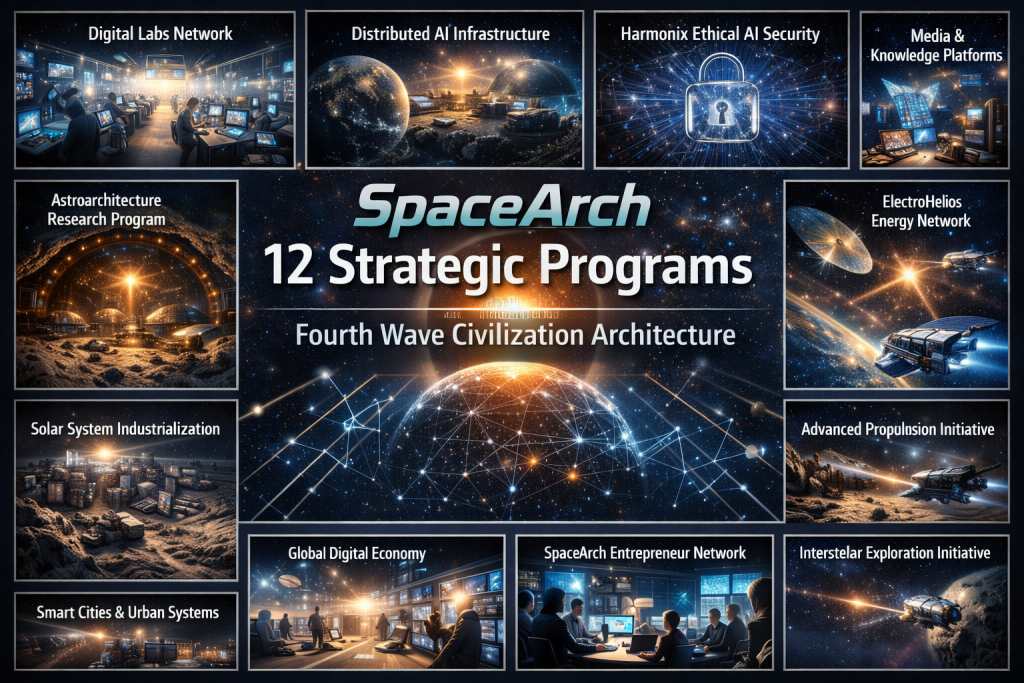
SpaceArch New NASA is beginning the deployment of its first physical Digital Lab cell as the founding node of a future international intermodular research and technology-development network.
The SpaceArch New NASA Digital Labs — SNNDL initiative proposes the creation of a distributed infrastructure capable of connecting researchers, engineers, scientists, Artificial Intelligence developers, universities, manufacturers, startups, technology companies and investors around a shared portfolio of high-complexity projects.
The initial corridor is designed to connect:
Argentina → Brazil → Dubai → Tokyo
as the first territorial architecture of a network that could later incorporate additional nodes across the Americas, Europe, Africa, MENA and Asia.
The objective is not simply to create several connected laboratories.
The objective is to create a distributed international laboratory.
Each Digital Lab operates as a specialized cell, while the entire network functions as a single research organism.
With an operational swarm of 1,000 to 10,000 Digital Labs (DLs) interconnected by agentic AI and coordinated by the ecosystem, the R&D&I equation undergoes an exponential transformation. We’re not talking about an incremental improvement of 20% or 50%, but rather an order-of-magnitude shift in speed and capital efficiency.
Estimated impact on acceleration, research costs, prototyping, and manufacturing:
Research acceleration (100 to 1,000): A design, simulation, adversarial validation, and optimization cycle that takes a traditional industrial structure between 2 and 5 years (physical testing, wind tunnel testing, test bench failures) is compressed into weeks or days. By parallelizing thousands of design variants across the swarm, the time required to find the optimal architecture for a satellite, robot, or vehicle is drastically reduced because combinatorial exploration is performed massively and simultaneously across the network.
Reduction in research and engineering costs ($90% to 98%): Capitalizable man-hours of engineers calculating by hand, iterating CAD drawings linearly, or setting up preliminary physical labs are almost entirely eliminated. The marginal cost of simulating an additional generation of models in the digital environment is virtually zero compared to building physical mock-ups.
Reduction in physical prototyping costs (95% or more): The fundamental advantage of the model is that entire generations of obsolete or failed models are discarded in the virtual domain. In traditional industry, each failed physical prototype costs millions in materials, workshop hours, and logistics. With rigorous filtering by digital twins, the first physical prototype to enter the real-world test bench is typically already a highly mature model (H6/H7), eliminating the graveyard of useless prototypes.
Cost reduction in the manufacture of intermediate models (80% to 90% or direct elimination): “Intermediate models” (test parts, subassemblies, experimental chassis) are no longer manufactured using expensive dies or slow machining processes. By integrating with advanced additive manufacturing and AI-guided robotic cells, only the exact components that passed the swarm stress test are manufactured on demand, optimizing the use of raw materials and energy.
The New Industrial Paradigm
When a network of this scale discards ten thousand faulty variants of a satellite or autonomous vehicle in 72 hours—something that would take a conventional company a decade of physical prototyping to eliminate in laboratories—the cost per unit of useful innovation plummets. The economics of development are no longer penalized by physical error and become governed purely by the speed of logical processing.
The end of the traditional analytical bottleneck: While conventional research centers rely on linear sequencing, paper bureaucracy, and limited human resources, a network of one thousand to ten thousand Digital Labs (DLs) operating with decentralized, local agentic swarms can parallelize experimentation, design, and prototype validation on an unprecedented timescale.
Hierarchical intelligence architecture (Edge and Core): The local AIs of each DL handle hyper-local iteration, physical/virtual trial and error, and real-time code or component optimization, while the central AIs act as a macro synthesizer that processes, cross-references, and distills the discoveries from the entire constellation.
Collapse of the technology development cycle: By synchronizing thousands of autonomous nodes online, a research hypothesis or technology prototype no longer takes years to test; the entire network simulates, breaks, fixes, and evolves it in a matter of hours.
Distributed sovereignty and resilience: By not depending on a single centralized supercomputer but on a constellation of interconnected modular laboratories, the system becomes immune to systemic failures, allowing innovation to flow organically from the periphery to the core and vice versa.
Industrial-scale leap: Digital Labs cease to be mere advanced workstations, becoming the cellular nodes of a research and development superorganism, where the collective intelligence of agentic swarms eliminates the downtime of traditional R&D.
Network-speed prototyping: The ability to simultaneously simulate, iterate, and validate across thousands of distributed nodes means that any technological innovation—from composite materials to propulsion or modular architecture—is designed, tested, and refined instantly through sheer intelligent saturation.
Decentralized technological sovereignty: By interconnecting these DLs with global platforms and GenAcademy programs, an ecosystem is created where the capacity to invent and manufacture is no longer the domain of corporate or state monopolies, becoming an open, modular, and self-governing network.
Exponential compression of the R&D cycle: Technological acceleration is multiplied by a factor of several orders of magnitude, transforming processes that traditionally took decades (such as the development of new materials, drugs, or aerospace systems) into cycles of weeks or months thanks to parallel execution across thousands of nodes.
Network effect in problem-solving: With a constellation of thousands of interconnected Digital Labs, every failure, stress test, or discovery at a local node instantly feeds into the central core, allowing the global network to learn from millions of simultaneous experiments in real time.
Breaking the law of diminishing returns: While centralized science suffers from bureaucratic and linear funding bottlenecks, the distributed agentic swarm model eliminates administrative friction, enabling the technological curve to adopt a near-vertical slope of continuous and sovereign progress.
1. WHAT IS SPACEARCH NEW NASA DIGITAL LABS?
SNNDL — SpaceArch New NASA Digital Labs is a distributed architecture for research, simulation, engineering, prototyping and technological validation, primarily focused on:
- orbital access;
- space infrastructure;
- energy;
- computing;
- telecommunications;
- robotics;
- advanced materials;
- AI-Native manufacturing;
- orbital mobility;
- biotechnology;
- longevity;
- autonomous systems;
- scientific Artificial Intelligence;
- Earth–Moon exploration;
- interplanetary infrastructure;
- enabling technologies for intersolar expansion.
The central concept is to partially replace the traditional paradigm:
Mega Laboratory → Mega Budget → Large Centralized Team → Long Development Cycle
with a different architecture:
**Distributed Digital Labs
- Specialized Human Talent
- Multiple AI Systems
- Simulation
- Digital Twins
- Shared Experimental Infrastructure
- Industrial Partners
- Rapid Prototyping
= Accelerated Distributed R&D**
Digital Labs do not replace specialized physical laboratories.
They complement them.
They allow a substantial portion of the intellectual, mathematical, computational and engineering work to take place before expensive hardware is built.
2. CORE PRINCIPLE: SIMULATE BEFORE BUILDING
The first major reduction in development cost does not necessarily come from manufacturing cheaper components.
It comes from discarding incorrect configurations as early as possible.
SNNDL therefore adopts a progressive development methodology:
Hypothesis
→ Formalization
→ Modeling
→ Simulation
→ Adversarial Analysis
→ Optimization
→ Digital Twin
→ Prototype
→ Physical Testing
→ MVP
→ Independent Validation
→ Industrialization
A hypothesis that fails during simulation costs orders of magnitude less than an infrastructure system that fails after construction.
For this reason, within SNNDL, Artificial Intelligence should not function merely as a writing assistant.
It should operate as a:
scientific and engineering coprocessor.
3. AI-WIFI: A SWARM OF DISTRIBUTED INTELLIGENCE
One of the structural concepts of the program is AI-WIFI.
AI-WIFI should not be understood merely as wireless connectivity.
It represents a conceptual architecture of distributed interoperable intelligence.
Each SNNDL node may contain different AI models, agents, knowledge bases, human specialists, scientific software and experimental capabilities.
The network allows these resources to work collectively.
A problem initiated in Argentina could be:
modeled in Brazil,
submitted to advanced simulation in Dubai,
industrially optimized with specialists in Tokyo,
and then experimentally tested again at the original laboratory.
The laboratory no longer coincides with a building.
The laboratory becomes the entire network.
4. INTERMODULAR ARCHITECTURE
Each Digital Lab can specialize in different modules.
For example:
DL-A — Aerospace Systems
Orbital access, vehicles, aerodynamics and orbital dynamics.
DL-B — Energy Systems
Orbital photovoltaics, energy storage, energy transfer and geothermal systems.
DL-C — AI & Simulation
Scientific models, digital twins, optimization and multiparametric simulation.
DL-D — Robotics
Orbital robots, autonomous assembly and remote maintenance.
DL-E — Advanced Materials
Membranes, composites, inflatable structures, thermal protection and radiation shielding.
DL-F — Computational Infrastructure
Micro data centers, orbital edge computing and Earth–Orbit–Moon communications.
DL-G — Biotechnology
RetroAge, computational biology, bioinformatics and regenerative systems.
DL-H — Industrialization
Design for manufacturing, BigFabs, robotic production and cost analysis.
Projects can move through several laboratories simultaneously.
This is precisely the difference between a distributed system and a traditional isolated laboratory.
5. ARGENTINA–BRAZIL–DUBAI–TOKYO CORRIDOR
The first international corridor can be structured as a complementary chain of capabilities.
ARGENTINA
Initial node for conceptual development, engineering, software, AI-Native research, prototyping, systems architecture and talent development.
It can operate as an entry point for new technological hypotheses and MVPs.
BRAZIL
A strategic connection with one of Latin America’s largest industrial, scientific, aerospace, energy and manufacturing ecosystems.
Brazil can contribute industrial scale, engineering capabilities and access to regional production chains.
DUBAI
A potential node for business coordination, investment, international infrastructure, technology projects and MENA–Asia–Europe connectivity.
TOKYO / JAPAN
A high-value node for robotics, electronics, advanced materials, precision engineering, automation, manufacturing and technological cooperation.
The combination is intended to generate complementarity.
The objective is not for every Digital Lab to do the same thing.
The objective is for each node to contribute what it does best.
6. DEVELOPMENT PRINCIPLE
The SNNDL model can be summarized as:
Low Cost
× Distributed Intelligence
× Artificial Intelligence
× Simulation
× Modular Engineering
× International Collaboration
× Rapid Experimental Validation
= High-Acceleration R&D
The Low Cost / High Impact concept does not mean lowering technical standards.
It means concentrating capital on the areas that truly require physical infrastructure while moving everything else into the digital domain whenever possible.
7. INITIAL PROGRAM PORTFOLIO
The first projects intentionally form a highly transversal portfolio.
They do not all share the same Technology Readiness Level.
Some are conceptual architectures.
Others may move directly into advanced simulation.
Some require fundamental research.
Others may reach MVP stage relatively quickly.
SNNDL will establish a specific TRL — Technology Readiness Level for each subsystem.
PROGRAM I
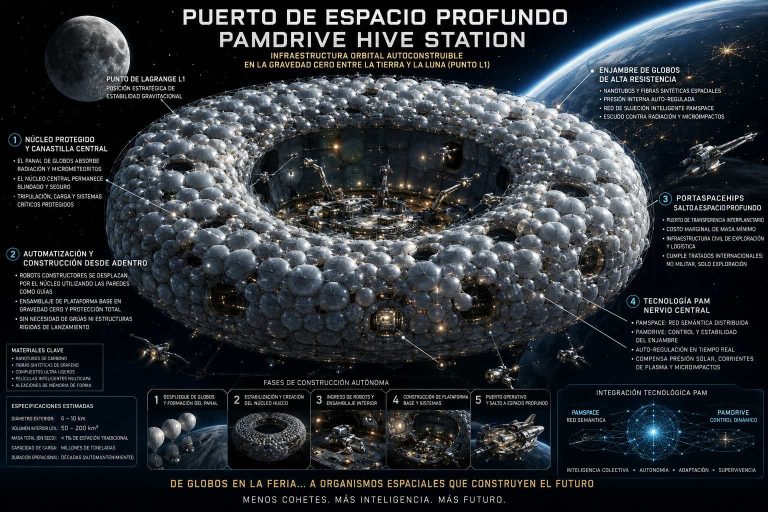
PAM ORBITAL HIVE
Self-Constructing Germinal Orbital Architecture
PAM Orbital Hive explores a fundamental idea:
rather than transporting an entire finished infrastructure into space, transport the minimum system capable of beginning to manufacture infrastructure in space.
The architecture begins with an initial orbital enclosure within which robots and autonomous systems could progressively:
- assemble structures;
- deploy modules;
- install energy systems;
- manufacture components;
- repair facilities;
- produce new units;
- expand the infrastructure itself.
The principle can be summarized as:
Seed Infrastructure → Robotic Construction → Orbital Factory → Expanded Infrastructure
The strategic transition is therefore from:
Space Station
toward:
Orbital Manufacturing Organism.
SNNDL Research Line
The Digital Lab should study:
- minimum initial mass;
- deployable structures;
- robotic architecture;
- orbital manufacturing;
- material logistics;
- autonomy;
- redundancy;
- repair systems;
- power generation;
- communications;
- modular growth;
- fault control.
PAM Orbital Hive represents a potential shift from infrastructure that is merely transported into orbit toward infrastructure that can progressively expand itself there.
PROGRAM II
ULTRALIGHT HYBRID ORBITAL ACCESS SYSTEM
One of the largest constraints on any orbital economy remains the transportation of mass from Earth’s surface.
SpaceArch proposes investigating a hybrid architecture designed to transfer part of the energy burden from the vehicle itself to reusable ground infrastructure.
The concept combines:
- ground-based electromagnetic acceleration;
- a low-pressure launch conduit;
- an ultralight capsule or vehicle;
- a terminal micro-propulsion stage;
- minimal orbital payload;
- programmed deorbiting.
An essential technical distinction must remain clear.
The ground infrastructure does not completely replace orbital propulsion.
A terminal propulsion stage would still need to supply the additional velocity required for orbital insertion and circularization.
The hypothesis is therefore not:
“eliminate the rocket.”
It is:
transfer an increasing fraction of the heavy infrastructure, energy requirements and launch complexity to reusable ground-based systems.
Critical SNNDL research parameters would include:
- tolerable acceleration;
- exit velocity;
- accelerator length;
- heat transfer;
- structural dynamics;
- atmospheric trajectory;
- terminal propulsion;
- useful payload mass;
- launch cost;
- reuse frequency;
- cost per kilogram delivered to orbit;
- safety;
- environmental impact;
- regulatory compatibility.
The program should ultimately be evaluated through measurable engineering, economic, sustainability and operational performance indicators.
PROGRAM III
SPACEARCH SUPERTECHNOLOGY TYPE 7
The SpaceArch Supertechnology Type 7 category can operate within SNNDL as a framework for frontier technologies whose scientific or technological maturity remains insufficient for classification as conventional engineering systems.
A methodological distinction is essential.
A Supertechnology should not be defined merely because it is extraordinary.
It should be defined because:
- if validated, it would produce a radical change in technological capability;
- it integrates phenomena or technologies not yet available at industrial scale;
- it requires fundamental research;
- it must remain explicitly classified as a hypothesis until reproducible experimental validation exists.
SNNDL should therefore apply an especially rigorous protocol to this category:
Extraordinary Hypothesis
→ Mathematical Formalization
→ Compatibility with Established Physics
→ Differentiating Predictions
→ Falsifiability
→ Simulation
→ Critical Experiment
→ Independent Replication
The Type 7 designation can therefore serve as an internal classification for advanced exploratory research rather than as a declaration that the technology already exists operationally.
PROGRAM IV
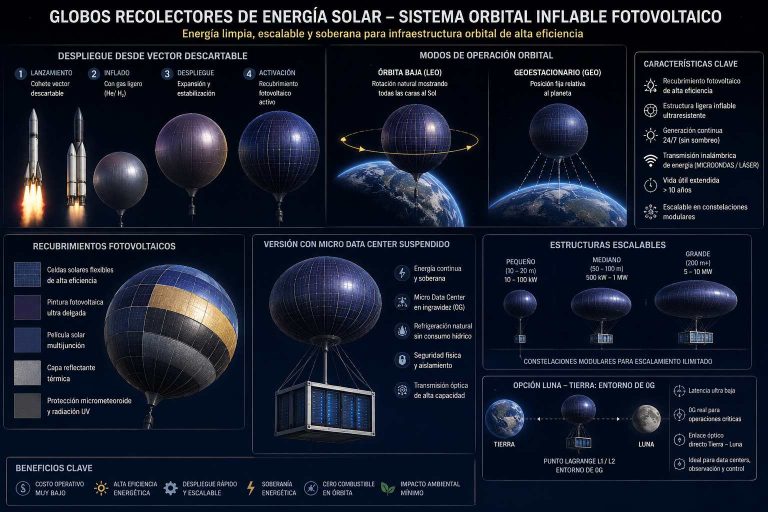
ORBITAL PHOTOVOLTAIC INFRASTRUCTURE & MICRO DATA CENTERS
Inflatable Earth–Orbit–Moon Photovoltaic Infrastructure
This program investigates orbital systems with very low mass and very large deployable surface area.
The concept integrates:
- inflatable space membranes;
- flexible photovoltaic films;
- orbital power generation;
- micro data centers;
- Artificial Intelligence servers;
- optical communications;
- RF communications;
- future Earth–Moon connectivity;
- robotic maintenance.
The central engineering logic is to modify one of the most important variables in orbital economics:
maximize functional surface area per kilogram launched.
The basic unit can be conceived as:
Technology Core + Folded Membrane + Electronics
which, after launch, transforms into a significantly larger operational infrastructure.
This could allow future platforms to provide:
Energy-as-a-Service
Compute-as-a-Service
Communications-as-a-Service
through modular orbital infrastructure.
The engineering challenges are substantial:
- radiation;
- micrometeoroids;
- structural stability;
- photovoltaic degradation;
- thermal dissipation;
- orbital control;
- energy storage;
- maintenance;
- data transmission;
- membrane lifetime;
- operational safety.
Every one of these variables must ultimately be experimentally validated.
PROGRAM V
M-777 S5K / SOLAR LAGRANGE
High-Frequency Orbital Energy and Logistics Infrastructure Network
M-777 represents a higher level of system integration.
While other projects investigate individual components, M-777 explores how these components could evolve into a complete orbital logistics network.
The architecture conceptually integrates:
- orbital nodes;
- photovoltaic generation;
- logistics stations;
- connectivity;
- energy transfer;
- spacecraft and satellite servicing;
- future multifilament transportation systems;
- Earth–Orbit–Moon infrastructure.
Within SNNDL, this architecture should be divided into multiple independent validation programs.
Areas requiring especially rigorous research include:
structural materials;
orbital dynamics;
wireless energy transmission;
thermal control;
propulsion;
automation;
maintenance;
operational economics.
Claims regarding future efficiency, losses, service lifetime or economic costs must remain research targets until supported by corresponding experimental evidence.
PROGRAM VI
SPACEARCH RETROAGE
Computational Regenerative Biology and Digital Labs
SNNDL does not limit human expansion to transportation systems.
A civilization seeking to operate for increasingly long periods beyond Earth must improve its understanding of:
- longevity;
- regeneration;
- radiation;
- metabolism;
- cellular deterioration;
- neurophysiology;
- human adaptation to extreme environments.
SpaceArch RetroAge proposes using a digital-first architecture to investigate aging and regeneration through:
- multi-omics models;
- digital twins;
- biological simulation;
- biomarkers;
- predictive analysis;
- biomimetic environments;
- neurophysiology;
- safety layers against abnormal cellular proliferation.
The concept is to move a large part of the initial investigative work from major biomedical infrastructure into computational Digital Labs and simulation before advancing toward higher-cost experimental phases.
RetroAge must operate under especially strict scientific standards.
Every hypothesis must ultimately undergo:
**bioethics
- experimental evidence
- reproducibility
- independent validation
- clinical regulation**
before any application involving humans.
PROGRAM VII
SONARDRILL
Deep Drilling Research and Next-Generation Geothermal Energy
SonarDrill introduces another strategic dimension.
Before humanity can build a large-scale space civilization, it needs terrestrial energy systems capable of supporting an increasingly electrified economy.
Deep geothermal energy has a particularly important property:
it can provide continuous power generation without directly depending on solar radiation or wind conditions.
Within SNNDL, SonarDrill can be structured as a research program covering:
- geological characterization;
- geophysics;
- acoustic propagation;
- drilling;
- controlled fracture;
- erosion;
- materials;
- temperature;
- pressure;
- sensors;
- AI-assisted drilling;
- subsurface digital twins;
- predictive maintenance;
- cost per meter drilled.
The final objective should not simply be defined as:
“drill deeper.”
It should be defined as:
radically reduce the economic, energy and time costs required to safely and controllably access deep thermal reservoirs.
8. THE PROJECTS AS AN INTEGRATED SYSTEM
The full conceptual power of this portfolio becomes clearer when the interdependencies are examined.
SonarDrill
can contribute abundant terrestrial energy.
↓
Ultralight Hybrid Orbital Access System
investigates lower-cost transportation of small payloads into orbit.
↓
Orbital Photovoltaic Platforms
create energy and computational infrastructure in orbit.
↓
M-777
attempts to transform isolated assets into an integrated energy and logistics network.
↓
PAM Orbital Hive
investigates how infrastructure could be manufactured and expanded directly beyond Earth.
↓
RetroAge
investigates the biological dimension necessary to extend human operational capability and duration.
SpaceArch New NASA is therefore not asking only:
“How do we travel into space?”
It is asking a much larger question:
How do we build a progressively self-sustaining infrastructure capable of supporting permanent human presence between Earth, the Moon and eventually the wider Solar System?
9. DIGITAL LABS AS AN R&D COST-REDUCTION ENGINE
The traditional innovation model may require:
**large installations
- large teams
- expensive equipment
- long organizational cycles.**
SNNDL proposes reversing the sequence.
First:
Intelligence.
Then:
Simulation.
Then:
Selection.
Then:
Prototype.
Finally:
Physical Infrastructure.
This allows financial resources to be concentrated on the hypotheses that survive the previous stages.
10. AI-NATIVE SCIENTIFIC ENGINEERING
SNNDL is designed from its inception as an AI-Native system.
Researchers may use multiple specialized Artificial Intelligence systems for:
- scientific search;
- literature review;
- mathematical calculation;
- programming;
- modeling;
- generative CAD;
- structural analysis;
- CFD;
- thermal simulation;
- electromagnetic simulation;
- orbital dynamics;
- optimization;
- materials analysis;
- hypothesis generation;
- adversarial testing;
- documentation;
- experimental management.
Artificial Intelligence does not replace experimental validation.
It accelerates it.
11. HUMAN + AI HYBRID RESEARCH
The operational principle is:
Human
provides:
- purpose;
- intuition;
- creativity;
- context;
- ethics;
- priorities;
- interpretation.
Artificial Intelligence
provides:
- speed;
- externalized memory;
- computation;
- comparison;
- combinatorial exploration;
- simulation;
- pattern detection.
Instrumentation
provides:
- physical reality.
The combination:
Human Intelligence
× Artificial Intelligence
× Experimental Reality
forms the methodological core of SNNDL.
12. VALIDATION PROTOCOL
To prevent frontier research from becoming unlimited speculation, each project should be classified according to its maturity.
H0 — Concept
Preliminary idea.
H1 — Formalized Hypothesis
Variables and mechanisms identified.
H2 — Scientific Compatibility
Analysis against established scientific knowledge.
H3 — Mathematical Model
Equations, restrictions and parameters defined.
H4 — Simulation
Computational testing.
H5 — Digital Twin
Dynamic representation of the system.
H6 — Prototype
Partial physical validation.
H7 — MVP
Minimum operational system.
H8 — Demonstrator
Reproducible operation under relevant conditions.
H9 — Industrial System
Mature and scalable technology.
This system makes it possible to work with extremely ambitious technologies while preserving epistemological rigor.
13. SWARM DEVELOPMENT
Each complex problem can be divided into hundreds of smaller research problems.
For example:
Orbital Hive
can be decomposed into:
materials
→ membranes
→ robotics
→ energy
→ communications
→ assembly
→ thermal control
→ software
→ manufacturing
→ repair
→ navigation.
Each module can be assigned to:
**one Digital Lab
- one human team
- one or multiple AI agents.**
The results are then returned to the integrated system.
In this way:
a megaproject stops being a monolithic problem.
It becomes:
a network of smaller problems that can be solved in parallel.
14. DISTRIBUTED INTELLECTUAL PROPERTY
Corporate cooperation requires clear rules.
SNNDL can implement a modular IP framework:
Background IP
Technology each participant owned before entering the program.
Project IP
Technology developed during a specific project.
Joint IP
Technology developed collaboratively.
Platform IP
Cross-program infrastructure owned by the SNNDL ecosystem.
Contracts should define in advance:
- ownership;
- licenses;
- royalties;
- exclusivity;
- territories;
- patents;
- scientific publication;
- industrial secrecy;
- economic participation.
This allows cooperation without forcing any company to surrender its pre-existing technological assets.
15. CORPORATE PARTICIPATION MODEL
SpaceArch New NASA invites:
- aerospace companies;
- technology companies;
- energy companies;
- manufacturers;
- construction companies;
- advanced materials companies;
- robotics companies;
- telecommunications companies;
- cloud computing providers;
- semiconductor companies;
- biotechnology companies;
- engineering firms;
- universities;
- scientific centers;
- technology funds;
- venture capital firms;
- family offices;
- startups;
- independent researchers.
Organizations may participate through different modalities:
Research Partner
Scientific participation.
Technology Partner
Hardware, software or know-how contribution.
Industrial Partner
Prototyping and manufacturing.
Infrastructure Partner
Laboratories, computing resources and facilities.
AI Partner
Models, agents and computational capacity.
Investment Partner
Funding of programs or spin-offs.
University Partner
Research, education and validation.
Experimental Partner
Specialized testing.
16. FROM PROJECT TO STARTUP
An SNNDL result does not necessarily need to remain inside a single organization.
Once a technology reaches sufficient maturity, it may evolve into:
a patent;
a license;
a joint venture;
a spin-off;
a startup;
an industrial product;
an international infrastructure project.
Thus:
Research
becomes:
Innovation
and then:
Industry.
17. FROM DIGITAL LABS TO BIGFABS
The natural evolution of the system would be:
PHASE 1
DIGITAL LAB
Ideas, calculation and simulation.
PHASE 2
PHYSICAL LAB
Experimentation.
PHASE 3
PROTOTYPE CELL
Prototyping.
PHASE 4
PILOT FACTORY
Initial manufacturing.
PHASE 5
BIGFAB
Large-scale AI-Native robotic manufacturing.
The Digital Lab generates knowledge.
The BigFab transforms that knowledge into infrastructure.
18. STRATEGIC OBJECTIVE
SpaceArch New NASA begins from one premise:
the next space revolution will not depend only on building larger rockets.
It will depend on simultaneously reducing:
mass
cost
complexity
development time
dependence on centralized infrastructure
while increasing:
automation
modularity
reusability
distributed intelligence
international cooperation
manufacturing capacity.
19. FROM A MISSION INDUSTRY TO AN INFRASTRUCTURE INDUSTRY
The first space age was dominated by missions.
The next may be dominated by infrastructure.
Not only:
launching a satellite.
But building:
- energy networks;
- computing centers;
- communications systems;
- depots;
- logistics platforms;
- robotic stations;
- manufacturing systems;
- habitats;
- orbital industries.
The fundamental transition would be:
Space Missions
↓
Permanent Space Infrastructure
↓
Orbital Economy
↓
Earth–Moon Economy
↓
Solar Economy
20. SPACEARCH NEW NASA DIGITAL LABS
SNNDL proposes becoming the research infrastructure supporting this transition.
It does not claim that all of its hypotheses have already been solved.
It proposes building an organization capable of determining:
which ones work,
which ones must be modified,
which ones must be discarded,
and which ones can become real technologies.
This distinction is fundamental.
Scientific innovation does not consist of defending every idea.
It consists of generating many hypotheses and building a sufficiently rigorous system to discover which ones survive contact with reality.
INTERNATIONAL INVITATION
JOIN SPACEARCH NEW NASA DIGITAL LABS
SpaceArch New NASA invites companies, universities, researchers, scientists, engineers, programmers, manufacturers, investors and technology organizations to participate in the deployment of the SpaceArch New NASA Digital Labs Network — SNNDL.
The first intermodular network begins its development through the corridor:
ARGENTINA
BRAZIL
DUBAI
TOKYO
with the objective of progressively expanding the architecture into an international constellation of specialized Digital Labs.
Participating organizations may join existing projects, contribute technologies, propose new challenges, finance specific programs, develop prototypes or establish new joint initiatives.
We are not simply creating another laboratory.
We are exploring a new way to organize high-complexity technological research:
distribute the laboratory,
connect the talent,
multiply intelligence through AI,
simulate before manufacturing,
validate before scaling,
manufacture only what survives the test.
SPACEARCH NEW NASA DIGITAL LABS
Global Intelligence.
Distributed Research.
AI-Native Engineering.
Physical Validation.
Orbital Infrastructure.
From a network of small laboratories to the infrastructure of a solar civilization.
SpaceArch New NASA
Argentina · Brazil · Dubai · Tokyo
Research → Simulation → Prototype → Validation → Industry → Space Infrastructure