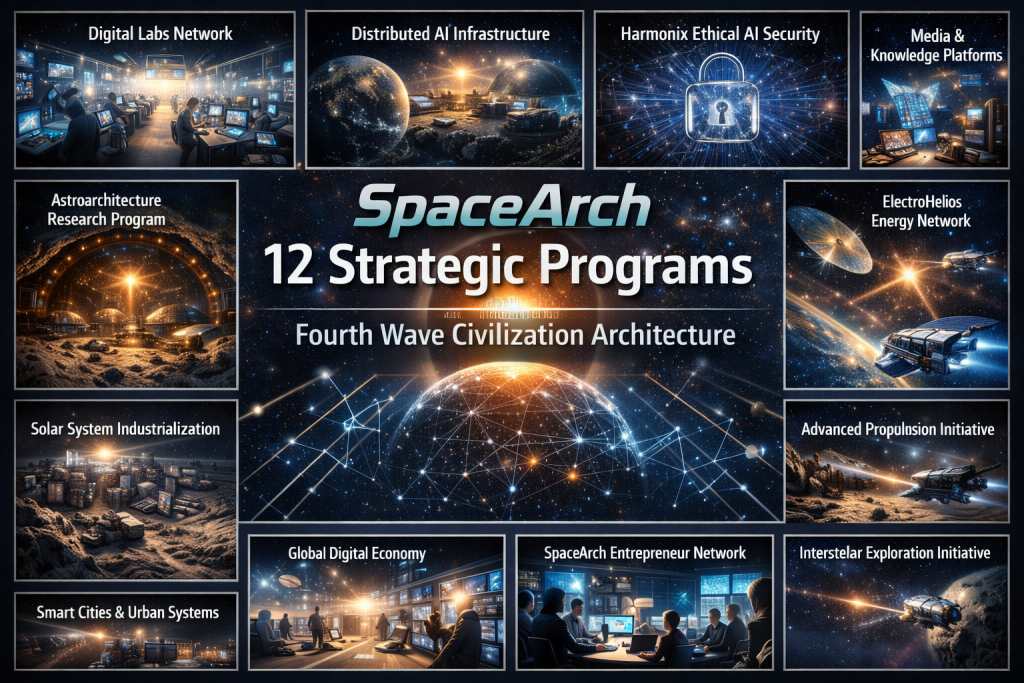





SpaceArch New NASA is designed as an open global platform for collaboration.
We do not seek to replace existing space agencies, aerospace companies, universities or research institutions. Our objective is to complement them, connect them and help reduce the cost, duplication and fragmentation that currently slow down technological progress.
The next era of space development will not be achieved by one country, one company or one agency acting alone. It will emerge from a new model of distributed cooperation in which governments, private investors, engineers, AI systems, Digital Labs and space organizations work as a coordinated network.
Why Investors Matter
The future space economy will not be built only through large centralized programs. It will also be built through thousands of smaller, lower-cost, faster-moving innovation nodes connected globally.
This is the logic behind SpaceArch New NASA:
- Distributed Digital Labs
- Shared engineering resources
- AI-assisted R&D
- Collective global intelligence
- Modular, scalable projects
- Strategic partnerships across regions
Instead of concentrating billions into a few isolated structures, we seek to create a network capable of multiplying innovation with far lower cost and much higher speed.
For investors, this creates a new kind of opportunity:
- Participation in future-tech ecosystems
- Access to scalable intellectual property
- Entry into aerospace, AI and advanced infrastructure markets
- Exposure to hundreds of future-oriented projects rather than a single isolated venture
The long-term objective is to create a portfolio of interconnected megaprojects capable of generating both economic return and civilizational impact.
The Digital Labs Model
The operational base of SpaceArch New NASA is the creation of globally distributed Digital Labs.
Each Digital Lab is a compact innovation node capable of functioning as:
- Research and development center
- AI-assisted engineering studio
- Space systems simulation unit
- Future technologies laboratory
- Local accelerator for talent and startups
- Collaborative workspace for international programs
Each node can be created with relatively low cost compared to traditional aerospace infrastructure.
A typical Digital Lab may include:
- 20–30 m² facility
- Immersive screens and visualization systems
- Local micro data center
- AI systems and engineering software
- 6–8 specialists connected to the global network
- Cloud-based collaboration with other labs worldwide
This makes it possible to deploy hundreds or thousands of units across strategic regions, especially in PanAfrica, PanMENA and PanLATAM.
A New Layer for Global Space Development
SpaceArch New NASA proposes an additional collaborative layer for the existing global aerospace ecosystem.
This means offering software, simulation environments, AI tools, Digital Labs and distributed support systems to organizations such as:
- NASA
- European Space Agency
- Japan Aerospace Exploration Agency
- Indian Space Research Organisation
- China National Space Administration
- United Arab Emirates Space Agency
- African Space Agency
- SpaceX
- Blue Origin
- Rocket Lab
- Northrop Grumman
- Lockheed Martin
- Airbus
Our proposal is simple:
👉 Instead of each organization developing every tool independently, SpaceArch New NASA can provide a shared layer of software, Digital Labs, distributed engineering teams and AI-assisted systems.
This could reduce:
- Development costs
- Time to prototype
- Repetition of identical research
- Dependence on centralized infrastructure
- Delays caused by isolated workflows
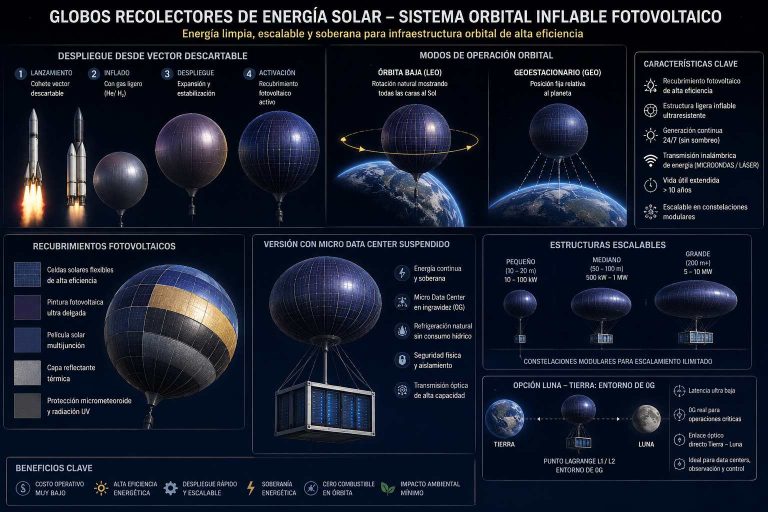
HeliArms: Distributed Orbital Energy for Space Expansion
One of the long-term strategic programs within New NASA is the concept of HeliArms.
HeliArms is conceived as a future distributed network of orbital solar energy systems capable of:
- Capturing solar energy in space
- Transmitting it to Earth or orbital platforms
- Powering Digital Labs, research nodes and future infrastructure
- Supporting future space missions without relying exclusively on terrestrial energy systems
In the long term, HeliArms could become part of the energy backbone required for:
- Space elevators
- Orbital manufacturing
- Lunar and Martian logistics
- Interplanetary transport systems
- Deep-space missions
By combining HeliArms with Digital Labs and AI-assisted engineering, SpaceArch New NASA seeks to create a complete ecosystem:
- Intelligence
- Energy
- Infrastructure
- Execution
Software as Strategic Infrastructure
SpaceArch New NASA also intends to become a global software support layer for the space sector.
This includes:
- Simulation systems
- AI engineering assistants
- XR and immersive control environments
- Digital twins
- Modular cloud platforms
- Distributed R&D management systems
- Shared knowledge databases
- Operational coordination between countries and institutions
The objective is not only to build technology, but to make global collaboration easier.
Today, many agencies and companies still operate through separated systems, different standards and limited interoperability.
SpaceArch New NASA seeks to create a common operational language for future collaboration.
Why Partnership Is Essential
No single organization can lead the expansion of the species alone.
The path toward the Solar System and, eventually, the stars will require:
- Governments
- Universities
- Space agencies
- Investors
- Entrepreneurs
- Engineers
- AI systems
- Millions of trained people
That is why SpaceArch New NASA is structured as a partnership platform rather than as a closed organization.
We are open to:
- Strategic investors
- Universities and research centers
- Aerospace companies
- AI and software companies
- Public-private partnerships
- Space agencies and innovation ministries
- Local partners interested in creating Digital Labs
Investor Opportunities
Potential areas for participation include:
- Digital Labs franchises and regional networks
- AI software for space and engineering
- Distributed R&D ecosystems
- Space infrastructure concepts
- Advanced materials and energy systems
- XR and future control environments
- The 300 SpaceArch megaprojects portfolio
The model allows investors to participate in multiple levels:
- Local Digital Lab
- Regional network
- Technology vertical
- International platform
- Strategic co-development of future programs
Our Long-Term Vision
We believe that the expansion of humanity into the Solar System and beyond should not be fragmented by national competition alone.
The next stage of civilization requires a more cooperative model in which the technological capacity of the entire planet can be organized as one distributed intelligence.
SpaceArch New NASA seeks to help create that framework.
Our objective is not only to support the next generation of space projects.
It is to help unify the effort of the species itself.
Closing Statement
We do not see investors and partners only as financiers.
We see them as co-builders of the first globally coordinated architecture for humanity’s expansion toward the stars.