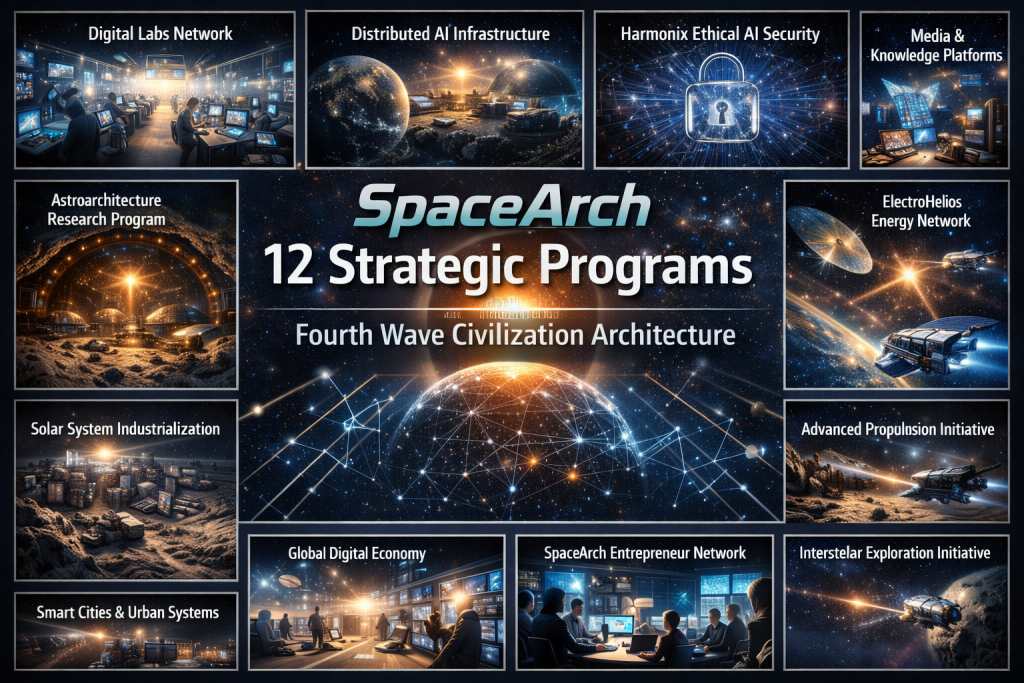






SpaceArch New NASA exists to help humanity evolve from a fragmented planetary civilization into an organized solar and, eventually, interstellar civilization.
Our long-term horizon is clear: to contribute, step by step, to the technological, organizational and cognitive pathway that one day allows humanity to place its first operational footprint beyond the Solar System, with Alpha Centauri B as a symbolic and strategic destination.
This is not approached as fantasy, nor as an isolated aerospace dream. It is approached as a civilizational engineering process. Before humanity can travel farther, it must learn to think farther, coordinate better, innovate faster and build systems capable of sustaining exponential progress across generations. For that reason, SpaceArch New NASA is not limited to rockets, hardware or orbital projects. Its mission is broader: to organize the intelligence, infrastructure, training and global cooperation required for the next stage of human expansion.
A Mission Built in Stages
We believe interstellar ambition must be built on practical foundations. The path to deep space begins on Earth, through systems that improve how we learn, design, test, produce and scale advanced technologies.
That is why New NASA is structured as a progressive mission:
Stage 1: Organize intelligence on Earth
Build the human, educational, digital and operational base required for large-scale innovation. This includes Digital Labs, AI-assisted research, global collaboration networks, training systems, hybrid teams and distributed innovation nodes.
Stage 2: Accelerate applied R&D+i
Reduce technological development times by combining collective intelligence, AI, immersive environments, local micro-infrastructure and coordinated international execution. Innovation must stop being slow, isolated and expensive.
Stage 3: Create a global innovation lattice
Connect strategic regions such as PanAfrica, PanMENA and PanLATAM into one Fifth Wave ecosystem capable of generating talent, startups, scientific capacity, engineering solutions and long-term technological momentum.
Stage 4: Develop the infrastructure of expansion
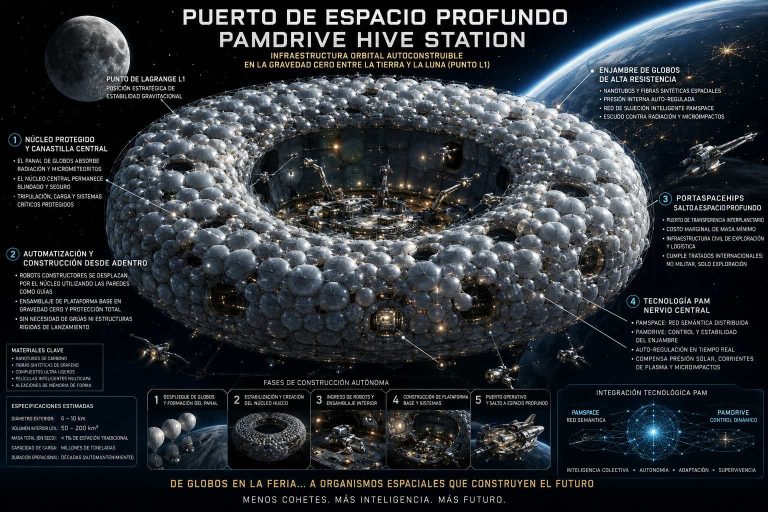
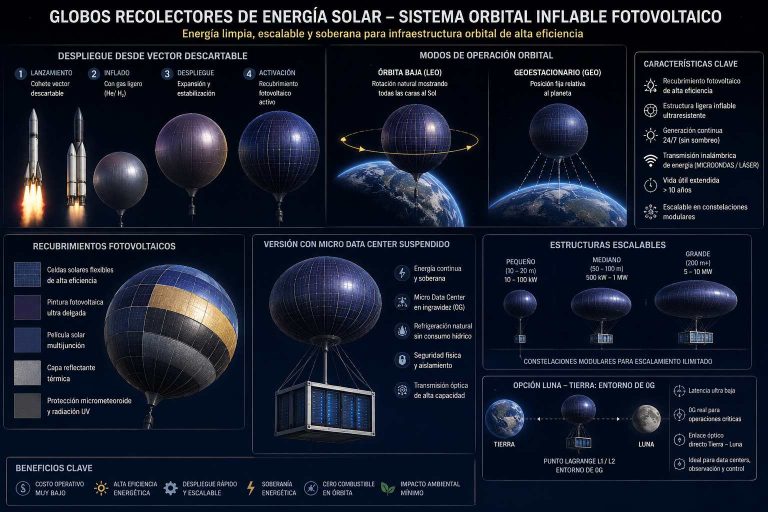
Advance toward new models of orbital systems, smart logistics, space engineering, hybrid habitats, energy systems, advanced materials, XR control environments, robotics and future aerospace architectures.
Stage 5: Prepare the species for the next frontier
Once humanity learns to operate as a more coordinated intelligence, it can move from surviving on one planet to expanding across the Solar System and, in the long run, preparing for interstellar missions.
Why New NASA Exists
Humanity does not lack intelligence. It lacks organization at scale.
Scientific knowledge exists. Engineering talent exists. Artificial intelligence exists. Global communication exists. What is still missing is a system capable of integrating all of these into an operational architecture with continuity, direction and civilizational purpose.
SpaceArch New NASA was conceived to help fill that gap.
Its mission is to create a bridge between:
- education and execution
- intelligence and infrastructure
- local talent and global systems
- present needs and future frontiers
- Earth-based development and space expansion
In this sense, New NASA is both an innovation platform and a mission architecture. It is designed to convert dispersed talent into coordinated capability.
Earth First, Then Beyond
Our mission begins with Earth because no civilization can expand sustainably into space while remaining disorganized, unequal, technologically fragmented and strategically short-sighted at home.
For that reason, New NASA supports the development of:
- globally distributed Digital Labs
- low-cost, high-impact R&D+i systems
- AI-powered engineering and innovation workflows
- hybrid human + AI teams
- advanced educational pipelines
- smart cities and future-ready operational hubs
- international innovation corridors across emerging regions
This is not separate from the space mission. It is the foundation of the space mission.
Every Digital Lab, every trained operator, every node activated, every system prototyped and every collaboration network built is part of the deeper objective: increasing the species’ capacity to solve harder problems, faster.
Our Operational Philosophy
SpaceArch New NASA works from a simple principle:
The future will not be built only by launching machines. It will be built by organizing intelligence.
That means our mission is not limited to aerospace hardware. It includes the creation of a new operational culture where humans and AI work together as a scalable cognitive force.
We believe the next great leap in civilization will emerge from the convergence of:
- collective intelligence
- distributed infrastructure
- artificial intelligence
- advanced education
- modular innovation systems
- long-range strategic vision
This is why New NASA places such importance on Digital Labs as its operational base. They are not just facilities. They are intelligence amplifiers: compact nodes where scientists, engineers, programmers, designers, strategists and AI systems can work in synchronized environments to accelerate development cycles.
From Planetary Civilization to Interstellar Mindset
To think seriously about Alpha Centauri B is to adopt a new scale of mission.
It means moving beyond short-term thinking. Beyond isolated startups. Beyond national fragmentation. Beyond the idea that space is only a sector. Space is the next macro-environment of civilization, and the preparation for it begins now.
Alpha Centauri B represents more than a destination. It represents a new level of species consciousness:
- the decision to stop thinking only in local terms
- the discipline to build systems that outlast one generation
- the courage to design for centuries, not quarters
- the will to transform intelligence into trajectory
New NASA embraces that horizon while remaining grounded in step-by-step execution.
What We Seek to Build
Our mission is to help create the conditions for:
- faster technological evolution
- globally distributed innovation capacity
- reduced R&D timelines
- stronger integration between AI and human expertise
- strategic expansion of high-value knowledge networks
- scalable space and future-tech ecosystems
- a civilization capable of operating first at planetary scale, then solar scale, and eventually interstellar scale
Mission Statement
SpaceArch New NASA is building the distributed intelligence, advanced innovation systems and global operational architecture required to help humanity evolve from a planetary civilization into a solar and future interstellar civilization — step by step, beginning on Earth, accelerating through Digital Labs, and aiming ultimately toward the frontier represented by Alpha Centauri B.
Closing Line for the Menu Page
We do not begin by reaching Alpha Centauri B.
We begin by becoming the kind of civilization capable of reaching it.