




Investor Brief – 2026–2027
“From Anti-Aging to the Operating System of Biological Regeneration.”
“We are not asking for billions to defeat aging. We are asking for the chance to prove that there may be a smarter way.”
“No single company will solve aging alone. That is why RetroAge is designed as a global collaborative ecosystem.”
“A relatively small initial investment can activate a global collaborative network in one of the largest markets on Earth.”
“RetroAge is not trying to make an 80-year-old become 20 again overnight.
It is trying to progressively slow aging, extend healthy life beyond 100, then 150 and eventually 200 years.
Once that know-how exists, we may finally have the key to safe cellular regeneration without oncogenic risk.”
“RetroAge explores aging as the progressive degradation of the body’s bioinformational coordination system. Digital Labs, AI and digital twins provide the hard infrastructure; bioelectrical signaling, neurophysiology and organic informational fields provide the soft layer to be understood and restored.”
SpaceArch AntiAge is not conceived as another traditional longevity biotech company focused on a single drug, biomarker or isolated therapy. The core thesis is that aging is a systemic phenomenon: multiple biological, neurological, immune and epigenetic layers lose coordination simultaneously.
Most anti-aging investments over the last 15 years have tried to solve the problem through one isolated component:
- eliminating senescent cells
- partially reprogramming genes
- targeting a single organ
- pursuing a “miracle molecule”
The result has been enormous capital expenditure, but only limited, fragmented or difficult-to-scale progress.
SpaceArch AntiAge proposes a different logic:
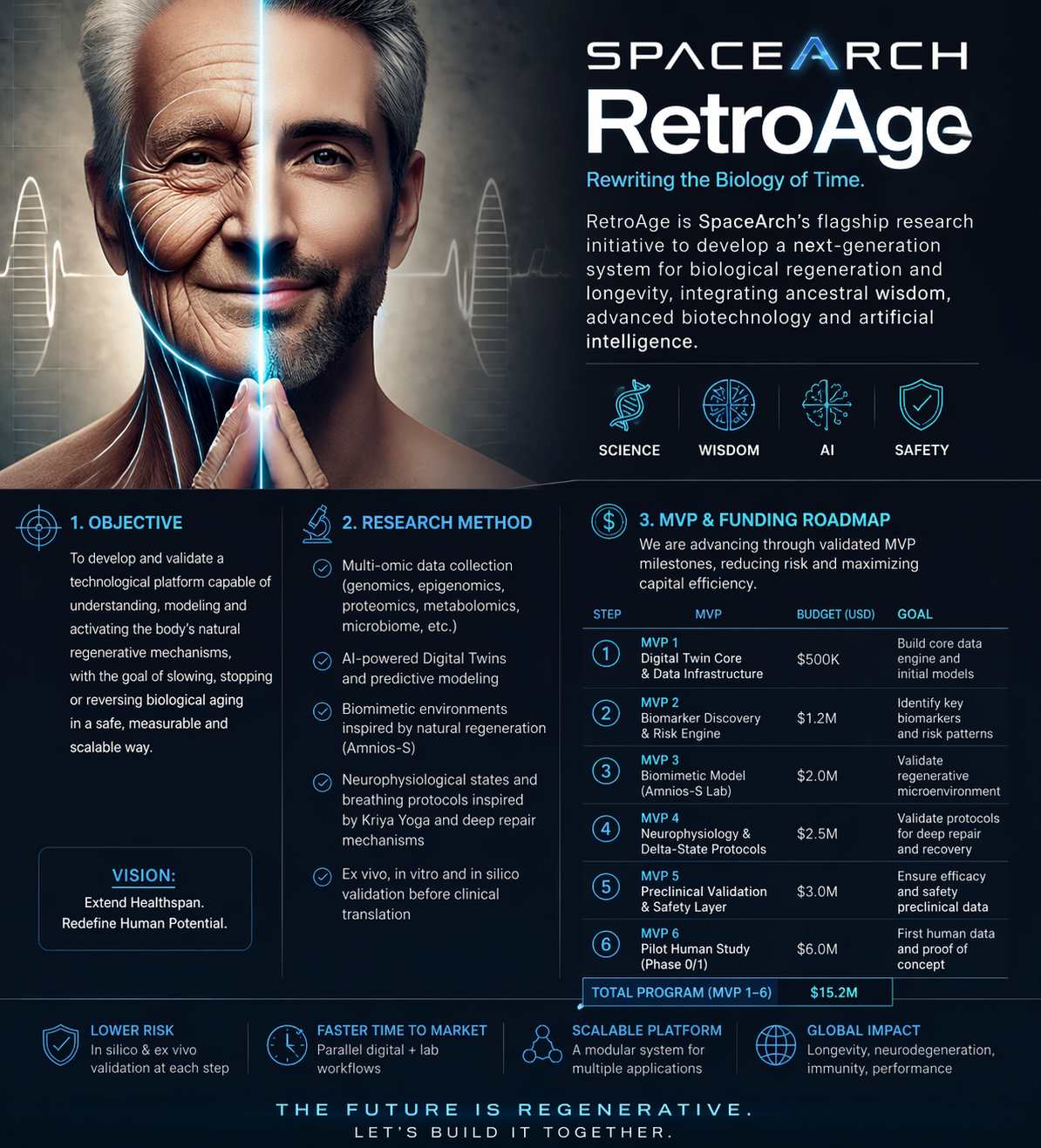
not to sell a “cure”, but to build the operating system, control architecture and technological environment capable of researching, modeling and eventually coordinating biological regeneration.
1. Strategic Advantage
The CEO of SpaceArch was initiated into the ancient Kriya Yoga tradition attributed to Babaji in the Himalayas. According to that tradition, there are methods to preserve biological youth and slow bodily deterioration through deep control of breathing, neurophysiology, sleep, metabolism and states of consciousness.
SpaceArch AntiAge’s thesis is that this ancestral know-how can be translated into technology:
- deep neurophysiological synchronization
- breathing and metabolic rhythms
- delta-state restorative sleep
- control of biological cycles
- interaction between mind, immune system and regeneration
Beginning in 2027, SpaceArch plans to initiate the experimental technological implementation of these principles through:
- biomedical AI
- multi-omic digital twins
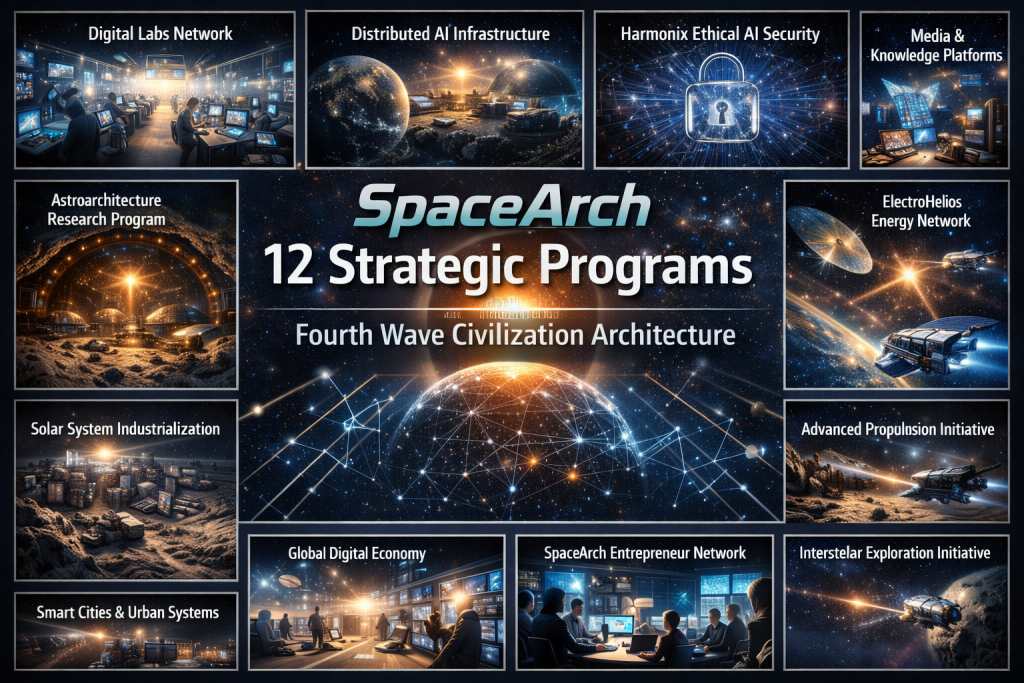
- cloud-based swarm Digital Labs
- biological simulation and probability scanning
- controlled biomimetic environments
The advantage is not in spending billions on massive physical laboratories from day one, but in reducing costs through digital MVPs, modeling and distributed research swarms.
2. Why Previous Attempts Failed
The major investments in the sector have followed a traditional pharmaceutical logic: investing billions into one narrow hypothesis.
| Company / Project | Approximate Capital | Focus | Result |
|---|---|---|---|
| Calico (Alphabet) | +USD 3.5B | General longevity research | Massive investment, limited visible results |
| Altos Labs | USD 3B | Cellular reprogramming | Still in research phase, no commercial validation |
| Unity Biotechnology | +USD 700M market value | Senolytics | Main clinical trial failed and company collapsed |
| Human Longevity | +USD 300M | Genomics and precision medicine | Partial progress, no breakthrough |
Unity Biotechnology lost nearly 60% of its value after the failure of its primary senolytic clinical trial, and ultimately ceased operating as a major longevity leader.
Altos Labs received nearly USD 3 billion in funding from investors such as Jeff Bezos and Yuri Milner, yet remains focused primarily on basic research and cellular reprogramming without a systemic integrated platform.
Calico, Alphabet’s longevity company, has invested billions for more than a decade, but the field continues to question the lack of tangible outcomes and the highly secretive model.
The Common Error
All of these initiatives attempt to solve a systemic problem with partial tools.
SpaceArch AntiAge proposes an integrated four-layer architecture:
- Biomimetic microenvironment
- Deep repair neurophysiology
- Multi-omic AI control
- Immune firewall and biological safety
3. RetroAge: The Architecture
The Four Layers of the System
A. Amnios-S
A biomimetic microenvironment inspired by natural regenerative conditions.
- controlled liquid environment
- simulated microgravity
- electromagnetic fields
- photobiomodulation
- optimized atmosphere
B. Delta-State
Inspired by Kriya Yoga deep states, delta sleep and restorative neurophysiology.
- brain synchronization
- maximum repair windows
- metabolic cleansing
- hormonal and autonomic regulation
C. HBC – Holo-Bio-Code
The core of the system.
It is not a therapy. It is software.
- multi-omic digital twin
- biological simulation
- predictive control
- safety constraints
- probability optimization
D. Immuno-Firewall
A safety layer designed to prevent:
- uncontrolled proliferation
- oncogenesis
- fibrosis
- reprogramming errors
4. The Paradigm Shift: From MegaLabs to Digital Labs
The major financial innovation of SpaceArch AntiAge is that the first MVP does not require building huge biotechnology centers immediately.
Instead:
- distributed Digital Labs
- researchers and programmers connected through the cloud
- simulation and modeling before physical laboratory deployment
- dramatic burn-rate reduction
- early validation at minimal cost
Comparative model:
| Traditional Model | SpaceArch AntiAge |
|---|---|
| Large laboratories from day one | Digital MVP first |
| USD 100–500M initial investment | USD 500k–5M initial investment |
| Closed teams | Distributed global network |
| High CAPEX | Low CAPEX + software leverage |
| Slow research cycles | Fast, scalable iteration |
SpaceArch intends to “comb probabilities” through AI: exploring millions of possible biological combinations virtually before moving into physical experimentation.
5. What Is Sold First
The initial product is not an anti-aging therapy.
It is a software and research platform:
- HBC Core License
- Digital Twin Engine
- Risk Engine
- Data Fabric
- Audit & Compliance System
- Governance Framework
Proposed SaaS model:
- Starter Lab: USD 1,500/month
- Pro Lab: USD 5,000/month
- Enterprise / CRO: USD 20,000/month + setup
With only 10–20 institutional clients, the company could approach break-even without waiting a decade for an approved therapy.
6. Development Timeline
2026
- formation of the initial team
- HBC v0.1
- basic Digital Twin
- first biological datasets and atlases
2027
- beginning of the experimental implementation inspired by Kriya Yoga principles and deep regenerative states
- Digital Labs MVP
- simulations and organoid testing
- first international partnerships
2028–2030
- ex vivo validation
- first biomimetic environments
- international expansion
- regeneration center franchises and enterprise licensing
7. Unique Competitive Advantage
SpaceArch AntiAge combines five elements that almost no company currently integrates simultaneously:
- deep neurophysiological tradition (Kriya Yoga)
- advanced biomedical AI
- systemic rather than fragmented architecture
- distributed Digital Labs
- scalable SaaS business model
This creates a unique position at the intersection of biotechnology, software, longevity and artificial intelligence.
8. Investment Sought
Seed / Pre-Seed Round
- target: USD 2–5 million
- use of proceeds:
- 40% software and HBC development
- 20% datasets and digital twin
- 20% Digital Labs and cloud infrastructure
- 10% compliance / bioethics
- 10% international partnerships
Goal of the Round
To build a functional MVP and demonstrate that it is possible to dramatically reduce the cost and time required for anti-aging research through a digital-first architecture.
SpaceArch AntiAge does not seek to compete with Altos Labs or Calico by spending more money.
It seeks to do something smarter:
to build the “Microsoft / AWS” of regenerative research, where other laboratories, universities and longevity centers use the platform to investigate, simulate and validate their own hypotheses.
The conceptual framework and original architecture were developed within the SpaceArch Biotech Division.
The real challenge is not to “reverse time”, but to understand how to restore biological coordination without crossing dangerous thresholds. That is precisely why RetroAge is designed not as a single therapy, but as a controlled research architecture combining digital twins, biomimetic environments, neurophysiology and safety layers.
SpaceArch is open to partnerships, co-development and scientific collaboration for the RetroAge project. We invite laboratories, biotech companies, universities, AI researchers and longevity specialists to join us through our cloud-based Digital Labs model.