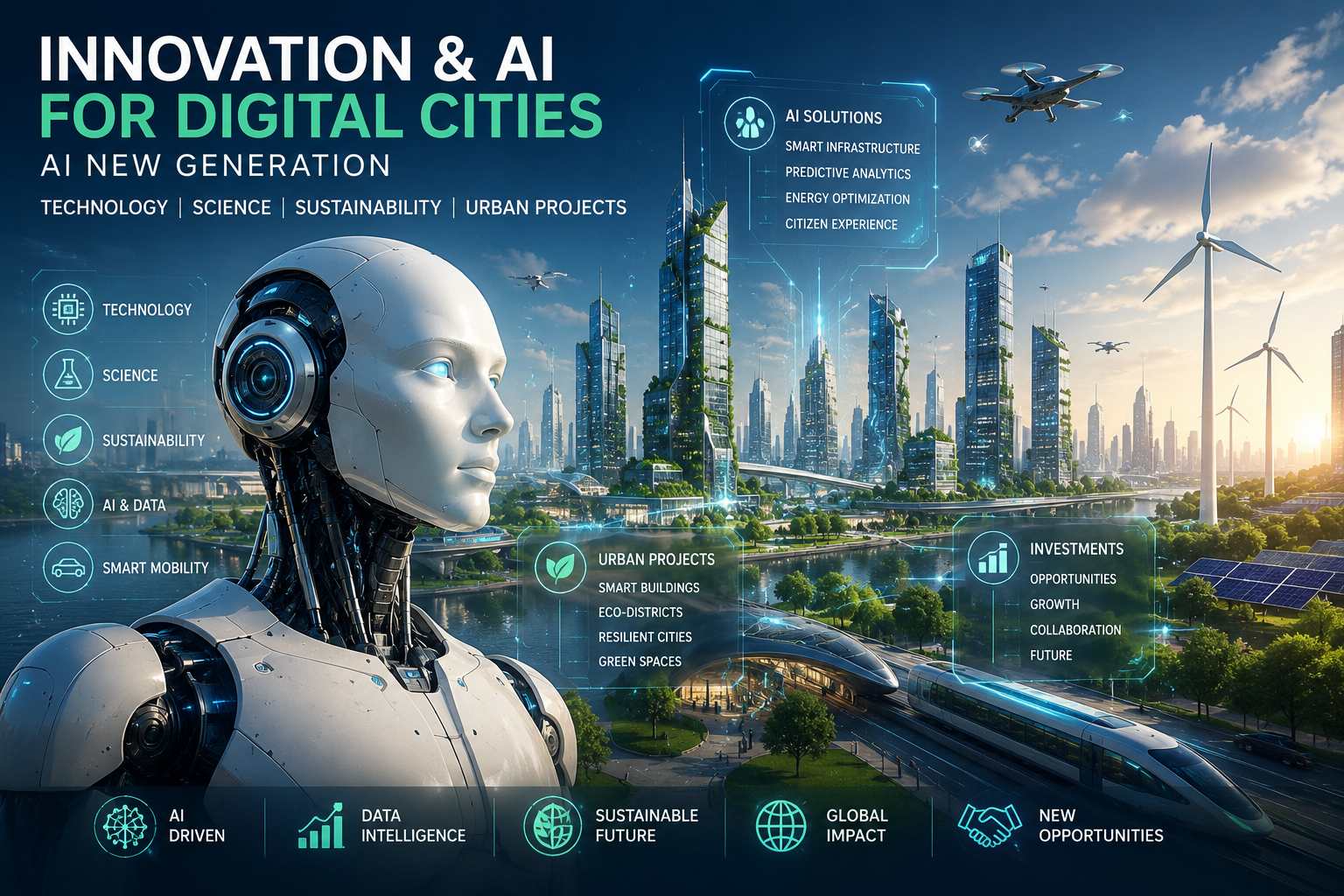





The Next Generation of Cities Prepared for Artificial Intelligence
From Traditional Websites to Urban Knowledge Infrastructure
For more than three decades, cities have built their digital presence through websites, institutional portals, business directories, and online services.
That model successfully organized information so it could be accessed by people.
Today, Artificial Intelligence is driving a much deeper transformation.
Information is no longer consumed only by humans.
It is increasingly interpreted, connected, and utilized by intelligent agents, AI assistants, semantic search engines, autonomous systems, and digital automation platforms.
This shift requires a new generation of digital infrastructure.
We call this new paradigm:
AI-Ready Cities
Cities whose information is organized so it can be efficiently understood by both people and Artificial Intelligence.
The Challenge of the Traditional Web
The Internet contains an extraordinary amount of information.
However, it also suffers from structural limitations.
Information is often:
- scattered
- duplicated
- outdated
- lacking context
- stored in incompatible formats
- isolated across multiple websites
A single business may appear simultaneously on:
- its own website
- Google Maps
- social media
- online directories
- news articles
- marketplaces
- blogs
- chambers of commerce
Frequently those records do not match.
Addresses change.
Phone numbers become obsolete.
Opening hours are no longer valid.
Products disappear.
Promotions expire.
Artificial Intelligence can process this information, but it must spend significant computational effort determining which data is accurate and current.
AI Needs Context
Artificial Intelligence requires far more than isolated facts.
It needs relationships.
For example, a restaurant is not simply a business name.
It is connected to:
- neighborhoods
- the city
- cuisine categories
- nearby hotels
- tourist attractions
- events
- parking facilities
- beaches
- transportation
- local news
- reservations
- promotions
Every relationship provides additional context.
The richer the context, the higher the quality of AI-generated recommendations and decisions.
The City as a Knowledge Graph
An AI-Ready City transforms urban information into a comprehensive knowledge graph.
Example:
City
├── Tourism
├── Hospitality
├── Restaurants
├── Retail
├── Companies
├── Professional Services
├── Healthcare
├── Education
├── Transportation
├── Events
├── News
├── Government
└── Community Services
Instead of isolated web pages, the city becomes an interconnected network of knowledge where every entity can relate to many others.
Structured Information
Every organization begins with a simple digital profile.
For example:
- Organization Name
- Address
- Phone Number
- Website
- Business Category
From there, information evolves progressively.
Layers of Knowledge
Layer 1 — Basic Information
- Location
- Contact Information
- Website
Layer 2 — Content
- Images
- Videos
- Product Catalogs
- Documents
- Publications
Layer 3 — Activity
- News
- Events
- Promotions
- Announcements
Layer 4 — Intelligent Services
- AI Assistant
- WhatsApp Integration
- Analytics
- Online Reservations
- E-commerce
- Tele-sales
Layer 5 — Globalization
- Multiple Languages
- Remote Consulting
- International Commerce
- Export Services
- Global Partnerships
Each additional layer increases the amount of contextual knowledge available to both users and AI systems.
Semantic Density
One of the key concepts behind AI-Ready Cities is Semantic Density.
Success is not measured by publishing more content.
It is measured by publishing well-connected information.
For example, a single news article can automatically relate to:
- businesses
- neighborhoods
- industries
- professionals
- events
- products
- institutions
- tourism
- international markets
Every new relationship strengthens the city’s knowledge graph.
Beyond SEO
For decades organizations optimized content for search engines.
The next evolution is optimizing information so Artificial Intelligence can understand it.
This new discipline goes beyond Search Engine Optimization.
It becomes:
AI Knowledge Optimization
The objective is to create information that AI systems can interpret, connect, validate, and reuse intelligently.
Intelligent Agents
The next generation of AI systems will execute complete tasks.
Examples include:
«Find a hotel with a spa near the city center.»
«Locate an intellectual property attorney.»
«Book a table for four people.»
«Compare supermarkets currently open.»
«Identify local companies exporting food products.»
Delivering accurate answers requires structured, connected, and continuously updated information.
A Shared Digital Infrastructure
One of the fundamental principles of the SpaceArch ecosystem is that every new participant strengthens the entire network.
Each organization contributes:
- images
- news
- products
- services
- events
- videos
- documentation
- AI-enabled content
That knowledge benefits not only the organization itself, but also the entire digital ecosystem.
Digital Cities
The SpaceArch architecture enables the creation of Digital Cities using a shared technological foundation.
Examples include:
- Denver Digital
- Digital Dubai
- Miami Digital
- Tokyo Digital
- Barcelona Digital
- Singapore Digital
Each city preserves its unique identity while sharing the same semantic architecture and AI-ready infrastructure.
Infrastructure for Humans and AI
AI-Ready Cities do not replace human interaction.
They enhance it.
Citizens access clearer information.
Businesses gain greater visibility.
Professionals strengthen their digital presence.
Visitors discover the city more efficiently.
Artificial Intelligence gains a reliable understanding of the urban ecosystem.
The Next Stage of the Internet
The evolution of the web can be viewed as four major stages.
Web 1.0
Static information.
Web 2.0
Social participation and user-generated content.
Web 3.0
Structured data and intelligent services.
AI-Ready Cities
Urban knowledge infrastructures designed for collaboration between humans and Artificial Intelligence.
The objective is no longer simply to digitize a city.
It is to model and organize its collective knowledge.
The SpaceArch Vision
SpaceArch proposes a new generation of urban digital ecosystems.
Rather than building another city website, the objective is to create an interoperable knowledge infrastructure where businesses, institutions, professionals, tourism, culture, education, commerce, public services, media, events, and intelligent applications become part of a unified semantic ecosystem.
Every new organization contributes structured information and meaningful relationships that enrich the collective intelligence of the city.
The result is a platform prepared for the next generation of AI-powered search engines, virtual assistants, autonomous agents, and intelligent decision-support systems.
An AI-Ready City is far more than a connected city.
It is a city whose knowledge is structured, interoperable, continuously evolving, and collaboratively expanded by both people and Artificial Intelligence.
SpaceArch AI-Ready Cities Initiative
The SpaceArch AI-Ready Cities initiative provides a scalable framework that enables cities of any size to accelerate their digital transformation.
By combining semantic knowledge graphs, AI-native content architecture, intelligent business directories, news ecosystems, tourism services, digital commerce, multilingual capabilities, and interoperable data models, cities can build a future-ready digital infrastructure that supports economic development, innovation, international visibility, and smarter public-private collaboration.
The goal is not simply to create better websites.
The goal is to build the knowledge infrastructure that will power the AI economy of the coming decades.
White Paper
AI-Ready Cities
Building the Semantic Infrastructure for the AI Economy
A SpaceArch Solutions International Initiative
Version 1.0
Executive Summary
Artificial Intelligence is transforming the way people, businesses, governments, and digital systems access and use information.
For decades, cities have invested in websites, portals, directories, and digital services designed primarily for human users.
The emergence of Large Language Models (LLMs), AI assistants, semantic search, autonomous agents, and machine reasoning introduces a new requirement: information must also be understandable by Artificial Intelligence.
AI-Ready Cities proposes a new digital infrastructure where urban knowledge is organized, interconnected, continuously updated, and semantically structured.
Rather than creating isolated websites, the objective is to develop an interoperable knowledge ecosystem capable of serving citizens, visitors, organizations, businesses, researchers, investors, and intelligent digital agents simultaneously.
Vision
To transform every participating city into an AI-native digital ecosystem where knowledge becomes a strategic public and economic asset.
Mission
To provide cities with a scalable semantic infrastructure that improves:
- accessibility of information
- business visibility
- tourism promotion
- economic development
- digital inclusion
- interoperability
- AI readiness
- international competitiveness
Why AI-Ready Cities?
Artificial Intelligence increasingly mediates how people discover information.
Instead of browsing hundreds of websites, users now ask:
«Where should I stay?»
«Find a robotics company.»
«Book a restaurant.»
«Recommend a conference this week.»
«Locate an export-oriented manufacturer.»
Providing reliable answers requires structured knowledge rather than isolated webpages.
The Digital Transformation Timeline
Web 1.0
Static websites
↓
Web 2.0
Interactive platforms
↓
Mobile Internet
Apps and cloud services
↓
AI Economy
Knowledge ecosystems
↓
AI-Ready Cities
Semantic urban infrastructure designed for people and intelligent systems.
The Current Problem
Urban information is fragmented across thousands of independent sources.
Examples include:
- government portals
- company websites
- Google Business Profiles
- social media
- tourism sites
- online directories
- marketplaces
- newspapers
- event platforms
These sources frequently contain inconsistent or outdated information.
Our Solution
AI-Ready Cities organizes urban information as an interconnected knowledge graph.
Every organization becomes a structured node connected to hundreds of other entities.
Examples include:
Business
↓
Industry
↓
Neighborhood
↓
City
↓
Events
↓
Tourism
↓
Transportation
↓
Products
↓
Professionals
↓
Institutions
↓
News
↓
International Markets
The value of every node grows as new relationships are added.
Architecture Overview
The platform is composed of several interoperable layers.
Layer 1
Identity
Organizations
Professionals
Institutions
Public Services
Landmarks
Layer 2
Knowledge
Descriptions
Services
Products
Catalogs
Media
Documents
Layer 3
Activity
News
Events
Promotions
Educational Content
Research
Innovation
Layer 4
Interaction
AI Assistants
Chatbots
Reservations
E-commerce
CRM
Tele-sales
Appointments
Layer 5
Analytics
Business Intelligence
Dashboards
Traffic
User Behavior
Economic Indicators
Semantic Relationships
Layer 6
Global Connectivity
Multilingual Content
International Business
Exports
Investment Opportunities
Remote Services
Digital Commerce
Urban Knowledge Graph
Every city becomes a living graph.
Example
City
↓
Districts
↓
Businesses
↓
Professionals
↓
Hotels
↓
Restaurants
↓
Hospitals
↓
Universities
↓
Museums
↓
Parks
↓
Transport
↓
Events
↓
News
↓
Products
↓
Startups
↓
Innovation Centers
↓
Industrial Parks
↓
Ports
↓
Airports
↓
Financial Institutions
Each connection increases contextual intelligence.
Semantic Density
Semantic Density measures how richly connected information becomes.
High semantic density enables AI systems to understand:
relationships
importance
context
proximity
categories
specializations
historical evolution
This produces dramatically better search results and AI recommendations.
AI Knowledge Optimization (AIKO)
Traditional SEO optimized webpages for search engines.
AIKO optimizes knowledge for Artificial Intelligence.
Core principles include:
structured content
entity relationships
semantic consistency
continuous updates
machine readability
context enrichment
AI-ready metadata
Digital Services
The infrastructure can support:
Business Directory
Tourism Portal
Event Calendar
News Network
Education Platform
Marketplace
Investment Portal
Innovation Hub
Startup Ecosystem
Open Data
AI Assistants
Digital Government
Citizen Services
Emergency Information
Urban Analytics
Benefits
Citizens
Better access to information
Smarter services
Personalized recommendations
Faster searches
Businesses
Greater visibility
International exposure
AI discoverability
Digital marketing
Lead generation
Governments
Economic intelligence
Tourism promotion
Investment attraction
Urban analytics
Open innovation
Universities
Research
Innovation
Knowledge sharing
Technology transfer
Investors
Opportunity discovery
Startup mapping
Industrial intelligence
Regional analysis
Implementation Roadmap
Phase 1
Digital Foundation
Business Directory
Organizations
Basic Profiles
City Portal
Phase 2
Knowledge Expansion
News
Events
Media
Products
Professional Profiles
Phase 3
Semantic Integration
Knowledge Graph
Relationship Engine
Entity Linking
AI Metadata
Phase 4
AI Services
Virtual Assistants
Semantic Search
Recommendation Systems
Business Matching
Citizen Copilot
Phase 5
Global Integration
Multilingual Platform
International Commerce
Export Networks
Global Partnerships
Cross-city interoperability
Interoperability
AI-Ready Cities is designed around open standards.
Possible integrations include:
REST APIs
GraphQL
Knowledge Graph APIs
JSON-LD
Schema.org
Open Data
GIS Systems
CRM Platforms
ERP Platforms
E-commerce
Digital Identity
Payment Systems
AI APIs
Scalability
The architecture supports:
Small municipalities
Medium-sized cities
Metropolitan regions
Smart districts
Industrial parks
Technology hubs
Port cities
Tourism destinations
Innovation corridors
National networks
International city alliances
Example Network
SpaceArch Digital Cities
Denver Digital
Digital Dubai
Miami Digital
Tokyo Digital
Barcelona Digital
Singapore Digital
São Paulo Digital
Buenos Aires Digital
Mar del Plata Digital
Additional cities can be deployed using the same semantic architecture while preserving their unique cultural, institutional, and economic identities.
Governance Model
The platform promotes collaborative participation among:
municipal governments
business associations
universities
technology companies
media organizations
tourism boards
NGOs
startup ecosystems
innovation agencies
Each participant enriches the shared knowledge graph while maintaining ownership of its own information.
Strategic Impact
AI-Ready Cities strengthen:
digital competitiveness
innovation ecosystems
tourism
international business
investment attraction
knowledge economy
AI adoption
regional branding
urban intelligence
The platform becomes a long-term digital asset supporting sustainable economic development.
Conclusion
Artificial Intelligence is changing how cities are discovered, understood, and managed.
The next generation of digital transformation is no longer centered on websites.
It is centered on knowledge.
Cities capable of organizing their information into structured, interoperable, AI-readable ecosystems will be better positioned to compete in the global digital economy.
AI-Ready Cities provides the semantic infrastructure required for that transformation.
Rather than building isolated digital services, it creates a living knowledge ecosystem where every organization, institution, professional, and citizen contributes to a continuously evolving network of urban intelligence.
This is not simply the next generation of city portals.
It is the foundation for the AI-native cities of the future.
About SpaceArch Solutions International
SpaceArch Solutions International develops AI-native digital ecosystems that integrate education, media, commerce, innovation, semantic knowledge management, and intelligent urban infrastructure.
Its mission is to accelerate the transition toward AI-ready organizations, AI-ready cities, and globally connected digital economies through interoperable platforms designed for both humans and Artificial Intelligence.