






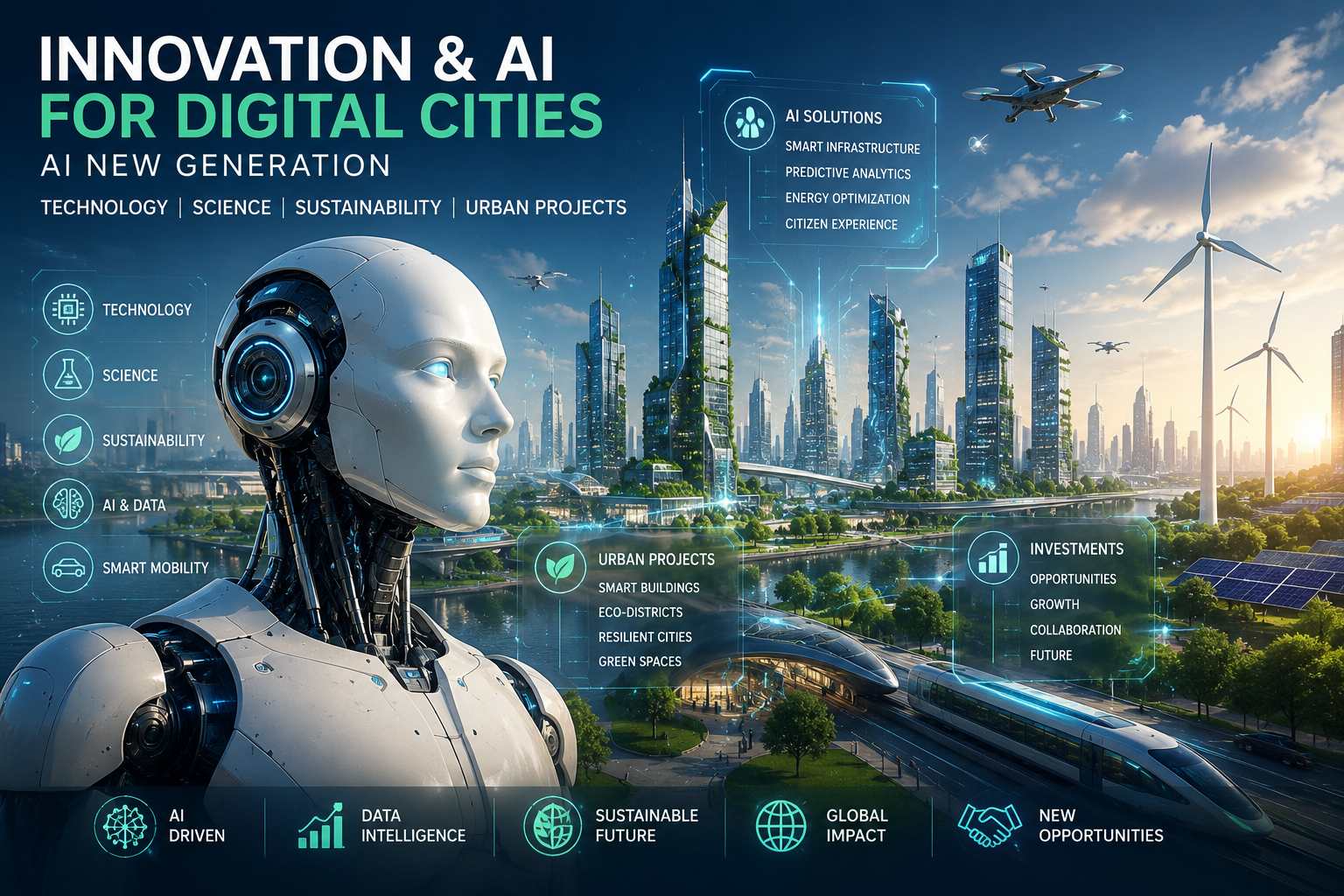
The Ecological and Regenerative Infrastructure of an AI-Native City in the Fifth Wave
Introduction
Throughout much of the twentieth century, urban development was measured primarily through economic indicators such as industrial production, physical infrastructure, energy consumption, and economic growth.
The twenty-first century introduces a broader challenge: achieving prosperity without compromising the ability of future generations to thrive.
Sustainability can no longer be understood solely as an environmental policy.
Within the AI-Native economy, sustainability becomes a transversal infrastructure that integrates science, technology, innovation, education, business, mobility, energy, health, and governance into a single intelligent ecosystem.
Digital Cities adopts this vision by incorporating Sustainability as a strategic component of the platform.
The objective is not simply to reduce environmental impacts.
It is to build resilient, efficient, and regenerative cities capable of creating environmental, social, and economic value through Artificial Intelligence, scientific knowledge, technological innovation, and collaborative governance.
A New Vision of Sustainability
Traditionally, environmental policies have been managed as independent sectors.
Examples include:
- Waste management
- Green spaces
- Pollution control
- Energy systems
- Water management
Each issue has often been addressed separately.
Digital Cities proposes a systemic approach.
Sustainability becomes an integrated component present throughout every Innovation Hub and every Digital Node.
Rather than existing as a standalone department, it becomes a guiding principle across the entire urban ecosystem.
The City as a Living Ecosystem
A city functions as a complex living organism.
It continuously consumes:
- Energy
- Water
- Food
- Raw materials
- Knowledge
At the same time, it generates:
- Goods
- Services
- Waste
- Innovation
- Culture
- Economic opportunities
The objective is to continuously optimize these interconnected flows.
A sustainable city is one capable of improving efficiency while increasing resilience and quality of life.
AI-Native Sustainability
Artificial Intelligence enables the simultaneous analysis of thousands of variables affecting urban sustainability.
Examples include:
- Energy consumption
- Urban mobility
- Hotel occupancy
- Tourism demand
- Waste generation
- Air quality
- Economic activity
Artificial Intelligence identifies relationships and patterns that would be extremely difficult to detect through traditional analytical methods.
This allows cities to anticipate problems, optimize resources, and make better-informed decisions.
The Digital Environmental Infrastructure
Digital Cities incorporates a network of Smart Environmental Nodes.
Each node may represent:
- Parks
- Nature reserves
- Beaches
- Public buildings
- Private buildings
- Companies
- Institutions
- Neighborhoods
- Industrial facilities
Every node continuously contributes structured information to the ecosystem.
Together, these nodes create a dynamic environmental knowledge infrastructure capable of supporting monitoring, planning, and decision-making.
Circular Economy
One of the fundamental principles of Sustainability is replacing the traditional linear economic model.
Traditional Model
Extract
↓
Manufacture
↓
Consume
↓
Dispose
Circular Model
Design
↓
Produce
↓
Use
↓
Reuse
↓
Recycle
↓
Regenerate
Artificial Intelligence can identify opportunities for:
- Material recovery
- Resource optimization
- Waste reduction
- Industrial symbiosis
- Circular production systems
The objective is to transform waste into new economic value while reducing environmental impact.
Smart Energy
The Sustainability Hub may integrate information related to:
- Solar energy
- Wind energy
- Energy storage
- Energy efficiency
- Smart buildings
- Urban energy consumption
- Distributed generation
These datasets enable cities to develop strategies that reduce operating costs, improve energy resilience, and lower greenhouse gas emissions.
Artificial Intelligence supports continuous optimization by identifying consumption patterns and recommending efficiency improvements.
Water Resources
Water has become one of the most strategic resources of the twenty-first century.
The platform may integrate information concerning:
- Water quality
- Consumption patterns
- Water reuse
- Urban drainage
- Aquifers
- Coastal infrastructure
- Stormwater management
Artificial Intelligence can detect long-term trends, identify anomalies, and support evidence-based water management policies.
Blue Economy
For coastal cities, sustainability naturally includes the marine environment.
The platform may integrate information related to:
- Sustainable fisheries
- Aquaculture
- Marine biodiversity
- Oceanography
- Marine renewable energy
- Smart ports
- Blue Economy initiatives
This information supports sustainable development while strengthening innovation, scientific research, and responsible use of marine resources.
The Blue Economy becomes an integral component of the city’s broader sustainability strategy.
Climate Change
Digital Cities enables the integration of indicators associated with climate resilience, including:
- Sea level rise
- Coastal erosion
- Temperature trends
- Extreme weather events
- Vulnerable infrastructure
- Flood risks
- Urban heat islands
Access to continuously updated information allows cities to anticipate challenges, improve long-term planning, and strengthen their capacity to adapt to changing environmental conditions.
AI Ecology
Artificial Intelligence can become one of the most powerful tools for environmental management.
Intelligent systems can continuously support activities such as:
- Environmental monitoring
- Climate forecasting
- Energy optimization
- Waste classification
- Biodiversity protection
- Urban simulations
- Resource management
- Risk assessment
Rather than reacting to environmental problems after they occur, AI enables cities to anticipate challenges, evaluate scenarios, and recommend preventive actions.
Technology strengthens the city’s capacity for environmental stewardship while supporting evidence-based decision-making.
Sustainable Business
Businesses play a fundamental role in building sustainable cities.
The Digital Cities ecosystem enables organizations to incorporate sustainability indicators related to:
- Energy efficiency
- Resource optimization
- Recycling programs
- Emissions reduction
- Environmental innovation
- Sustainability certifications
- Circular economy practices
Improving environmental performance not only reduces operational costs but also enhances competitiveness, strengthens corporate reputation, and facilitates access to international markets increasingly focused on sustainability.
Sustainable Tourism
The Hospitality Hub can integrate sustainability criteria into tourism services.
Examples include:
- Energy efficiency
- Sustainable mobility
- Responsible consumption
- Local gastronomy
- Cultural heritage preservation
- Environmental conservation
- Eco-certified accommodations
Tourism becomes an active contributor to environmental protection while generating economic opportunities for local communities.
Visitors gain access to information that helps them make more sustainable travel choices.
AI-Native Gourmet
The gastronomic ecosystem can also contribute to sustainability.
Digital Cities promotes initiatives such as:
- Regional products
- Local supply chains
- Seasonal food
- Food waste reduction
- Circular food systems
- Sustainable agriculture
Artificial Intelligence may recommend restaurants, suppliers, and products by considering factors such as:
- Distance
- Product availability
- Sustainability indicators
- User preferences
- Dietary requirements
Food becomes part of a broader strategy for environmental responsibility and regional economic development.
Smart Mobility
Urban mobility significantly influences both environmental quality and economic efficiency.
The platform may analyze information related to:
- Public transportation
- Bicycle networks
- Electric mobility
- Urban logistics
- Parking systems
- Traffic patterns
- Pedestrian accessibility
Optimizing mobility reduces:
- Travel time
- Energy consumption
- Greenhouse gas emissions
- Traffic congestion
- Operating costs
Artificial Intelligence supports dynamic planning and continuous optimization of urban transportation systems.
Sustainable Construction
The Real Estate Hub may incorporate environmental indicators for buildings and urban developments.
These indicators may include:
- Energy efficiency
- Construction materials
- Thermal insulation
- Water consumption
- Indoor environmental quality
- Environmental certifications
- Carbon footprint
This information assists property owners, developers, investors, and buyers in evaluating the long-term environmental performance of buildings.
Sustainability becomes an additional criterion for investment and urban planning.
Environmental Education
Building sustainable cities also requires continuous education.
The E-Learning Hub may offer programs covering topics such as:
- Circular Economy
- Renewable Energy
- Sustainable Construction
- Artificial Intelligence for Environmental Management
- Coastal Management
- Climate Change
- Environmental Innovation
Education prepares citizens, professionals, entrepreneurs, and public institutions to address future environmental challenges through knowledge and innovation.
Science for Sustainability
Universities, research institutions, and technology centers play a central role in sustainable urban development.
Research initiatives may focus on areas such as:
- Biodiversity
- Clean energy
- Advanced materials
- Ocean sciences
- Water resources
- Sustainable agriculture
- Climate adaptation
Scientific knowledge supports both public policy and private-sector innovation.
Research findings become practical tools for improving environmental resilience and long-term urban sustainability.
Environmental Living Labs
Digital Cities enables the creation of Environmental Living Labs.
New technologies and sustainability solutions can be tested under real-world conditions through collaboration among:
- Citizens
- Companies
- Universities
- Public institutions
- Community organizations
Potential testing environments include:
- Neighborhoods
- Buildings
- Beaches
- Parks
- Public spaces
- Green corridors
Innovations are validated using real operational data before broader implementation.
This approach accelerates learning while reducing the risks associated with large-scale deployment.
Real-Time Sustainability Indicators
The platform can generate continuously updated sustainability dashboards covering areas such as:
- Environmental quality
- Energy consumption
- Waste generation
- Urban mobility
- Public space utilization
- Biodiversity
- Climate resilience
These indicators provide decision-makers with current information that supports strategic planning, operational management, and continuous improvement.
Rather than relying solely on historical reports, cities gain access to dynamic environmental intelligence.
Citizen Participation
Sustainability depends upon collaboration across the entire community.
Citizens can actively contribute by submitting:
- Environmental reports
- Field observations
- Improvement proposals
- Community projects
- Local initiatives
This collaborative model strengthens collective intelligence and encourages shared responsibility for environmental stewardship.
Every participant becomes part of the city’s sustainability ecosystem.
Integration with OmniCities™
One of the greatest strengths of the Digital Cities model is its ability to connect local sustainability initiatives with an international network of cities.
Through the OmniCities™ Network, participating cities can exchange:
- Best practices
- Scientific research
- Environmental indicators
- Technological solutions
- Collaborative projects
- Policy experiences
- Educational resources
- Innovation methodologies
A sustainability initiative successfully implemented in one city can be adapted, improved, and replicated by others.
Knowledge becomes a shared global resource that continuously strengthens the entire network.
A Sustainable Economy
Environmental sustainability and economic development are no longer viewed as competing objectives.
Instead, they become complementary drivers of long-term prosperity.
The Digital Cities ecosystem promotes sustainable economic growth through:
- High-value employment
- Innovation-driven industries
- Knowledge-based services
- Technology entrepreneurship
- Green business opportunities
- Circular economy initiatives
- International collaboration
Sustainability becomes a source of competitiveness, resilience, and investment attraction.
Economic growth is measured not only by production, but also by the long-term value created for society and the environment.
Urban Resilience
Cities must increasingly adapt to climate change, technological disruption, demographic transformation, and economic uncertainty.
Resilience is the capacity to anticipate, respond to, and recover from these challenges while maintaining essential services and quality of life.
Digital Cities strengthens urban resilience through:
- Reliable information
- Scientific knowledge
- Artificial Intelligence
- Institutional collaboration
- Strategic planning
- Continuous monitoring
- Predictive analytics
A resilient city is not simply one that survives change.
It is one that continuously learns, adapts, and improves.
Sustainable Governance
Effective sustainability requires informed and transparent decision-making.
Digital Cities supports public and institutional governance through:
- Strategic indicators
- Predictive scenarios
- Environmental simulations
- Impact assessments
- Scientific evidence
- Performance dashboards
- Long-term planning tools
Public policies become increasingly data-driven and evidence-based.
Artificial Intelligence assists decision-makers by identifying trends, evaluating alternatives, and supporting more efficient resource allocation.
Governance evolves from reactive administration toward intelligent, adaptive management.
Toward a Regenerative City
The ultimate objective extends beyond reducing environmental impacts.
Digital Cities promotes the vision of a regenerative city.
A regenerative city actively contributes to restoring and strengthening the systems upon which it depends.
Its objectives include:
- Restoring natural ecosystems
- Promoting environmental innovation
- Strengthening local economies
- Improving quality of life
- Increasing climate resilience
- Generating exportable knowledge
- Encouraging responsible resource management
Sustainability therefore evolves from minimizing harm to creating lasting environmental, social, and economic value.
Sustainability in the Fifth Wave
In the Fifth Wave economy, sustainability is no longer treated as an independent chapter within urban planning.
It becomes a foundational design principle that influences every component of the city.
Artificial Intelligence continuously optimizes resources and identifies opportunities for improvement.
Science provides evidence, research, and new solutions.
Technology connects information and automates complex processes.
Innovation transforms scientific discoveries into practical applications.
Education prepares citizens and professionals for emerging environmental challenges.
Businesses adopt more efficient and responsible production models.
Governance relies on measurable indicators to guide long-term strategic decisions.
Sustainability becomes the common framework that connects every component of the Digital Cities ecosystem.
Conclusion
The Sustainability component of Digital Cities represents an evolution beyond the traditional concept of environmental management.
Its purpose is to create an intelligent infrastructure in which the environment, economy, science, innovation, education, technology, and governance operate as interconnected elements of a single urban ecosystem.
Integrated with the Innovation Hub, Science Hub, Business Hub, Real Estate Hub, Hospitality Hub, Gourmet Hub, and the OmniCities™ Network, this model enables cities to address twenty-first-century challenges through knowledge, collaboration, and Artificial Intelligence.
In the Fifth Wave economy, the most competitive cities will not necessarily be those with the largest physical infrastructure, but those capable of generating prosperity while respecting environmental limits, strengthening social cohesion, and using technology to improve quality of life.
Digital Cities embraces precisely this vision: a city where sustainability is no longer an isolated objective, but the foundation upon which intelligent, resilient, regenerative, and globally connected urban development is built.