






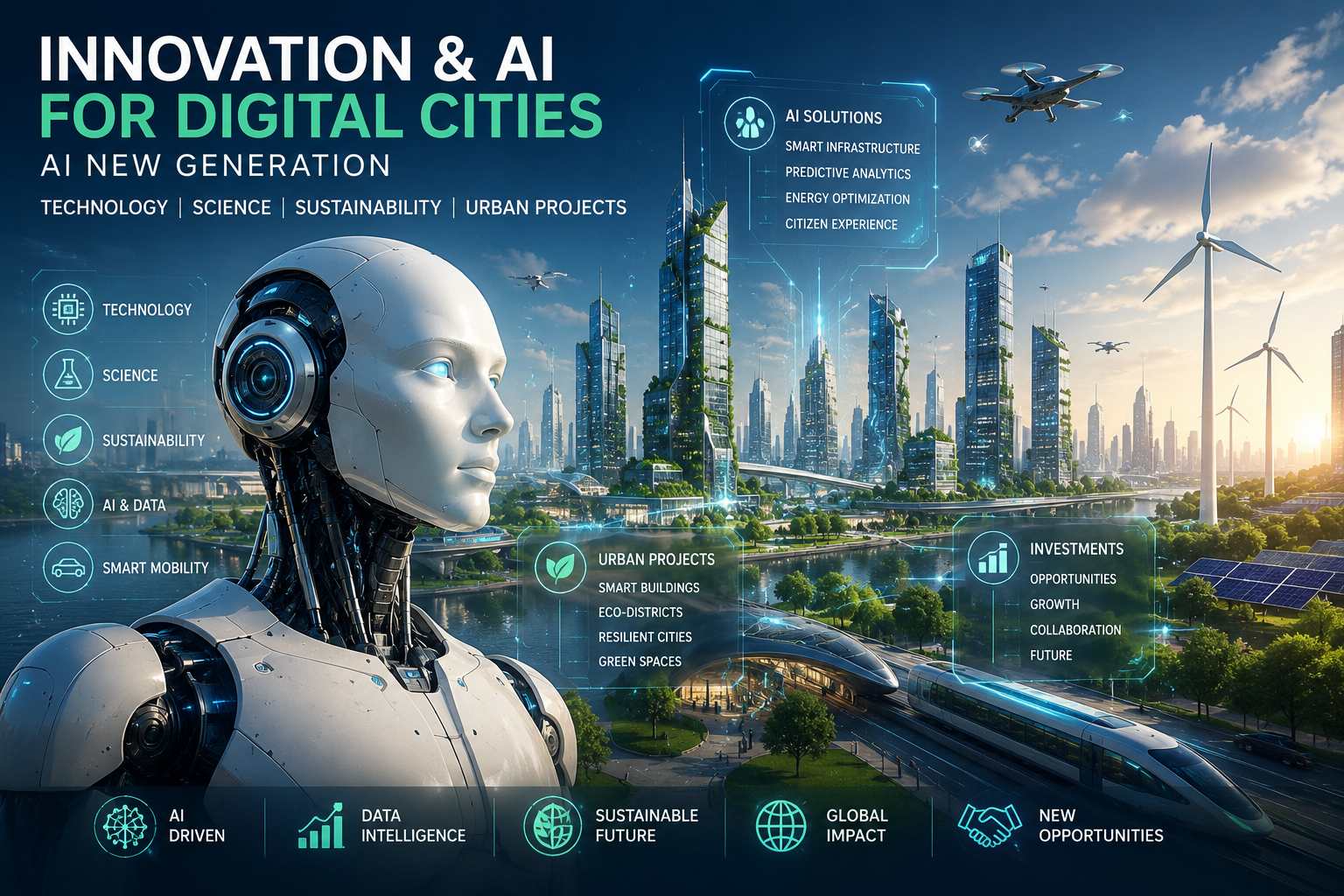
The Technological Infrastructure of an AI-Native City in the Fifth Wave
Introduction
Every major economic transformation begins with a technological transformation.
However, in the Fifth Wave economy, technology is no longer understood merely as a collection of tools. It becomes an intelligent infrastructure capable of connecting people, institutions, businesses, services, and knowledge in real time.
Digital Cities is built upon this vision.
The objective is not to create a single website, mobile application, or e-commerce platform.
The objective is to develop a modular, interoperable, and AI-Native technological infrastructure capable of evolving continuously and supporting the growth of a city for decades.
Technology is no longer an end in itself.
It becomes the connective fabric through which the entire urban ecosystem operates.
An Architecture Designed to Evolve
One of the greatest weaknesses of many technology projects is that they begin as isolated solutions.
Over time, new systems, databases, applications, and platforms are added without a common architecture.
This frequently produces:
- Duplication of work
- Incompatible systems
- Fragmented information
- Increasing maintenance costs
- Operational complexity
- Technological dependency
Digital Cities adopts a different approach.
The entire platform is developed through a modular architecture in which every component can evolve independently without disrupting the ecosystem as a whole.
Infrastructure
↓
Node Engine
↓
Specialized Hubs
↓
Connected Services
↓
Artificial Intelligence
↓
OmniCities™
Every new function reuses the technological layers that already exist.
The platform can therefore expand without requiring a complete reconstruction each time a new service is introduced.
Technology as Shared Infrastructure
Within the Digital Cities ecosystem, technology operates as a transversal service.
Its primary mission is to provide:
- Connectivity
- Interoperability
- Automation
- Scalability
- Security
- Integration
Every specialized Hub uses the same underlying infrastructure.
This reduces costs, simplifies maintenance, and allows the entire ecosystem to evolve according to common technical standards.
Instead of creating separate systems for every sector, Digital Cities provides a shared technological foundation upon which multiple services can be developed.
Cloud-Native Infrastructure
The platform is conceived as a distributed, cloud-native infrastructure.
This approach supports:
- High availability
- Progressive growth
- Lower initial costs
- Continuous updates
- Operational resilience
- Flexible resource allocation
The city does not depend on a single physical server or local data center.
Services may be distributed across different cloud providers, hosting environments, and geographic regions.
This distributed architecture enables the platform to adapt its capacity as demand grows.
It also reduces the risk associated with depending on one technological provider or one infrastructure location.
AI-Native Architecture
Artificial Intelligence is not added after the platform has been developed.
It is embedded within the architecture from the beginning.
Every technological component is designed to interact with:
- Intelligent assistants
- Autonomous agents
- Recommendation engines
- Analytical systems
- Process automation tools
- Semantic search systems
Artificial Intelligence therefore becomes a native component of the platform rather than an external application.
This allows the ecosystem to move progressively from simple information publication toward contextual assistance, automated coordination, and intelligent decision support.
The Node Engine
One of the central components of the architecture is the Node Engine.
Every participating organization receives its own Digital Node.
This node stores structured information such as:
- Identity
- Category
- Geographic location
- Contact details
- Images
- Videos
- Documents
- External links
- Products
- Services
- Capabilities
Because the information follows a consistent structure, both people and intelligent systems can understand it quickly.
The Node Engine transforms isolated institutional pages into standardized components of a shared urban knowledge infrastructure.
Specialized Hubs
Multiple specialized platforms can be developed above the Node Engine.
Examples include:
- Business Hub
- Professional Hub
- E-Learning Hub
- Innovation Hub
- Gourmet AI-Native Hub
- Hospitality Hub
- Real Estate Hub
- Omnimedia Hub
- Health & Wellness Hub
Each Hub incorporates sector-specific functions without modifying the technological core.
For example, a Hospitality Hub may include reservations and visitor services, while a Business Hub may focus on suppliers, commercial opportunities, and investment.
Both continue to use the same Node Engine, identity structure, interoperability standards, and AI infrastructure.
Structured Information
One of the fundamental principles of Digital Cities is the consistent organization of information.
Structured information enables:
- More accurate searches
- Integration between systems
- AI-based analysis
- Automated recommendations
- International interoperability
- Reliable data reuse
The city gradually moves away from publishing fragmented information across unrelated websites.
Instead, it begins to construct a shared and continuously evolving knowledge base.
Interoperability
The entire Digital Cities platform operates through a shared technological language.
This allows different systems, organizations, and services to exchange information without requiring a custom development process for every new connection.
For example, a university may collaborate with:
- Startups
- Companies
- Researchers
- Coworking spaces
- Government agencies
- Professional networks
All of them can interact through the same technological infrastructure.
Interoperability reduces fragmentation and enables the city to function as a connected ecosystem rather than as a collection of isolated platforms.
Intelligent Automation
The technological infrastructure supports the automation of numerous operational processes.
These may include:
- Data updates
- Content classification
- Directory generation
- Multimedia integration
- Information synchronization
- Personalized recommendations
- Content distribution
- Initial user assistance
Automation reduces repetitive work and improves operational efficiency.
It also allows organizations to maintain updated information without requiring large technical teams.
Artificial Intelligence can support these processes by identifying patterns, detecting missing information, generating summaries, and recommending actions.
Omnimedia Infrastructure
The platform also incorporates a connected digital communications network.
Content can be published once and then distributed automatically according to:
- Topic
- Language
- Audience
- City
- Sector
- Relevant Hub
- User interests
This avoids unnecessary duplication and strengthens the reach of every publication.
A single piece of content may become:
- A news article
- A radio segment
- A TVWeb report
- A social media publication
- An educational resource
- A business or investment briefing
Omnimedia transforms communication into an integrated technological service available to the entire ecosystem.
Digital Marketplace
The platform integrates tools that connect supply and demand across the city.
These may support:
- E-commerce
- Digital catalogs
- Reservations
- Requests for quotations
- Professional service contracting
- Electronic payments
- Business referrals
- Subscription services
Every Digital Node can progressively evolve into an active commercial interface.
A restaurant may receive reservations.
A professional may offer consulting services.
A technology company may publish software solutions.
A training institution may promote courses.
The marketplace therefore connects local capabilities with regional and international demand.
APIs and System Integration
The architecture is designed to incorporate open APIs and interoperable services.
This enables integration with systems such as:
- Customer Relationship Management platforms
- Enterprise Resource Planning systems
- Educational platforms
- Booking and reservation systems
- Payment gateways
- Logistics services
- Marketing automation tools
- Government platforms
- Data analytics systems
Each organization may connect its own technological environment without losing operational autonomy.
The objective is not to replace every existing system.
The objective is to create a common integration layer that allows those systems to communicate with the wider urban ecosystem.
Cybersecurity
Every digital infrastructure requires appropriate protection mechanisms.
Cybersecurity must be incorporated from the beginning of the design process.
The platform may include:
- Secure authentication
- Role-based access control
- Data backups
- Infrastructure monitoring
- Protection against cyberattacks
- Continuous software updates
- Incident detection
- Recovery procedures
- Data protection policies
Security is not treated as a final stage added after deployment.
It is a permanent architectural responsibility.
As the ecosystem grows, security standards must evolve according to the sensitivity of the information and the services involved.
Analytics and Business Intelligence
The technological infrastructure enables the development of real-time indicators and strategic dashboards.
These may analyze:
- Ecosystem growth
- Most active sectors
- User behavior
- Demand for services
- Business opportunities
- Market trends
- Tourism activity
- Educational demand
- Investment patterns
This information supports more informed decision-making by companies, institutions, investors, researchers, and public organizations.
Business Intelligence transforms dispersed operational activity into strategic knowledge.
The city can identify areas of growth, detect emerging needs, and allocate resources more effectively.
Technology for Innovation
The modular architecture facilitates continuous experimentation.
New functions can be developed as independent modules, tested within a limited environment, and later integrated into the wider ecosystem once they have been validated.
This approach supports:
- Faster prototyping
- Lower development risk
- Progressive investment
- Easier testing
- Continuous improvement
- Rapid replication
A successful technology tested in one city can later be adapted for other cities within the OmniCities™ Network.
Innovation therefore becomes an ongoing process rather than a series of isolated technological projects.
International Scalability
The architecture is designed to extend beyond a single city.
Each new city can deploy the same technological foundation while maintaining its own identity, language, institutions, and local priorities.
OmniCities™
↓
Digital City Node
↓
Local Hubs
↓
Organizations and Services
↓
Artificial Intelligence
↓
Global Interoperability
Possible connected cities may include:
- Mar del Plata
- Denver
- Miami
- Dubai
- Madrid
- São Paulo
- Tokyo
Each city remains autonomous while sharing a common technological framework.
This enables organizations in different locations to discover one another, exchange knowledge, create partnerships, and develop international projects through the same infrastructure.