





The Operational Link Between GenAcademy, Startup Incubation, and the Real Needs of Every City
Introduction
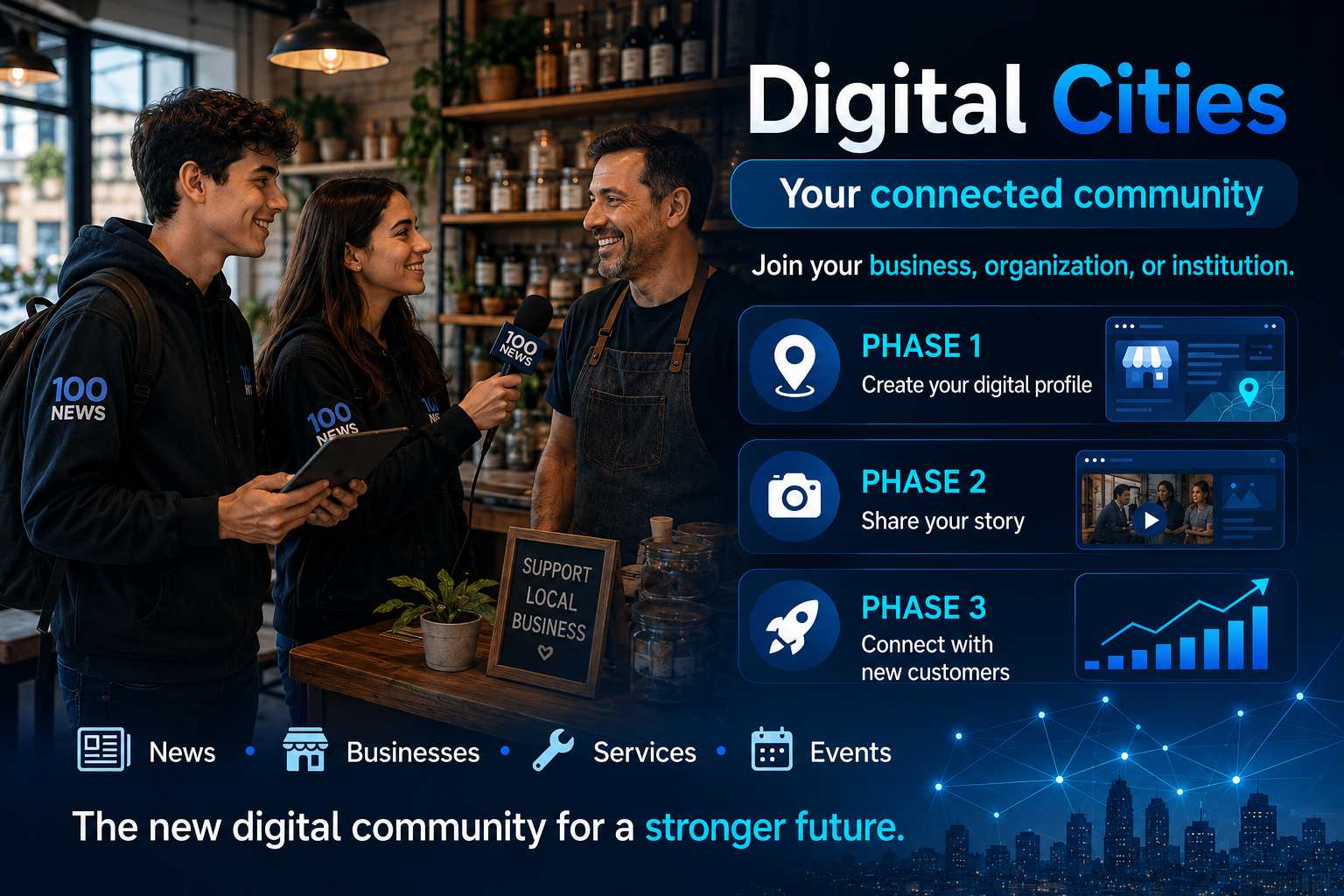
At first glance, Omnimedia 100 News may appear to be a digital media network composed of news portals, online radio, TVWeb channels, videos, podcasts, interviews, social media, and journalist-driven micro-ecosystems.
Its strategic purpose, however, extends far beyond media publishing.
Omnimedia does more than report what happens in a city.
It enables cities to be observed, understood, interpreted, and transformed by converting everyday information into practical knowledge that supports education, innovation, investment, entrepreneurship, and sustainable urban development.
From this perspective, Omnimedia represents the operational counterpart of both GenAcademy and the Startup Incubator.
Each fulfills a complementary role.
GenAcademy develops human capabilities.
The Startup Incubator transforms those capabilities into projects, businesses, and innovative solutions.
Omnimedia identifies where, how, and why those capabilities should be applied.
The complete operational architecture can be summarized as follows:
The Real City
↓
Omnimedia observes, interviews, documents, and organizes information
↓
Artificial Intelligence identifies patterns, needs, and opportunities
↓
GenAcademy designs targeted educational programs
↓
The Startup Incubator transforms knowledge into startups and practical solutions
↓
Those solutions return to the city, generating new data, employment, innovation, and economic activity
These are not three independent initiatives.
They are three interdependent functions operating within a single integrated ecosystem.
1. The Challenge of Innovation Ecosystems Disconnected from Local Reality
Many startup incubators, universities, and educational institutions develop programs based primarily on broad market trends.
Courses are created because a technology becomes fashionable.
Startups are promoted because investors are interested in a particular sector.
Professional training is offered because global demand appears promising.
Yet one essential component is often missing:
A continuous understanding of the real needs of each local community.
Every city has unique priorities.
A city may require:
- Digital transformation for local businesses
- Small business automation
- Logistics solutions
- Services for older adults
- Tourism modernization
- Educational technology
- Public safety systems
- Cultural platforms
- Youth employment opportunities
- Environmental management
- Technology tailored to local industries
Without a permanent listening mechanism, these needs often remain fragmented, poorly documented, or completely invisible.
Different organizations see different pieces of the picture.
Business associations understand certain challenges.
Public institutions understand others.
Residents experience daily problems firsthand.
Retailers identify operational obstacles.
Professionals recognize technical shortcomings.
Journalists witness conflicts, emerging trends, and key local actors.
Omnimedia can connect all of these scattered signals into a coherent body of knowledge.
2. Omnimedia as a Permanent Observation System
Every journalist, content creator, correspondent, or media operator within Omnimedia functions as a continuous point of contact with reality.
When interviewing a local business owner, the journalist gathers far more than a news story.
They may identify:
- Sales challenges
- Lack of digital presence
- Rising operational costs
- Training needs
- Logistics issues
- Expansion opportunities
- Export potential
- Regulatory barriers
- Shortages of qualified personnel
When interviewing educational institutions, they may discover:
- Skills not currently being taught
- Gaps between education and employment
- Technology requirements
- Projects lacking financial support
- Underutilized talent
When speaking with residents, community organizations, or professionals, they may identify:
- Insufficient public services
- Underserved neighborhoods
- Recurring urban challenges
- Cultural demands
- Community opportunities
- Inclusion needs
Journalistic content fulfills its traditional mission of informing the public.
However, it simultaneously generates an additional layer of knowledge.
A news story is no longer simply an isolated narrative.
It becomes a unit of territorial observation capable of contributing to a broader understanding of the city’s evolving needs.
3. From Journalistic Content to Structured Data
For Omnimedia to function as a true Territorial Intelligence Infrastructure, publishing articles alone is not enough.
Information must also be organized into structured knowledge.
Each interview, report, or publication may be associated with variables such as:
- City
- Neighborhood
- Economic sector
- Organization type
- Identified problem
- Declared need
- Observed opportunity
- Required technology
- Required education or training
- Level of urgency
- Investment capacity
- Potential impact
- Stakeholders involved
When information is structured this way, hundreds of individual articles begin revealing patterns that would otherwise remain hidden.
For example, analysis of one hundred interviews with local businesses might reveal:
- 38% need stronger digital sales capabilities.
- 24% lack modern management systems.
- 19% have no effective online presence.
- 14% require skilled personnel.
- 11% have export-ready products but lack commercial channels.
- 8% need administrative automation.
Territorial intelligence does not emerge from isolated stories.
It emerges from the systematic comparison of many interconnected observations.
Artificial Intelligence can assist by:
- Classifying information
- Summarizing content
- Identifying relationships
- Detecting recurring patterns
- Discovering trends
- Building maps of local needs
- Recommending educational priorities
- Suggesting entrepreneurial opportunities
AI does not replace human interpretation or journalistic judgment.
Its role is to expand our ability to understand large volumes of territorial information.
4. Omnimedia as a Sensor of Local Needs
Within this architecture, Omnimedia functions much like the sensory system of a living organism.
It:
- Observes
- Listens
- Records
- Compares
- Detects change
An economic ecosystem that fails to listen to its surroundings risks educating people without knowing where their skills will be applied and creating startups without understanding whether a genuine problem exists.
Omnimedia reduces this disconnect.
Example: Local Commerce
Imagine that MDQ Digital journalists interview one hundred local businesses.
Their reporting may reveal that:
- Many do not use e-commerce.
- Others rely exclusively on social media.
- Some cannot respond efficiently to customer inquiries.
- Several lack accurate cost analysis.
- Many have no digital product catalog.
- A significant number need stronger advertising strategies.
GenAcademy can respond by prioritizing educational programs in:
- E-commerce
- AI-Native Sales
- Web Design
- Business Automation
- Digital Marketing
- Customer Relationship Management
- Cost Analysis
- Audiovisual Production
At the same time, the Startup Incubator may encourage the development of:
- Smart digital catalog platforms
- Automated customer service systems
- Local commerce marketplaces
- Shared logistics services
- Cooperative advertising solutions
- CRM systems designed specifically for small businesses
In this model, a journalistic observation evolves into education, innovation, entrepreneurship, and measurable economic activity.
5. GenAcademy as a Responsive Education System
GenAcademy should not produce educational programs disconnected from the realities of the marketplace.
Instead, it can function as a dynamic learning platform continuously informed by real-world territorial intelligence.
The operational sequence may be described as follows:
Omnimedia identifies a recurring need.
↓
Artificial Intelligence groups and analyzes supporting evidence.
↓
Subject-matter experts evaluate the opportunity.
↓
GenAcademy designs or adapts specialized training.
↓
Students complete practical projects based on real cases.
↓
Organizations receive practical solutions.
↓
Outstanding participants advance toward employment or startup creation.
This approach fundamentally transforms education.
The traditional model typically follows this sequence:
Course → Certificate → Uncertain search for opportunities
The integrated model becomes:
Real need → Targeted education → Practical experience → Solution → Economic opportunity
This distinction is critical.
Education evolves from offering generic programs into providing practical responses to clearly identified local needs.
6. The Startup Incubator as a Transformation Engine
The Startup Incubator receives challenges that have already been observed, documented, and better defined.
This significantly reduces one of the greatest risks facing startups:
Building products that solve problems nobody actually has.
Instead of beginning with the question:
«What startup should we create?»
the process begins with a more meaningful question:
«What problem repeatedly appears in this city, who experiences it, what is its economic impact, and which solution could realistically scale?»
Omnimedia contributes:
- Territorial evidence
- Interviews
- Stakeholder identification
- Context
- Frequency
- Urgency
- Public visibility
GenAcademy contributes:
- Skilled talent
- Professional education
- Project teams
- Technical capabilities
- AI-native operators
The Startup Incubator contributes:
- Business model design
- Market validation
- Prototyping
- MVP development
- Intellectual property strategy
- Access to investment
- Corporate structuring
- Commercialization
Together, these elements create a continuous chain connecting real-world problems with real-world companies.
7. The Journalist as a Detector of Future Opportunities
Within this model, journalists continue performing their essential responsibilities:
- Informing the public
- Verifying facts
- Providing context
- Documenting reality
At the same time, they gain an additional capability:
Detecting emerging opportunities.
They no longer report only:
«This happened.»
They can also reveal:
- «This need is becoming increasingly visible.»
- «This problem continues to recur.»
- «This sector is expanding.»
- «A significant opportunity exists here.»
This does not transform journalism into advertising or business consulting.
Rather, it recognizes that reliable public information can also help society understand economic, technological, educational, and social dynamics.
The journalist becomes:
- An observer
- A translator of complexity
- A connector of stakeholders
- A detector of emerging trends
- A documentarian of local needs
Their responsibility is not to decide which companies should be created.
Their responsibility is to provide trustworthy information that enables others to make informed decisions.
8. Separating Journalism, Territorial Intelligence, and Startup Incubation
To preserve credibility, these three functions must remain clearly differentiated.
Journalism
Journalism:
- Investigates
- Conducts interviews
- Verifies information
- Presents facts
- Provides context
- Clearly distinguishes facts from opinions
Territorial Intelligence
Territorial Intelligence:
- Organizes information
- Identifies recurring patterns
- Compares sectors
- Builds indicators
- Detects emerging needs
Startup Incubation
The Startup Incubator:
- Selects opportunities
- Designs solutions
- Forms multidisciplinary teams
- Builds new companies
- Attracts investment
- Implements innovative projects
These functions complement one another, but they should never become confused.
For example:
- A journalist should never transform an interview into disguised commercial promotion.
- A news article should never present an entrepreneurial hypothesis as an established fact.
- Startups connected to the ecosystem should disclose potential conflicts of interest whenever appropriate.
Transparency is essential.
Without it, integration could undermine editorial trust.
9. The Living Map of Every City
Once Omnimedia reaches a critical mass of journalists, contributors, and local information sources, it becomes possible to construct a dynamic representation of the city.
This living map may include:
- Businesses
- Retailers
- Professionals
- Institutions
- Universities
- Projects
- Startups
- Events
- Neighborhoods
- Industries
- Identified needs
- Emerging opportunities
- Available resources
Unlike a traditional directory, this is not static information.
It remains continuously connected to current reporting.
For example, a business profile may include:
- Basic information
- Geographic location
- Social media
- Interviews
- Related news
- Videos
- Products or services
- Identified needs
- Collaboration opportunities
A neighborhood may display:
- Public services
- Community activities
- Recurring issues
- Local projects
- Businesses
- Institutions
- Community priorities
An industry profile may present:
- Active companies
- Employment opportunities
- Required professional skills
- Innovation projects
- Supply chains
- Investment opportunities
The digital city thus becomes an evolving Territorial Knowledge Interface rather than a static database.
10. The Network Effect Between Information, Education, and the Economy
The real strength of this model emerges once the complete cycle begins operating.
More journalists generate more information.
More information reveals a clearer understanding of local needs.
Better knowledge produces more relevant education.
Higher-quality education creates more capable professionals.
More capable professionals develop stronger solutions.
Better solutions strengthen businesses, institutions, and communities.
Those organizations generate new stories, new data, and new opportunities.
The cycle continuously reinforces itself.
It can be summarized as:
More Observation → Better Knowledge → Better Education → Better Solutions → Greater Economic Activity → More Information
This continuous feedback loop transforms Omnimedia from a communication platform into an essential component of local economic development.
Information becomes knowledge.
Knowledge becomes capability.
Capability becomes innovation.
Innovation returns value to the city, generating a continuous cycle of sustainable territorial development.