






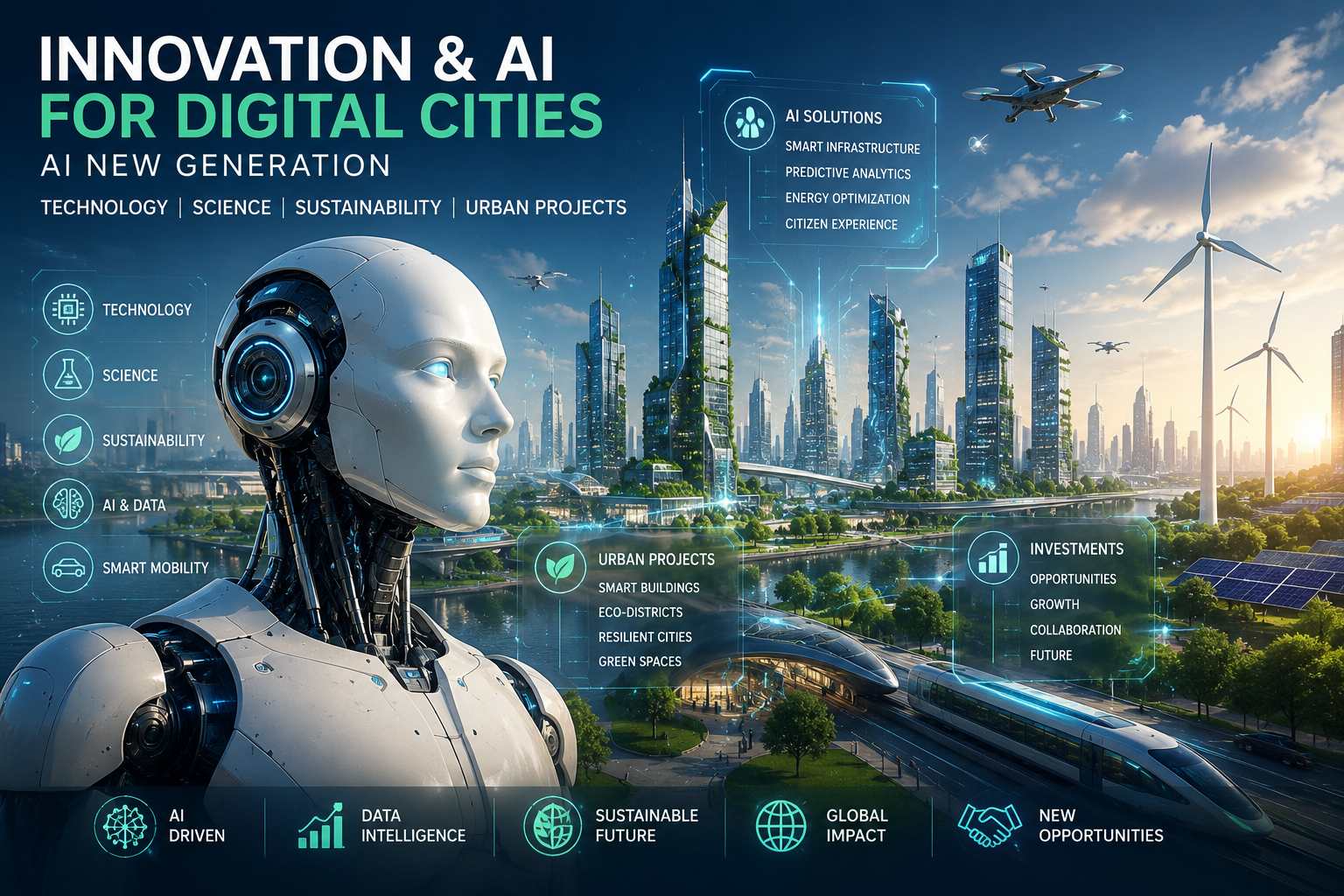
The Cognitive Infrastructure of an AI-Native City in the Fifth Wave
Introduction
Artificial Intelligence represents one of the most significant technological transformations since the emergence of the Internet.
However, its greatest potential extends far beyond generating text, images, software code, or multimedia content.
Its true value lies in becoming the cognitive infrastructure capable of coordinating, optimizing, and empowering entire urban ecosystems.
Within this vision, Digital Cities adopts a fundamentally different approach.
Artificial Intelligence is not treated as a standalone product or an additional service.
Instead, it operates as a transversal intelligence layer that connects every Smart Digital Node, Innovation Hub, institution, business, professional, and citizen across the city.
Artificial Intelligence evolves from being a tool into becoming the city’s digital nervous system.
A City Designed to Communicate with Artificial Intelligence
Most cities currently store information across disconnected websites, databases, and independent digital platforms.
Every organization publishes information using different formats, structures, and standards.
As a consequence:
- Information becomes difficult to integrate.
- AI systems must continually reinterpret inconsistent data.
- Knowledge fragmentation increases.
- Valuable information often remains hidden or inaccessible.
Digital Cities proposes a different model.
All information is organized through a common semantic architecture.
Every organization maintains a Smart Digital Node specifically designed to be understood by both people and Artificial Intelligence systems.
Artificial Intelligence as Infrastructure
Within the Digital Cities ecosystem, Artificial Intelligence does not replace organizations.
It connects them.
Its primary functions include:
- Organizing information
- Discovering relationships
- Automating processes
- Supporting decision-making
- Creating new opportunities
Artificial Intelligence therefore operates as a shared digital infrastructure that strengthens collaboration across the entire urban ecosystem.
AI-Native by Design
Many digital projects simply add Artificial Intelligence as an additional feature.
Digital Cities adopts an AI-Native philosophy.
This means the entire architecture has been designed from the beginning around collaboration between people and intelligent systems.
Every Smart Digital Node contains structured information describing:
- Identity
- Activities
- Categories
- Areas of specialization
- Geographic location
- Services
- Products
- Capabilities
- Relationships
This standardized structure enables Artificial Intelligence models to understand organizational context quickly and accurately.
Smart Digital Nodes
Every participating organization maintains its own Smart Digital Node within the ecosystem.
Each node may include structured information such as:
- Institutional profile
- Images
- Videos
- Documents
- External links
- Product and service catalogs
- Event calendars
- News
- Promotions
- Contact channels
Artificial Intelligence uses this information to:
- Answer questions
- Generate recommendations
- Identify collaboration opportunities
- Connect organizations with complementary capabilities
Each Smart Digital Node becomes an active participant within the city’s knowledge infrastructure rather than simply another webpage.
Specialized Innovation Hubs
Digital Cities organizes knowledge through specialized sector-based Innovation Hubs.
Examples include:
- E-Learning Hub
- Innovation Hub
- Business Hub
- Professional Hub
- Health & Wellness Hub
- Gourmet AI-Native Hub
- Hospitality Hub
- Real Estate Hub
- Omnimedia Hub
Each Hub incorporates specialized intelligence tailored to its own field.
There is not a single Artificial Intelligence system.
Instead, there is an ecosystem of specialized AI services working together through coordinated interoperability.
Intelligent AI Agents
The next evolutionary stage involves deploying specialized AI agents throughout the ecosystem.
Examples include:
AI Concierge
Assists residents and visitors by answering questions such as:
- What attractions should I visit?
- Where should I stay?
- What events are happening today?
- How can I get there?
AI Realtor
Helps users identify suitable real estate opportunities by analyzing:
- Budget
- Preferred location
- Property characteristics
- Investment potential
AI Gourmet
Recommends restaurants according to:
- Dietary preferences
- Current location
- Budget
- Available time
AI Business
Supports companies by recommending:
- Suppliers
- Strategic partners
- Professional services
- Funding opportunities
- Commercial partnerships
AI Learning
Guides students and lifelong learners by analyzing:
- Personal interests
- Existing skills
- Available educational programs
- Employment opportunities
Rather than functioning as isolated assistants, these specialized AI agents collaborate across the ecosystem to deliver contextual, personalized, and actionable recommendations.
Relationship Discovery
One of the most valuable capabilities of Artificial Intelligence is its ability to identify relationships that would otherwise remain invisible.
For example:
A startup is searching for specialists in computer vision.
Instead of relying on manual searches, the platform can automatically identify:
- University researchers
- Technology companies
- Research laboratories
- Specialized training programs
- Independent consultants
Artificial Intelligence transforms isolated information into connected knowledge, accelerating collaboration and reducing the time required to discover strategic opportunities.
Intelligent Automation
Artificial Intelligence enables the automation of numerous operational processes across the ecosystem.
These may include:
- Information updates
- Content classification
- Executive summaries
- Multilingual translation
- Initial customer assistance
- Statistical analysis
- Personalized recommendations
By automating repetitive tasks, organizations can dedicate more time and resources to activities requiring creativity, expertise, and strategic decision-making.
Automation becomes a productivity multiplier rather than a replacement for human talent.
Structured Information
The effectiveness of Artificial Intelligence depends directly on the quality of available data.
For this reason, Digital Cities is built upon a structured information architecture.
Every Smart Digital Node maintains clearly defined data fields describing its identity, services, capabilities, relationships, and activities.
This structured approach enables:
- Precise search capabilities
- Seamless interoperability
- Automated analysis
- Intelligent recommendation engines
- AI agent training
- Semantic understanding
Well-structured information becomes the foundation upon which the city’s cognitive infrastructure is built.
AI-Ready Cities
An AI-Ready City possesses specific characteristics that enable effective collaboration with intelligent systems.
Its information is:
- Consistent
- Structured
- Interoperable
- Continuously updated
- Reusable
Within such an environment, Artificial Intelligence can automatically understand:
- What each organization does
- Where it operates
- Which partners are compatible
- Which products and services are available
- What collaboration opportunities exist
Rather than navigating disconnected websites, AI systems interact with an organized urban knowledge base.
Cross-Sector Intelligence
Artificial Intelligence is not confined to individual Innovation Hubs.
It operates across the entire ecosystem.
A university may automatically connect with:
- Companies
- Startups
- Media organizations
- Coworking spaces
- Independent professionals
- Government agencies
Knowledge flows naturally across institutional and economic boundaries.
Cross-sector collaboration becomes a structural feature of the ecosystem rather than an exceptional event.
Continuous Learning
The Digital Cities ecosystem continuously improves as new participants join the network.
Every new Smart Digital Node contributes to:
- Expanding the collective knowledge base
- Creating new relationships
- Improving recommendation quality
- Strengthening ecosystem intelligence
The city gradually develops the characteristics of a learning ecosystem, where collective knowledge becomes increasingly valuable over time.
Each new participant increases the value of the network for every other participant.
Omnimedia and Artificial Intelligence
Content published throughout the Omnimedia ecosystem can be analyzed automatically by Artificial Intelligence.
AI may assist by:
- Summarizing news
- Detecting emerging trends
- Classifying information
- Recommending relevant content
- Distributing publications according to audience interests
This creates a communication ecosystem that is more relevant, personalized, and efficient.
Information evolves into structured knowledge capable of generating new opportunities throughout the city.
Intelligent Analytics
Aggregated ecosystem data enables the creation of strategic intelligence indicators.
Examples include:
- Fastest-growing economic sectors
- Demand for professional skills
- Tourism trends
- Educational needs
- Investment opportunities
- Commercial activity patterns
Decision-making can increasingly rely on measurable evidence rather than intuition alone.
Artificial Intelligence transforms operational data into actionable strategic insights that support businesses, institutions, researchers, investors, and public organizations alike.