





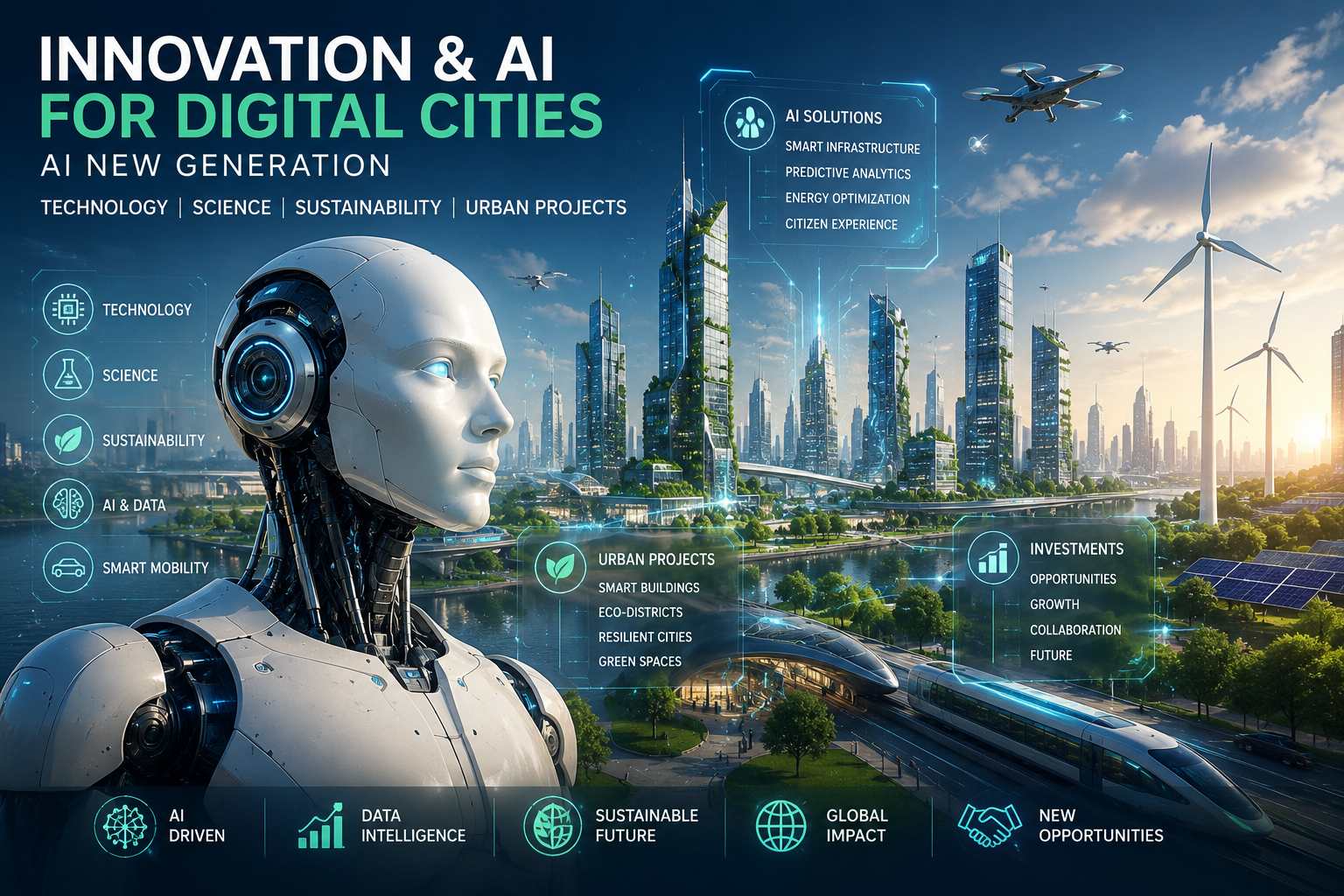
The City of the Future
An AI-Native Platform for Transforming Cities into Global Ecosystems of Innovation, Entrepreneurship, and Knowledge
Introduction
For decades, innovation was primarily understood as the creation of new technologies within universities, research centers, or large corporations.
Today, the emergence of Artificial Intelligence, automation, and digital platforms is fundamentally transforming that paradigm.
In the AI-Native economy, innovation no longer depends exclusively on large laboratories or extraordinary budgets.
Instead, it emerges from the ability to connect talent, knowledge, infrastructure, and markets through interoperable ecosystems.
Within this context, Innovation Hub was conceived as one of the strategic pillars of the Digital Cities ecosystem and the future international OmniCities™ Network.
Its objective is not to build another physical innovation center.
Its objective is to create an open digital infrastructure capable of transforming a city into an international hub for innovation, entrepreneurship, research, and technological collaboration.
A New Definition of an Innovation Hub
Traditionally, an innovation hub is understood as a physical location where startups, technology companies, accelerators, and entrepreneurs work together.
Innovation Hub significantly expands this concept.
It is not a place.
It is a distributed ecosystem.
Every company, university, professional, coworking space, public institution, laboratory, media organization, investor, or nonprofit organization can become an active node within the network.
Innovation is no longer concentrated inside a single building.
Instead, it becomes distributed across the entire city.
The City as a Platform
The concept begins with a simple idea:
A city can function as a single innovation platform.
Rather than operating through isolated initiatives, the ecosystem connects:
- Universities
- Technical schools
- Higher education institutes
- Research centers
- Industrial parks
- Companies
- Startups
- Coworking spaces
- Laboratories
- Government agencies
- Business associations
- Media organizations
- Investors
- Social organizations
All interconnected through a shared AI-Native digital architecture.
AI-Native Architecture
The platform is built upon a modular structure.
OmniCities™
↓
Digital City Platform
↓
Innovation Hub
↓
Smart Digital Nodes
↓
Artificial Intelligence
↓
Global Markets
Every participating organization receives its own Smart Digital Node.
A Smart Node is much more than an institutional profile.
It is a digital identity specifically designed to interact with:
- Citizens
- Businesses
- Institutions
- Investors
- AI assistants
- Autonomous software agents
Smart Digital Nodes
Every organization maintains its own dedicated page within the ecosystem.
Its structured profile may include:
- Organizational identity
- Areas of specialization
- Geographic location
- Contact information
- Images
- Videos
- Product and service catalogs
- Projects
- Research activities
- Publications
- Collaboration opportunities
All information is organized using semantic structures so that Artificial Intelligence systems can automatically understand, classify, and connect the capabilities of every participating organization.
The Innovation Ecosystem
Innovation Hub connects every major participant within the local innovation economy.
Education
Universities develop talent.
Technical institutes build operational capabilities.
Professional schools provide specialized skills.
Together, the educational system becomes directly connected to employment opportunities and entrepreneurial development.
Research
Research groups and scientific institutions can publish:
- Research programs
- Technological developments
- Patents
- Collaborative projects
Artificial Intelligence helps identify compatible research partners and potential technology collaborators.
Business
Companies are no longer viewed solely as employers seeking talent.
Instead, they become active participants in the innovation process.
Organizations may publish:
- Technological challenges
- Automation needs
- Applied research projects
- Investment opportunities
Startups
Within the ecosystem, startups gain direct access to:
- Mentors
- Clients
- Technology providers
- Software developers
- Investors
- Pilot testing environments
Everything exists within a single interconnected ecosystem designed to accelerate innovation and business creation.
The New Urban Laboratory
Innovation Hub transforms the city into a permanent living laboratory.
Every innovation can first be designed, tested, validated, and refined within the local urban environment before being replicated throughout the OmniCities™ Network.
This approach significantly reduces:
- Validation time
- Development costs
- Technological risk
- Market uncertainty
Cities become real-world innovation environments where solutions can evolve through continuous experimentation and measurable results.
Integration with GenAcademy
One of the strategic pillars of Innovation Hub is its integration with GenAcademy.
Rather than separating education from economic activity, the platform creates a continuous development pathway:
Education
↓
Practical Experience
↓
Coworking Spaces
↓
Collaborative Projects
↓
Startup Creation
↓
International Expansion
Learning no longer ends with a diploma.
Instead, education becomes the beginning of an innovation journey that leads toward productive employment, entrepreneurship, and international business development.
AI-Native Workforce
One of the primary objectives of Innovation Hub is to help develop a workforce prepared for the AI-Native economy.
Professionals are trained to work with technologies such as:
- Generative Artificial Intelligence
- Process Automation
- Intelligent Agents
- Data Analytics
- Digital Commerce
- Digital Media
- AI-Driven Marketing
- Robotics
The goal extends beyond teaching software tools.
It focuses on developing entirely new models of production, collaboration, and value creation that combine human expertise with Artificial Intelligence.
Distributed Innovation
Innovation Hub removes many of the traditional barriers separating organizations.
Companies can collaborate directly with:
- Universities
- Independent professionals
- Startups
- Research laboratories
- Students
Artificial Intelligence assists by identifying complementary capabilities and potential partnerships.
Innovation therefore becomes less dependent on personal networks and more dependent on structured knowledge, interoperability, and shared opportunities.
Immediate Internationalization
Through the OmniCities™ Network, innovations developed in one city can immediately be projected toward international markets, including:
- Latin America
- North America
- Europe
- Africa
- The Middle East
- Asia-Pacific
International expansion is no longer viewed as a later stage of growth.
Instead, it becomes an integral part of the innovation strategy from the very beginning.
Solutions are designed with global scalability in mind.
Innovation Marketplace
Innovation Hub incorporates a digital marketplace where organizations and professionals may offer:
- Professional services
- Consulting
- Technology solutions
- Software
- Industrial and digital design
- Scientific research
- Intellectual property
- Technology licensing
- Education and training
Every Smart Digital Node has the potential to become a global provider within the network.
This marketplace transforms local expertise into international business opportunities.
Smart Funding
The platform facilitates access to multiple funding mechanisms designed to support innovation at different stages of development.
Possible funding sources include:
- Private investment
- Strategic partnerships
- International cooperation programs
- Micro-investment models
- Milestone-based financing
- Revenue-sharing structures
- Collaborative investment mechanisms
Project evaluation may rely on objective performance indicators and measurable milestones, reducing information asymmetry between entrepreneurs, investors, and partner organizations.
The result is a more transparent, data-driven investment environment.
Omnimedia Integration
Every innovation developed within the ecosystem can be amplified through the integrated Omnimedia communications network.
A single innovation may generate multiple forms of content, including:
- News articles
- Feature stories
- Interviews
- Videos
- Case studies
- Educational resources
Communication therefore becomes an ongoing strategic process rather than an isolated marketing campaign.
By integrating journalism, education, audiovisual production, and digital publishing, Innovation Hub enables new ideas to gain visibility, attract collaborators, engage investors, and accelerate adoption both locally and internationally.