






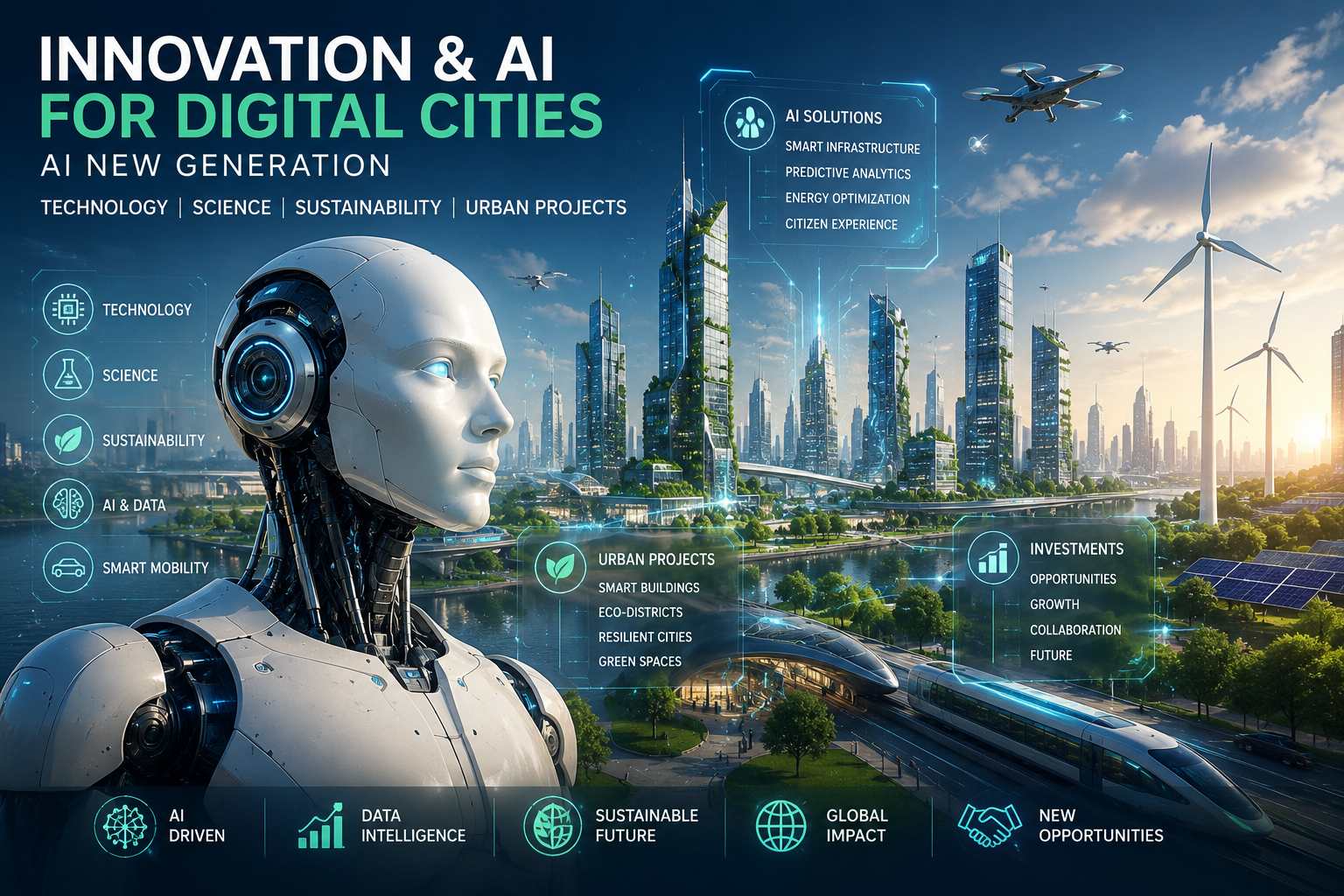
The Scientific Infrastructure of an AI-Native City in the Fifth Wave
Introduction
Throughout history, the cities that have led major economic transformations have shared one defining characteristic: the ability to generate, integrate, and apply scientific knowledge.
Today, Artificial Intelligence, distributed computing, biotechnology, robotics, data science, and automation are reshaping the way scientific research creates value for society.
Yet the greatest challenge is no longer simply producing more research.
The real challenge is connecting science with the economy, education, innovation, industry, and society.
Digital Cities addresses this challenge by incorporating Science as a strategic component of its AI-Native ecosystem.
Rather than functioning as an isolated academic activity, science becomes a shared knowledge infrastructure that connects researchers, universities, technology centers, companies, public institutions, startups, and citizens.
Science evolves from an independent discipline into a permanent driver of urban development.
A New Vision of Science
Traditionally, scientific research has been organized through relatively independent institutions.
Universities, laboratories, and research centers have generally developed their own research agendas with limited interaction across disciplines or sectors.
Digital Cities proposes a new model.
The city itself becomes a collaborative scientific laboratory.
Every institution preserves its autonomy while participating in a shared infrastructure that facilitates cooperation, knowledge exchange, and interdisciplinary innovation.
Science becomes part of a connected urban ecosystem rather than a collection of isolated organizations.
The City as a Scientific Ecosystem
Knowledge is no longer produced exclusively within universities.
Scientific and technological capabilities are also developed by:
- Companies
- Hospitals
- Research laboratories
- Government agencies
- Startups
- Independent professionals
- Nonprofit organizations
- Technology centers
- Scientific observatories
- Specialized institutes
Together, these organizations form a single scientific ecosystem.
Every participant contributes knowledge, expertise, and innovation to the city’s collective intelligence.
AI-Native Science
Artificial Intelligence is transforming the scientific method itself.
Researchers can now accelerate tasks such as:
- Literature review
- Statistical analysis
- Scientific simulations
- Image processing
- Mathematical modeling
- Pattern recognition
- Hypothesis generation
Digital Cities incorporates these capabilities as permanent scientific infrastructure.
Artificial Intelligence does not replace researchers.
It enhances their ability to explore knowledge, process information, and generate discoveries more efficiently.
The Scientific Digital Node
Every researcher, laboratory, university, or scientific institution may maintain its own Scientific Digital Node.
Each node can include structured information such as:
- Research areas
- Scientific publications
- Active projects
- Research teams
- Laboratories
- Scientific equipment
- Areas of expertise
- Collaboration needs
- Funding opportunities
- Intellectual property
- Technological outcomes
This information is organized semantically so that both people and intelligent systems can easily discover relevant expertise and collaboration opportunities.
The Scientific Network
The scientific ecosystem may integrate organizations such as:
Universities
- Research groups
- Academic departments
- Research institutes
- Graduate programs
National Research Organizations
- Research institutes
- Scientists
- Fellows
- Collaborative centers
Agricultural and Environmental Research Centers
- Sustainable production
- Food innovation
- Environmental technologies
Marine and Ocean Research Institutes
- Marine science
- Fisheries
- Oceanography
- Biodiversity
- Blue Economy
Technology Centers
- Industrial innovation
- Technology transfer
- Applied engineering
Hospitals and Healthcare Institutions
- Clinical research
- Digital health
- Epidemiology
- Biomedical innovation
Private Companies
- Research and Development
- Applied innovation
- Industrial experimentation
All of these organizations become interconnected through a common scientific infrastructure rather than operating independently.
Interdisciplinary Science
One of today’s greatest scientific challenges is connecting disciplines that traditionally worked separately.
For example, an Artificial Intelligence research project may require collaboration among:
- Mathematicians
- Physicians
- Engineers
- Psychologists
- Economists
- Environmental scientists
- Computer scientists
The Digital Cities platform facilitates the creation of multidisciplinary research teams capable of addressing complex real-world challenges.
Scientific collaboration becomes easier, faster, and more accessible through structured information and intelligent discovery.
Open Science
Digital Cities encourages the open circulation of scientific knowledge.
Each research project may publish:
- Scientific articles
- Datasets
- Research results
- Videos
- Conferences
- Technical documentation
- Demonstrations
- Educational resources
Knowledge sharing strengthens the entire ecosystem.
Scientific visibility increases collaboration opportunities, accelerates innovation, and promotes the reuse of existing knowledge across institutions and sectors.
Applied Science
The objective extends beyond publishing scientific research.
The goal is to generate practical solutions that improve society and create economic value.
Research may contribute to areas such as:
- Advanced manufacturing
- Medical technologies
- Industrial automation
- Renewable energy
- Smart logistics
- Blue Economy
- Smart agriculture
- Environmental sustainability
Scientific discoveries can rapidly evolve into real-world applications that benefit both the local community and international markets.
Technology Transfer
One of the fundamental objectives of the Digital Cities scientific ecosystem is to reduce the distance between scientific research and productive activity.
Organizations can publish technological challenges directly through the platform.
Artificial Intelligence can then identify the most suitable:
- Researchers
- Scientific teams
- Research laboratories
- Universities
- Technology centers
- Startups
This significantly accelerates the formation of multidisciplinary teams capable of solving real-world challenges.
Technology transfer becomes a continuous process rather than an occasional event.
Science and Innovation
Scientific knowledge forms the foundation of the Innovation Hub.
Every scientific discovery has the potential to evolve through a structured innovation pathway:
Scientific Research
↓
Prototype Development
↓
Intellectual Property
↓
Startup Creation
↓
Business Development
↓
Global Markets
Scientific discoveries are no longer viewed solely as academic achievements.
They become catalysts for entrepreneurship, industrial innovation, and sustainable economic growth.
Science and Education
The integration of Science with the E-Learning Hub creates a continuous relationship between research and education.
Scientific knowledge becomes the basis for:
- Academic programs
- Professional training
- Technical education
- Continuing education
- Specialized certifications
Students gain access to current scientific developments while participating in research projects at earlier stages of their education.
Learning and scientific research become complementary components of the same knowledge ecosystem.
Science and Business
The Business Hub enables scientific knowledge to be incorporated directly into productive activities.
Companies can:
- Access scientific expertise
- Contract specialized consulting
- Develop collaborative research projects
- Validate emerging technologies
- Accelerate innovation
- Improve competitiveness
Scientific knowledge evolves into a strategic economic asset capable of generating measurable business value.
Data Science
Data Science represents one of the strategic pillars of the Digital Cities ecosystem.
The platform continuously generates structured information about:
- Economic activity
- Tourism
- Education
- Urban mobility
- Employment
- Innovation
- Commerce
- Environmental conditions
These datasets support predictive models, scenario analysis, and evidence-based planning for both public and private organizations.
Artificial Intelligence for Scientific Research
Artificial Intelligence supports researchers by accelerating many knowledge-intensive tasks.
Intelligent systems may assist with:
- Literature searches
- Publication comparison
- Scientific translation
- Statistical analysis
- Numerical simulations
- Report generation
- Knowledge organization
- Semantic document classification
These capabilities reduce research time while improving scientific productivity.
Artificial Intelligence acts as an intelligent research assistant rather than replacing scientific expertise.
Scientific Omnimedia
Scientific discoveries can be communicated through a specialized digital media ecosystem.
Every research project may generate:
- News articles
- Educational videos
- Expert interviews
- Podcasts
- Scientific reports
- Educational materials
Scientific communication becomes more accessible to citizens, businesses, policymakers, investors, and educational institutions.
Knowledge no longer remains confined to academic journals.
It becomes part of the public innovation ecosystem.
International Scientific Collaboration
Through the OmniCities™ Network, scientific institutions can establish collaborative relationships with organizations around the world.
Potential partners include:
- Universities
- Technology centers
- Research laboratories
- Companies
- Scientific institutes
- Independent researchers
The city becomes an active participant in a global network of scientific cooperation.
Artificial Intelligence helps identify complementary expertise, emerging research opportunities, and potential international collaborations.
The Knowledge Economy
Scientific performance is no longer measured solely by the number of academic publications.
Knowledge also generates:
- Intellectual property
- Technology licensing
- Scientific consulting
- Startup creation
- High-skilled employment
- Exportable knowledge-based services
- New industries
Knowledge itself becomes a strategic economic resource capable of strengthening regional competitiveness and long-term sustainable development.
Science for Public Policy
Scientific knowledge also strengthens evidence-based decision-making.
Public institutions may access:
- Strategic indicators
- Predictive scenarios
- Scientific simulations
- Research-based evidence
- Comparative analyses
- Impact assessments
This supports more transparent, informed, and effective public policies.
Rather than relying exclusively on intuition or historical experience, governments can incorporate scientific evidence into urban planning, environmental management, economic development, education, healthcare, and innovation policies.