






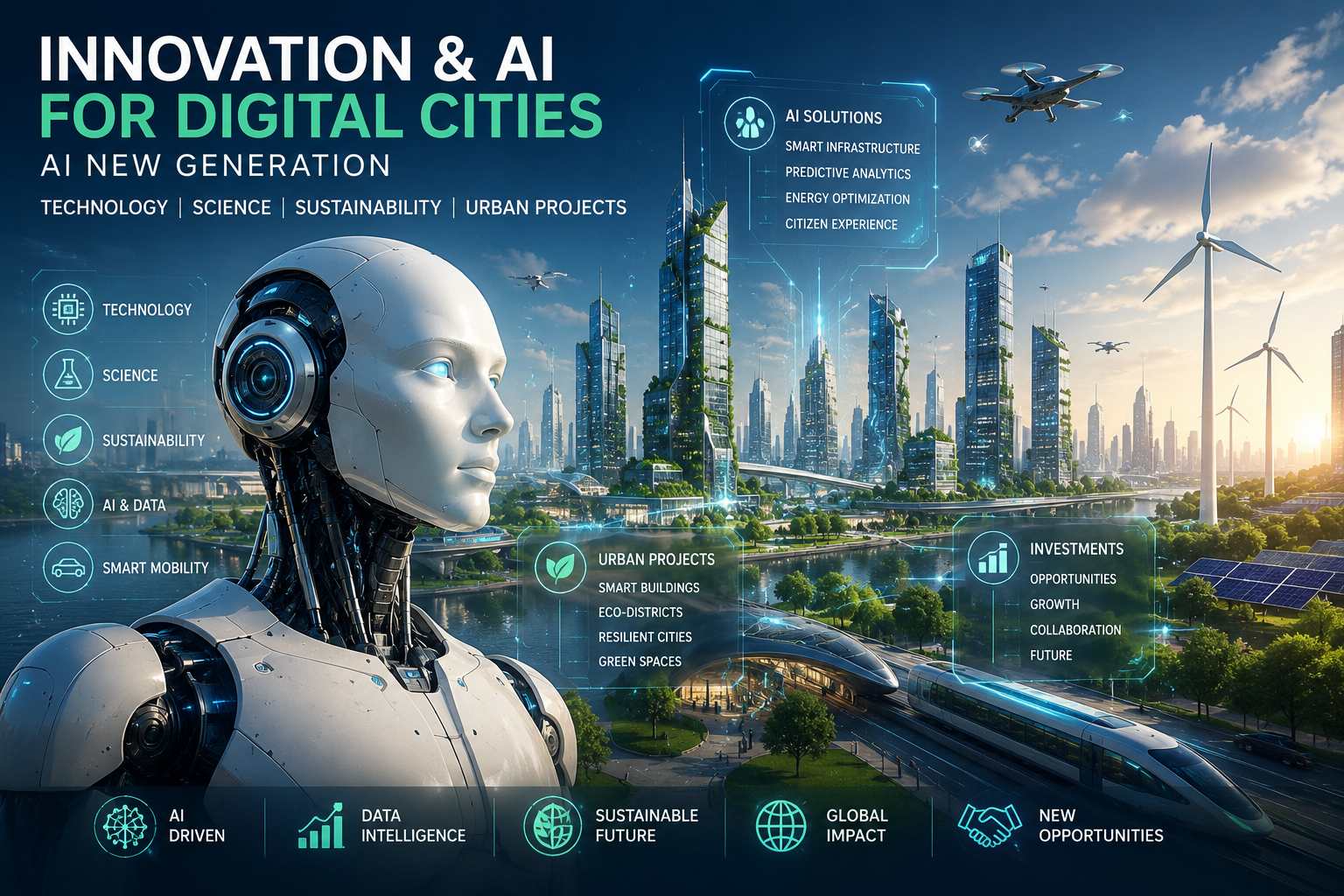
Transforming Cities into AI-Native, Interoperable, Productive, and Fifth Wave Ecosystems
Introduction
Twenty-first century cities can no longer be planned solely through physical infrastructure, traditional zoning, and fragmented responses to isolated problems.
The emerging urban landscape requires the integration of infrastructure, technology, sustainability, mobility, economy, education, housing, tourism, healthcare, culture, and governance within a single strategic framework.
Digital Cities introduces a new approach to urban development.
An urban project is no longer viewed simply as a construction project.
It becomes a territorial transformation system capable of integrating:
- Physical infrastructure
- Digital layers
- Artificial Intelligence
- Structured data
- Interoperable services
- Investment
- Institutional collaboration
- Economic activity
- Education and workforce development
- Communication
- Sustainability
Cities no longer grow through disconnected projects.
They evolve as coordinated, intelligent ecosystems.
A New Definition of Urban Projects
Traditionally, urban projects have consisted of physical interventions such as roads, public squares, housing developments, ports, transportation terminals, or commercial districts.
Within Digital Cities, every project is conceived as a hybrid infrastructure.
Each initiative includes not only a physical dimension but also digital, economic, social, environmental, and cognitive components.
For example, a new urban center should incorporate far more than buildings and streets.
It should also integrate:
- Digital connectivity
- Online commerce
- Smart mobility
- Urban data
- Business nodes
- Public services
- Education
- Analytics
- Artificial Intelligence
- Digital communication
- Integration with the OmniCities™ Network
The true urban project is not the isolated construction itself.
It is the network of relationships, services, and opportunities that the project creates.
The City as a Project Platform
Digital Cities functions as a common platform for identifying, organizing, evaluating, communicating, and managing urban projects.
Every initiative may include its own Project Digital Node, containing structured information such as:
- Project name
- Geographic location
- Objectives
- Scope
- Participating organizations
- Development phases
- Budget
- Funding sources
- Expected impact
- Technical documentation
- Images
- Videos
- Performance indicators
- Risk assessment
- Progress reports
- Participation opportunities
This standardized structure allows every project to become transparent, traceable, and easily understood by citizens, institutions, investors, and intelligent systems.
The Smart Urban Node
Every project can evolve into a Smart Urban Node.
This node centralizes all relevant information within a unified digital environment, including:
🏗 Technical description
📍 Geographic location
📐 Plans, drawings, and renderings
📊 Performance indicators
💰 Investment requirements
🤝 Participating institutions
📅 Development schedule
🌱 Environmental impact
👥 Social impact
🏢 Business opportunities
🎓 Related educational programs
📰 News and updates
🎥 Videos and multimedia
🤖 AI-powered assistant
Instead of becoming a static administrative document, each project becomes a living platform that supports information sharing, collaboration, monitoring, and continuous improvement.
A Layered Urban Architecture
Digital Cities organizes urban projects through multiple interconnected layers.
Physical Layer
Includes:
- Buildings
- Infrastructure
- Utility networks
- Public spaces
- Urban facilities
- Ports
- Transportation corridors
- Public services
Digital Layer
Includes:
- Connectivity
- Sensors
- Digital platforms
- Smart nodes
- Geographic information
- Data infrastructure
- Applications
- Process automation
Economic Layer
Includes:
- Investment
- Business models
- Employment
- Commerce
- Services
- Industry
- International exports
Social Layer
Includes:
- Housing
- Social inclusion
- Education
- Healthcare
- Accessibility
- Citizen participation
Environmental Layer
Includes:
- Energy
- Water
- Waste management
- Biodiversity
- Urban resilience
- Resource efficiency
- Climate adaptation
AI-Native Layer
Includes:
- Predictive simulations
- Demand forecasting
- Resource optimization
- Predictive maintenance
- Continuous monitoring
- Risk detection
- Intelligent coordination among stakeholders
Artificial Intelligence enhances every other layer by improving decision-making, operational efficiency, and long-term planning.
Urban Project Portfolio
Digital Cities can organize a comprehensive portfolio of projects grouped into strategic development areas.
Rather than evaluating initiatives independently, the platform views them as complementary components of a shared urban transformation strategy.
Each project contributes to strengthening the overall ecosystem while remaining capable of evolving independently.
This modular approach allows cities to prioritize investments, coordinate stakeholders, measure impacts, and progressively expand successful initiatives over time.
1. Digital Neighborhood Centers
A balanced city distributes opportunities rather than concentrating them in a single urban core.
Digital Cities promotes the development of Digital Neighborhood Centers that bring essential services closer to every community.
Each neighborhood center may integrate:
- Coworking spaces
- AI-Native education
- Local commerce
- Public services
- Telemedicine
- Digital government services
- Cultural activities
- Last-mile logistics
- Smart pickup points
- AI-powered assistance
The objective is to reduce unnecessary travel while increasing local economic activity and improving residents’ quality of life.
Every neighborhood becomes an active participant in the city’s digital economy.
2. AI-Native Commercial Corridors
Traditional commercial streets can evolve into intelligent commercial ecosystems.
Each business may be connected through its own Digital Node, including:
- Digital storefront
- Product catalog
- Geolocation
- Promotions
- Digital payments
- Delivery services
- Business analytics
- AI-powered customer assistance
- Omnimedia integration
Instead of operating independently, businesses become part of a distributed urban marketplace.
Artificial Intelligence can recommend products, optimize customer journeys, and improve visibility for local businesses.
3. Regeneration of Existing Commercial Areas
Many cities possess commercial buildings, shopping arcades, downtown districts, and mixed-use developments with underutilized infrastructure.
Rather than prioritizing entirely new construction, Digital Cities encourages the regeneration of existing urban assets.
Regeneration strategies may include:
- Digital transformation
- Improved security
- Adaptive reuse
- Coworking facilities
- Educational spaces
- Events and community activities
- E-commerce integration
- Urban logistics
- Shared services
- Coordinated promotion
Revitalizing existing infrastructure reduces investment costs while preserving urban identity and accelerating economic recovery.
4. Innovation Districts
Innovation does not need to be concentrated within a single technology park.
Digital Cities supports the creation of distributed Innovation Districts connected through digital infrastructure.
Participants may include:
- Universities
- Coworking spaces
- Research laboratories
- Technology companies
- Startups
- Technical centers
- Public innovation agencies
- Business organizations
The entire city becomes an interconnected innovation ecosystem where knowledge, entrepreneurship, and investment circulate freely.
5. The GenAIHub Network
Micro-coworking spaces and practical learning centers may form a highly distributed urban network known as the GenAIHub Network.
Each node can provide:
- AI-Native education
- Practical training
- Remote work facilities
- Professional meetings
- Mentorship
- Startup incubation
- Digital access
- Business networking
This distributed model lowers barriers to participation in the digital economy and expands opportunities across every neighborhood.
Knowledge and entrepreneurship become accessible throughout the city rather than remaining concentrated in a few locations.
6. AI-Native Residential Buildings
Residential developments can evolve into intelligent living environments.
Future housing projects may integrate:
- Energy efficiency
- Smart automation
- Predictive maintenance
- Intelligent security
- Shared digital services
- Sustainable mobility
- Telemedicine
- Remote work infrastructure
- Digital property management
Buildings become active operational systems rather than passive physical structures.
Residents benefit from greater efficiency, lower operating costs, improved comfort, and enhanced quality of life.
7. Smart Building Operations
Artificial Intelligence and automation can improve the daily operation of residential and commercial buildings.
Applications may include:
- Security monitoring
- Cleaning coordination
- Predictive maintenance
- Access control
- Visitor management
- Internal logistics
- Digital concierge services
- Facility management
The objective is not simply to automate existing tasks.
It is to redesign operational processes, eliminate repetitive work, improve safety, reduce costs, and create new opportunities for highly skilled technical employment.
8. Residential Community Transformation
Residential communities and property associations can evolve into more active management ecosystems.
With appropriate digital tools, they may coordinate:
- Group purchasing
- Shared energy initiatives
- Maintenance planning
- Insurance management
- Recycling programs
- Shared services
- Compatible commercial activities
- Local energy generation
Digital governance, transparency, and clearly defined legal frameworks enable residential communities to operate more efficiently while creating additional value for residents.
Instead of functioning solely as administrative entities, they become collaborative communities capable of improving sustainability, reducing costs, and strengthening neighborhood resilience.
9. Smart Mobility
Urban mobility should be managed as an integrated system rather than as independent transportation services.
The Digital Cities platform can coordinate information related to:
- Public transportation
- Parking systems
- Bicycle networks
- Electric vehicles
- Taxis and ride-sharing services
- Urban logistics
- Pedestrian routes
- Tourism mobility
- Universal accessibility
Artificial Intelligence can analyze traffic conditions, recommend optimal routes, anticipate congestion, and improve the efficiency of transportation networks.
The objective is to reduce travel times, operational costs, energy consumption, and environmental impacts while improving the overall urban experience.
10. Micromobility Corridors
The expansion of bicycles, e-bikes, scooters, and other forms of light electric mobility requires dedicated infrastructure.
Digital Cities supports the development of interconnected micromobility corridors that may include:
- Protected lanes
- Secure parking
- Charging stations
- Connections with public transportation
- Smart signage
- Interactive maps
- Predictive maintenance systems
These corridors connect neighborhoods, educational institutions, commercial districts, parks, waterfronts, and business centers while encouraging healthier and more sustainable mobility.
11. Smart Urban Logistics
The continued growth of e-commerce requires a new approach to urban logistics.
The platform can coordinate:
- Delivery operations
- Pickup points
- Urban micro-distribution centers
- Courier services
- Delivery schedules
- Freight consolidation
- Route optimization
By connecting local businesses, payment platforms, logistics providers, and neighborhood hubs, cities can reduce congestion, improve delivery efficiency, and lower transportation costs.
Artificial Intelligence continuously optimizes logistics according to demand, traffic conditions, and available resources.
12. Digital Gourmet Districts
Food and hospitality districts can evolve into digitally connected ecosystems.
Each district may integrate:
- Restaurants
- Local producers
- Chefs
- Culinary events
- Gastronomic routes
- Reservation systems
- Delivery services
- AI-powered recommendations
Artificial Intelligence can personalize recommendations based on:
- User location
- Budget
- Culinary preferences
- Dietary requirements
- Available time
- Sustainability criteria
Local gastronomy becomes an important driver of tourism, entrepreneurship, and regional identity.
13. Smart Hospitality Network
Hotels, hostels, vacation rentals, resorts, visitor centers, and tourism operators can become part of a shared digital network.
The platform may provide:
- Reservation systems
- Local experiences
- Gastronomy recommendations
- Smart mobility services
- Cultural events
- Local commerce
- Multilingual assistance
- AI Concierge services
Visitors experience the city as a coordinated digital ecosystem rather than a collection of independent services.
This integrated approach improves visitor satisfaction while increasing opportunities for local businesses.
14. Coastal and Waterfront Regeneration
For cities with rivers, lakes, or coastlines, waterfronts represent strategic economic, environmental, and social assets.
Planning should integrate:
- Environmental conservation
- Public spaces
- Tourism development
- Sustainable mobility
- Universal accessibility
- Coastal protection
- Economic activities
- Environmental monitoring
Artificial Intelligence and environmental science support continuous evaluation of shoreline conditions, visitor capacity, erosion risks, biodiversity, and long-term sustainability.
15. Climate-Resilient Neighborhoods
Urban areas exposed to flooding, coastal erosion, extreme weather, or rising temperatures require proactive planning.
Projects may incorporate:
- Risk mapping
- Early warning systems
- Adaptive infrastructure
- Insurance strategies
- Resilient building standards
- Emergency evacuation routes
- Green infrastructure
Resilience is most effective when incorporated during planning rather than after disasters occur.
Artificial Intelligence helps evaluate future scenarios and prioritize preventive investments.
16. Green Infrastructure
Parks, urban forests, ecological corridors, wetlands, and green spaces should be understood as essential urban infrastructure.
They contribute to:
- Temperature regulation
- Stormwater management
- Biodiversity conservation
- Recreation
- Public health
- Ecological connectivity
- Climate adaptation
Digital Cities enables these assets to be mapped, monitored, and integrated into educational, scientific, and environmental management programs.
Green infrastructure becomes a measurable component of urban resilience.
17. Smart Water Management
Water management should be approached as an integrated urban system rather than as an isolated public utility.
The platform can support monitoring of:
- Water consumption
- Distribution losses
- Drainage systems
- Water reuse
- Flood management
- Water quality
- Rainwater harvesting
Artificial Intelligence helps identify inefficiencies, forecast demand, and optimize long-term water resource planning.
Water becomes a strategic resource managed through continuous data analysis and predictive intelligence.
18. Circular Materials Economy
Waste management evolves into a resource management system.
Material streams can be identified, classified, and connected with new productive uses.
Examples include:
- Glass
- Plastics
- Textiles
- Organic materials
- Electronic equipment
- Construction materials
Artificial Intelligence can identify reuse opportunities, facilitate industrial symbiosis, and connect producers with organizations capable of transforming waste into valuable resources.
The objective is to reduce landfill dependency while creating new economic opportunities through circular production systems.
19. Smart Energy Districts
Urban energy systems can evolve from isolated consumers into interconnected energy ecosystems.
Neighborhoods, business districts, industrial areas, and residential developments may collaborate through shared energy strategies that include:
- Solar power generation
- Wind energy integration
- Battery storage systems
- Energy efficiency programs
- Smart microgrids
- Demand-response management
- Community energy purchasing
Artificial Intelligence continuously analyzes production, consumption, storage, and demand to improve efficiency and reduce operational costs.
Energy becomes a manageable strategic asset rather than a fixed operating expense.
20. Smart Markets and Local Commerce
Neighborhood markets, public markets, farmers’ markets, and local producers can become part of a connected digital marketplace.
Each participant may maintain a Digital Node containing:
- Product catalog
- Location
- Real-time inventory
- Digital payments
- Online orders
- Logistics services
- Promotional campaigns
Technology enhances local commerce without replacing the physical shopping experience.
Consumers benefit from greater convenience, while producers gain increased visibility and market access.
21. Integrated Healthcare Networks
Healthcare infrastructure can be strengthened through intelligent digital services that complement existing medical systems.
The platform may integrate:
- Telemedicine
- Appointment scheduling
- AI-assisted triage
- Healthcare facility geolocation
- Service availability
- Preventive care programs
- Patient follow-up
- Wellness resources
Artificial Intelligence supports healthcare professionals by improving coordination, optimizing workflows, and enhancing access to information.
Clinical decisions always remain under qualified professional supervision.
22. Health and Wellness Networks
Cities increasingly recognize that public health extends beyond medical care.
Digital Cities encourages coordinated wellness ecosystems connecting:
- Healthcare providers
- Fitness centers
- Nutrition professionals
- Physical therapists
- Mental health specialists
- Wellness centers
- Community sports organizations
Integrated wellness programs may promote:
- Active mobility
- Physical fitness
- Flexibility
- Healthy sleep
- Nutrition
- Preventive healthcare
- Mental well-being
Artificial Intelligence can personalize recommendations while helping citizens build healthier lifestyles.
23. Connected Cultural Infrastructure
Culture represents an essential component of urban identity and economic development.
Digital Cities enables cultural institutions to operate as an interconnected ecosystem.
Participants may include:
- Theaters
- Museums
- Libraries
- Cultural centers
- Festivals
- Independent creative spaces
- Performing arts organizations
The platform may integrate:
- Event calendars
- Digital ticketing
- Multimedia content
- Cultural routes
- Digital archives
- Educational programs
- Creative production
Culture becomes both a social asset and an economic driver supporting tourism, education, and the creative industries.
24. Digital Heritage
Urban heritage can be preserved through comprehensive digital documentation.
Digital assets may include:
- Historical photographs
- Architectural drawings
- Oral histories
- Three-dimensional models
- Digital archives
- Virtual tours
- Geographic documentation
Digital preservation strengthens conservation efforts while expanding educational opportunities and public access to cultural heritage.
Artificial Intelligence can assist in organizing archives, restoring historical information, and improving discoverability.
25. Youth and Creative Economy Spaces
Future cities require environments where young people can learn, experiment, collaborate, and create new ventures.
Urban projects may include facilities such as:
- Innovation workshops
- Creative studios
- Digital laboratories
- Startup incubators
- Makerspaces
- Collaborative coworking environments
- Multimedia production facilities
These spaces encourage entrepreneurship, technological experimentation, artistic production, and knowledge exchange.
Young talent becomes an essential driver of urban innovation.
26. International Remote Work Networks
The growth of the global digital economy enables cities to attract international professionals and export knowledge-based services.
To support this transformation, cities may develop:
- High-speed connectivity
- AI-Native education
- Distributed coworking spaces
- Digital business services
- International payment solutions
- Professional support services
- Global networking communities
- International promotion strategies
Rather than depending exclusively on traditional industrial infrastructure, cities can participate directly in global knowledge markets through remote work and digital entrepreneurship.
27. AI-Native Urban Observatory
Every intelligent city requires a permanent analytical layer.
The AI-Native Urban Observatory continuously monitors key dimensions of urban development, including:
- Housing
- Mobility
- Economic activity
- Tourism
- Employment
- Environment
- Investment
- Education
- Healthcare
- Innovation
The Observatory goes beyond presenting historical statistics.
It combines real-time information, predictive analytics, and Artificial Intelligence to identify trends, anticipate future challenges, evaluate public policies, and support evidence-based decision-making.
28. Urban Digital Twin
A Digital Twin provides a dynamic virtual representation of urban systems.
Unlike static maps, Digital Twins continuously incorporate real-world information that allows cities to simulate future scenarios.
Potential applications include:
- Traffic simulation
- Flood-risk analysis
- Land-use planning
- Energy management
- Building development
- Emergency evacuation
- Tourism forecasting
- Infrastructure maintenance
Artificial Intelligence transforms the Digital Twin into an interactive planning environment capable of testing alternative strategies before physical implementation.
Rather than replacing the real city, it improves the city’s ability to understand, manage, and continuously optimize its development.
Urban Project Development Methodology
Digital Cities applies a common methodology that enables urban projects to evolve in a structured, transparent, and measurable way.
Rather than treating projects as isolated interventions, each initiative follows a continuous lifecycle that facilitates validation, collaboration, and long-term scalability.
1. Opportunity Identification
The first stage consists of identifying:
- Urban challenges
- Development opportunities
- Existing assets
- Key stakeholders
- Market demand
- Community needs
Artificial Intelligence may assist by analyzing available data, identifying emerging trends, and highlighting strategic opportunities.
2. Project Modeling
Each initiative is then structured by defining:
- Objectives
- Scope
- Stakeholder relationships
- Development phases
- Performance indicators
- Risks
- Expected outcomes
This common framework allows projects from different sectors to be evaluated using consistent criteria.
3. Digital Project Node
Every project receives its own structured Digital Node.
The node centralizes technical information, documentation, progress reports, multimedia resources, investment data, and collaboration opportunities.
This digital infrastructure becomes the project’s permanent knowledge repository throughout its entire lifecycle.
4. Validation
Before large-scale implementation, projects should undergo multiple validation processes, including:
- Technical studies
- Simulations
- Stakeholder consultations
- Pilot programs
- Proofs of concept
Early validation reduces uncertainty while improving project quality.
5. Financing
Digital Cities encourages diversified financing models combining:
- Private investment
- Public funding
- International cooperation
- Public-private partnerships
- Milestone-based financing
Funding is progressively aligned with measurable achievements rather than relying exclusively on large upfront investments.
6. Phased Implementation
Large monolithic projects are replaced by modular implementation.
Each phase should generate measurable value before the next stage begins.
This approach:
- Reduces financial risk
- Accelerates learning
- Improves adaptability
- Encourages continuous improvement
7. Continuous Monitoring
Project performance should be continuously monitored through:
- Progress reports
- Performance indicators
- Budget tracking
- Risk monitoring
- Public transparency dashboards
Continuous evaluation allows projects to adapt as conditions evolve.
8. Scaling
Successful modules can be replicated across:
- Additional neighborhoods
- Other districts
- Metropolitan regions
- International partner cities
Scalability transforms local innovation into globally transferable solutions.
Multi-Criteria Project Evaluation
Urban projects may be evaluated using multiple dimensions rather than relying solely on financial criteria.
Potential evaluation factors include:
- Economic impact
- Social impact
- Environmental performance
- Investment requirements
- Implementation time
- Technical risk
- Scalability
- Interoperability
- Employment generation
- Export potential
- Innovation capacity
- Urban resilience
This balanced evaluation framework supports more objective prioritization and resource allocation.
Stage-Based Financing
One of the central principles of the Digital Cities methodology is progressive investment.
Projects advance through successive stages:
Concept
↓
Feasibility Study
↓
Prototype
↓
Pilot Project
↓
Urban Minimum Viable Project (Urban MVP)
↓
Neighborhood Deployment
↓
Citywide Implementation
↓
OmniCities™ Replication
Each stage is financed according to verified results, reducing investment risk while encouraging continuous validation and improvement.
Institutional Collaboration
Urban transformation requires collaboration among diverse stakeholders.
Potential participants include:
- Municipal governments
- Universities
- Private companies
- Professional associations
- Business chambers
- Nonprofit organizations
- Community groups
- Investors
- Technology providers
Innovation Clusters can function as coordination platforms where public institutions, academia, industry, and civil society jointly develop strategic urban initiatives.
Artificial Intelligence for Urban Planning
Artificial Intelligence can support urban planning throughout every project stage.
Applications may include:
- Scenario modeling
- Project prioritization
- Demand forecasting
- Predictive simulations
- Risk analysis
- Infrastructure maintenance
- Energy optimization
- Logistics planning
- Performance monitoring
- Public communication
Artificial Intelligence enhances planning capabilities by providing analytical support.
Strategic decisions and public accountability remain the responsibility of human leadership.
Transparency and Traceability
Every urban project should maintain complete transparency throughout its lifecycle.
Information may include:
- Objectives
- Responsible organizations
- Budget
- Timeline
- Progress reports
- Performance indicators
- Design revisions
- Public documentation
Transparent governance strengthens public trust, reduces uncertainty, and improves institutional accountability.
Integration with OmniCities™
Urban projects developed within Digital Cities can interact with similar initiatives around the world through the OmniCities™ Network.
Examples include:
- Smart ports
- Sustainable tourism
- Urban mobility
- Blue Economy
- Innovation districts
- Climate resilience
- Digital governance
- Knowledge-based economies
The network enables participating cities to exchange:
- Proven methodologies
- Technology providers
- Operational experience
- Investment opportunities
- Scientific knowledge
- Digital solutions
Successful local projects may evolve into internationally transferable models.
Strategic Benefits
For Cities
- Better strategic planning
- Stronger institutional coordination
- Increased investment attraction
- Lower operational costs
- Greater capacity to anticipate future challenges
For Businesses
- Participation in urban development projects
- Access to new markets
- Innovation opportunities
- Collaboration with research institutions
- International visibility
For Professionals
- High-value employment
- Consulting opportunities
- Participation in multidisciplinary projects
- Continuous professional education
- International collaboration
For Citizens
- Better public services
- Greater transparency
- Active participation
- Improved quality of life
- Expanded economic opportunities
For Investors
- Transparent projects
- Structured information
- Stage-based investment
- Performance indicators
- Reduced information asymmetry
- Improved risk assessment
Risk Management
Large-scale urban transformation also requires careful management of potential risks.
These may include:
- Overly ambitious projects
- Outdated information
- Institutional fragmentation
- Technological dependency
- Digital exclusion
- Environmental impacts
- Governance challenges
- Financial opacity
The Digital Cities architecture incorporates governance mechanisms, periodic audits, cybersecurity practices, and continuous review processes to reduce these risks while maintaining long-term adaptability.
The Fifth Wave City
In the Fifth Wave economy, cities evolve beyond being territories managed through administrative structures alone.
They become intelligent platforms capable of:
- Learning
- Coordinating
- Producing
- Innovating
- Anticipating change
- Collaborating globally
Urban projects are no longer isolated interventions.
They become interconnected components of a common urban architecture.
Project
↓
Digital Node
↓
Specialized Hub
↓
Digital City
↓
OmniCities™ Network
↓
Global Innovation Ecosystem
Each successful project strengthens not only its local environment but also the collective intelligence of the entire network.
Conclusion
Urban Projects for Digital Cities presents a new approach to urban transformation.
Rather than replacing traditional urban planning, architecture, engineering, or public administration, it provides a common digital infrastructure through which data, institutions, businesses, citizens, and Artificial Intelligence can collaborate more effectively.
Each project can begin as a focused intervention and progressively evolve by integrating physical, digital, economic, social, environmental, and AI-Native layers.
The long-term vision is a city capable of innovating as a coordinated system, maximizing the value of existing assets, connecting institutional capabilities, and transforming every urban project into an opportunity for sustainable local development and international collaboration.
In the Fifth Wave economy, the cities that lead will not necessarily be those that build the most infrastructure, but those that best integrate what they build, measure its impact, continuously learn from experience, and connect every new initiative to a shared, intelligent urban ecosystem.