






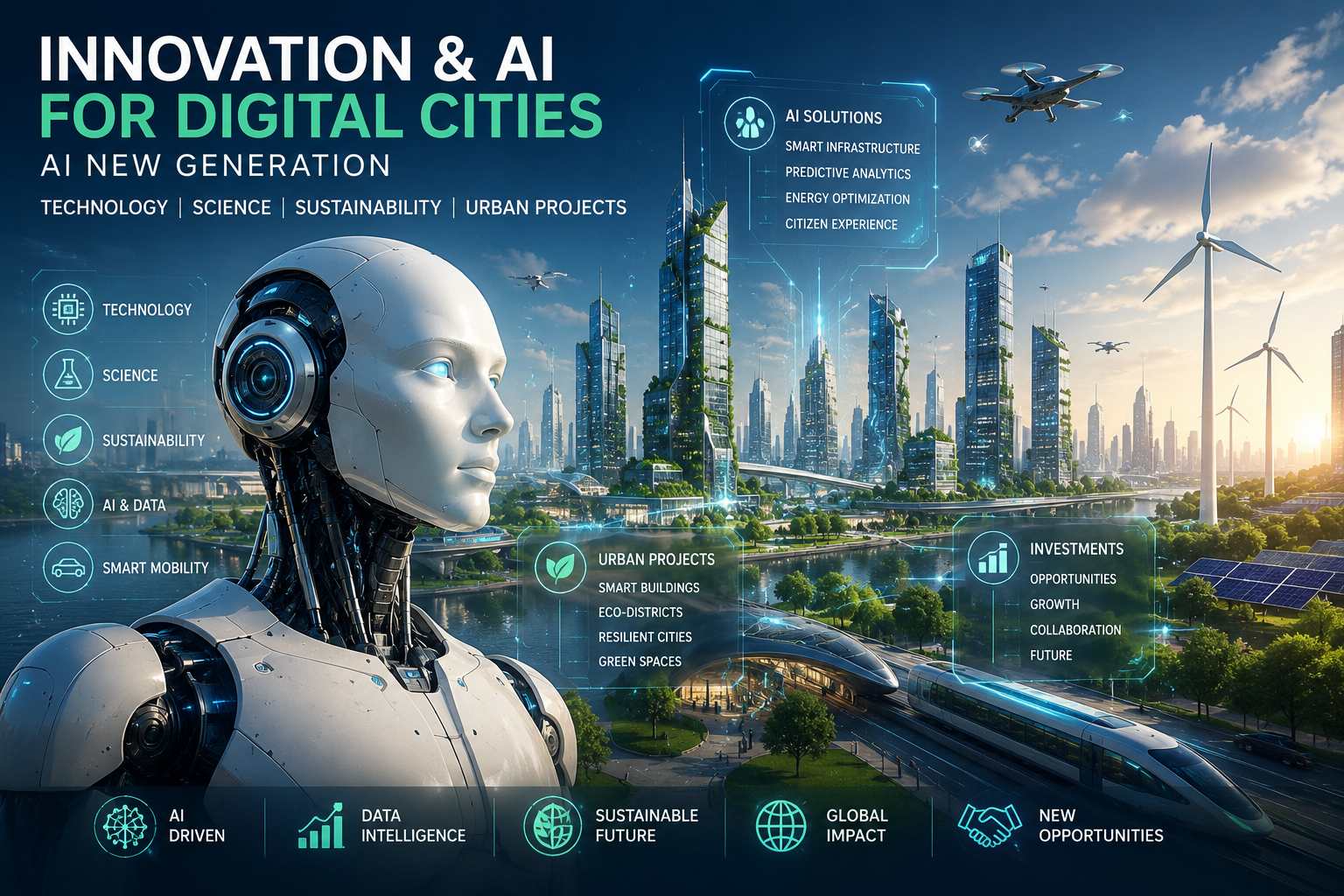
The Financial Architecture of an AI-Native City in the Fifth Wave
Introduction
Every urban, technological, and economic transformation requires investment.
However, one of the greatest limitations of traditional development models is viewing investment solely as financial capital used to build infrastructure, acquire assets, or fund individual companies.
In the AI-Native economy, investment must be understood much more broadly.
Cities invest not only in buildings, software, or equipment, but also in:
- Knowledge
- Human talent
- Data
- Intellectual property
- Collaborative networks
- Automation
- Market access
- Operational capabilities
- Interoperability
- Institutional trust
Within the Digital Cities ecosystem, investment is not an isolated financial function.
It is a transversal infrastructure connecting urban projects, startups, businesses, professionals, research institutions, technology, sustainability initiatives, and international opportunities.
The objective is not simply to attract capital.
The objective is to create an intelligent investment architecture capable of allocating resources progressively, transparently, and according to measurable results.
A New Definition of Investment
Traditional investment models generally follow a linear sequence:
Project
↓
Budget
↓
Capital
↓
Execution
Digital Cities proposes a different approach.
Investment becomes an evolutionary process:
Challenge or Opportunity
↓
Validation
↓
Design
↓
Minimum Viable Product (MVP)
↓
Performance Indicators
↓
Milestone-Based Financing
↓
Scaling
↓
International Expansion
This methodology reduces the risk of allocating significant capital before a project’s feasibility has been demonstrated.
Investment is no longer treated as a single financial event.
It becomes a continuous process of validation, learning, and measured growth.
The AI-Native Investment Hub
Investment activities can be organized through a dedicated Investment Hub within the Digital Cities ecosystem.
Its purpose is to connect:
- Urban projects
- Startups
- Companies
- Investors
- Financial institutions
- Investment funds
- Universities
- Research organizations
- Professional networks
- International markets
Every investment opportunity is represented through its own structured Digital Node.
This standardized architecture improves transparency, comparability, and collaboration throughout the investment process.
The Investment Digital Node
Every investment opportunity should evolve into a Smart Investment Node.
Rather than relying solely on presentations or business proposals, each project maintains a continuously updated digital profile.
Essential Information
Each node may include:
- Project name
- Strategic objective
- Economic sector
- Geographic location
- Responsible organizations
- Development stage
- Capital requirements
- Estimated timeline
- Expected outcomes
- Key risks
- Technical requirements
- Target markets
Supporting Evidence
Projects may also include:
- Technical studies
- Prototypes
- Performance metrics
- Pilot programs
- Commercial agreements
- Letters of intent
- Validation results
- Intellectual property documentation
This evidence allows investors to evaluate opportunities using verified information rather than assumptions.
Continuous Monitoring
Investment Nodes remain active throughout the project lifecycle.
They may include:
- Progress reports
- Completed milestones
- Schedule deviations
- Project updates
- Use of funds
- Performance indicators
- Measured outcomes
Investment therefore becomes connected to continuously evolving information rather than static documentation.
Stage-Based Capital Allocation
One of the fundamental principles of the Digital Cities investment model is progressive financing.
Most projects do not require their entire capital allocation at the beginning.
Instead, funding evolves alongside project maturity.
Stage 1 – Exploration
Supports activities such as:
- Research
- Opportunity analysis
- Concept development
- Market studies
- Technical evaluation
Stage 2 – Prototype
Supports:
- Initial development
- Functional design
- Technical validation
- Early testing
Stage 3 – Minimum Viable Product (MVP)
Supports:
- Operational MVP development
- Pilot deployment
- First users
- Initial commercial validation
Stage 4 – Local Scale
Supports:
- Team expansion
- Marketing
- Operational infrastructure
- Automation
- Local market growth
Stage 5 – Regional or National Expansion
Supports:
- New markets
- Distribution channels
- Operational scaling
- Customer support
- Organizational growth
Stage 6 – International Expansion
Supports:
- Localization
- Multilingual adaptation
- Regulatory compliance
- International partnerships
- Global commercialization
- Market development
Each stage generates measurable evidence that justifies progression to the next phase.
This creates a disciplined investment process that balances innovation with responsible capital allocation.
Milestone-Based Investment
One of the defining characteristics of the Digital Cities investment framework is milestone-based financing.
Rather than releasing large amounts of capital in advance, investment is progressively allocated as predefined milestones are successfully completed.
For example:
Milestone 1
Technical architecture completed
↓
Milestone 2
Operational MVP validated
↓
Milestone 3
First active users
↓
Milestone 4
Initial commercial revenue
↓
Milestone 5
Scalable growth
This approach protects both investors and project teams.
Investors reduce financial exposure through continuous validation.
Project leaders benefit from a clear development roadmap with measurable objectives.
Investment Models
Digital Cities supports multiple investment structures, recognizing that different projects require different financing mechanisms.
Rather than promoting a single funding model, the platform enables a diversified investment ecosystem capable of adapting to the characteristics of each initiative.
Venture Capital
Suitable for startups and high-growth technology companies.
Possible structures include:
- Equity participation
- Convertible notes
- Investment agreements
- Revenue-sharing models
- Strategic partnerships
The objective is to provide growth capital while aligning investor and entrepreneur interests over the long term.
Project Financing
Some initiatives have clearly defined scopes and measurable deliverables.
Examples include:
- Urban infrastructure
- Software development
- Digital platforms
- Production facilities
- Equipment acquisition
- Marketing campaigns
In these cases, financing is linked directly to project execution rather than corporate ownership.
Revenue Sharing
Revenue-sharing agreements allow investors to participate in future income until a predefined return has been achieved.
This model may be particularly appropriate when:
- Cash flow is expected relatively early.
- Entrepreneurs prefer to minimize equity dilution.
- Projects generate recurring operational revenue.
The arrangement aligns financial returns with actual business performance.
Milestone-Based Financing
Funding may be divided into successive stages linked to verified results.
Each financing round is released only after predefined objectives have been successfully completed.
This methodology:
- Reduces investment risk.
- Encourages disciplined execution.
- Improves transparency.
- Supports continuous validation.
Micro-Investment
Certain projects may benefit from smaller contributions distributed among multiple participants, subject to applicable legal and regulatory frameworks.
Micro-investment can broaden participation while supporting community engagement and local economic development.
Strategic Partnerships
Not all investment is financial.
Organizations may contribute:
- Technology
- Distribution channels
- Market access
- Operational expertise
- Infrastructure
- Intellectual property
- Professional knowledge
In return, they may receive commercial rights, equity participation, licensing arrangements, or other forms of strategic collaboration.
Debt Financing
Debt financing may be appropriate for projects with predictable cash flow and sufficient repayment capacity.
However, excessive debt during early development stages should generally be avoided until operational sustainability has been demonstrated.
The Objective Evaluation Matrix
Projects can be evaluated using a common framework that considers multiple dimensions beyond financial return.
Economic Variables
- Revenue potential
- Profitability
- Market size
- Return horizon
- Capital requirements
- Scalability
Operational Variables
- Execution capability
- Team experience
- Operational complexity
- External dependencies
- Speed of implementation
Technology Variables
- Technology maturity
- Innovation level
- Automation potential
- Interoperability
- Intellectual property
Commercial Variables
- Customer access
- Distribution channels
- Market demand
- Competitive landscape
- International expansion potential
Risk Variables
- Legal risk
- Regulatory risk
- Financial risk
- Operational risk
- Technological risk
- Reputational risk
Impact Variables
- Employment generation
- Educational value
- Innovation capacity
- Sustainability
- Social inclusion
- Local economic development
Using standardized evaluation criteria allows opportunities from different sectors to be compared more consistently and objectively.
Valuing Contributions Beyond Capital
Investment participation should not be determined solely by financial contributions.
Projects often benefit from valuable non-financial assets, including:
- Existing intellectual property
- Proprietary technology
- Technical expertise
- Professional services
- Market access
- Business relationships
- Specialized teams
- Operational infrastructure
- Distribution capabilities
- Brand recognition
- Industry experience
Recognizing these contributions creates more balanced partnerships while encouraging broader collaboration.
Intellectual Property
Investment structures should clearly distinguish different forms of intellectual property.
Pre-Existing Intellectual Property
Technology, knowledge, or creative works developed before the project remain the property of their original owners unless otherwise agreed.
Project-Generated Intellectual Property
New intellectual property created during the collaboration should be governed according to contractual agreements established among participants.
Shared Intellectual Property
Certain innovations may be jointly owned according to each participant’s contribution, responsibilities, and contractual arrangements.
Licensing
Licensing agreements allow technologies to be used without transferring ownership.
This model facilitates collaboration while protecting long-term intellectual assets.
Trademarks and Patents
Appropriate protection strategies should be considered according to:
- Geographic scope
- Commercial objectives
- Regulatory requirements
- Industry practices
Clearly defining ownership from the beginning helps reduce future disputes and strengthens investor confidence.
Investment in Startups
Within the Startup Hub, investment can accompany every stage of entrepreneurial development.
A typical progression may include:
Idea
↓
Education
↓
Team Formation
↓
Prototype
↓
Minimum Viable Product (MVP)
↓
Commercial Validation
↓
Scaling
Artificial Intelligence can assist by identifying:
- Competitive strengths
- Capability gaps
- Technical risks
- Talent requirements
- Market opportunities
However, investment decisions should always remain under human evaluation and governance.
Investment in Established Businesses
Digital transformation is equally important for existing companies.
Investment opportunities may include:
- Digital transformation
- Process automation
- E-commerce expansion
- Internationalization
- Energy efficiency
- Business modernization
- Operational expansion
Projects should define measurable objectives, performance indicators, and expected outcomes before financing is allocated.
Investment in Professionals
Professional knowledge itself can become an investable asset.
Examples include:
- Personal brand development
- International positioning
- Professional education
- Digital content creation
- AI specialization
- Remote sales capabilities
- Digital platforms
Returns may be generated through consulting services, international clients, education, licensing, or the export of professional expertise.
Urban Infrastructure Investment
Urban development projects require specialized financing structures.
Potential funding sources may include:
- Private capital
- Public investment
- Concession agreements
- Infrastructure funds
- Public-private partnerships
- International cooperation
Each project should clearly define:
- Development phases
- Capital expenditures (CAPEX)
- Operating expenditures (OPEX)
- Project timeline
- Governance structure
- Risk management
- Expected outcomes
- Economic and social impact
The Digital Cities platform provides transparency, traceability, and coordination while complementing—not replacing—the legal, financial, and technical processes required for infrastructure development.
Investment in Education
Education should be viewed not only as a social service but also as a strategic investment in a city’s future economic capacity.
The Digital Cities Learning Hub positions education as productive capital capable of generating long-term value.
Investment in education may support:
- AI-Native workforce development
- Professional reskilling
- Technical certification
- Remote work capabilities
- Entrepreneurship
- Startup creation
- Digital literacy
- Continuous professional development
The return on educational investment extends beyond tuition revenue.
It contributes to:
- Higher employment
- Increased productivity
- Business creation
- Service exports
- Innovation capacity
- Long-term economic resilience
Knowledge becomes one of the city’s most valuable strategic assets.
Investment in Science and Innovation
Scientific research requires financing models that differ from traditional commercial investment.
Digital Cities encourages collaboration among:
- Universities
- Research centers
- Innovation agencies
- Technology companies
- Investors
- Public institutions
- International organizations
Potential funding mechanisms include:
- Research grants
- Innovation funds
- Corporate sponsorship
- Technology licensing
- Joint ventures
- Research and Development (R&D) agreements
- Technology investment
The objective is to shorten the path between scientific discovery and practical application.
Research becomes an active contributor to economic development rather than remaining isolated within academic institutions.
Investment in Sustainability
Sustainability initiatives increasingly generate measurable economic value alongside environmental benefits.
Investment opportunities may include:
- Energy efficiency
- Circular economy
- Renewable energy
- Water management
- Sustainable mobility
- Green buildings
- Waste reduction
- Resource optimization
- Climate resilience
Projects should define measurable indicators such as:
- Energy savings
- Operational cost reductions
- Carbon emissions avoided
- Resource efficiency
- Environmental impact
- Financial return
Sustainability is no longer viewed solely as a cost but as a long-term investment in resilience, competitiveness, and quality of life.
International Investment
The OmniCities™ Network expands investment opportunities beyond local markets.
Projects developed in one city may attract:
- International investors
- Strategic partners
- Technology providers
- Universities
- Commercial distributors
- Institutional collaborators
- Global customers
Interoperability between participating cities reduces barriers to international expansion by providing standardized project information and common collaboration frameworks.
Internationalization becomes a structured process rather than an isolated commercial effort.
AI-Native Due Diligence
Artificial Intelligence can significantly improve the efficiency of investment evaluation.
Potential applications include:
- Document organization
- Market analysis
- Financial modeling
- Risk assessment
- Scenario comparison
- Performance monitoring
- Data consistency verification
However, AI should complement—not replace—professional expertise.
Critical activities such as:
- Financial auditing
- Legal review
- Regulatory compliance
- Technical verification
- Strategic decision-making
must continue to be performed under qualified human supervision.
Artificial Intelligence accelerates analysis while professional responsibility remains with experienced practitioners.
Transparency
Trust is one of the most valuable assets in any investment ecosystem.
Every investment opportunity should communicate clearly:
- Strategic assumptions
- Project objectives
- Risk factors
- Allocation of funds
- Expected outcomes
- Governance structure
- Participation models
- Decision-making processes
Transparent communication enables investors, institutions, and project teams to collaborate with greater confidence and accountability.
Performance Indicators
A mature investment ecosystem requires continuous measurement.
Each project should define objective indicators from its earliest stages.
Examples include:
- Capital secured
- Capital deployed
- Milestones completed
- Revenue generation
- Customer acquisition
- Profit margins
- Cash flow
- Burn rate
- Employment created
- Environmental impact
- Social outcomes
- Investor returns
These indicators support informed decision-making throughout the project lifecycle.
Governance
Strong governance is essential for sustainable investment.
Every initiative should establish clear rules defining:
- Decision-making authority
- Reporting responsibilities
- Approval processes
- Change management
- Conflict resolution
- Benefit distribution
- Accountability mechanisms
Well-designed governance structures reduce uncertainty while improving long-term collaboration among stakeholders.
Risk Management
Every investment system must recognize and actively manage uncertainty.
Potential risks include:
Execution Risk
Projects may fail to achieve planned objectives.
Market Risk
Customer demand may differ from initial expectations.
Technology Risk
Technical solutions may require redesign or additional development.
Legal and Regulatory Risk
Changes in legislation or regulatory frameworks may affect implementation.
Financial Risk
Available funding may become insufficient or delayed.
Governance Risk
Coordination challenges may arise among participating organizations.
Reputational Risk
Poor communication or inadequate execution may affect stakeholder confidence.
Rather than promising certainty, the Digital Cities investment framework promotes continuous monitoring, adaptive management, and evidence-based decision-making.
Benefits for the Ecosystem
An intelligent investment ecosystem creates value far beyond the projects it finances.
By connecting capital, knowledge, technology, institutions, and entrepreneurship, investment becomes a catalyst for long-term urban transformation.
For Entrepreneurs
The platform provides:
- Access to structured investment opportunities
- Greater visibility to investors
- Standardized project presentation
- Professional networks
- Strategic partnerships
- Market access
- Scalable growth pathways
Rather than seeking capital independently, entrepreneurs become part of an organized investment ecosystem.
For Investors
Investors gain access to:
- Structured investment opportunities
- Standardized project information
- Transparent documentation
- Measurable performance indicators
- Portfolio diversification
- Continuous project monitoring
- International collaboration opportunities
This reduces information asymmetry while improving the quality of investment decisions.
For Businesses
Established companies can benefit through:
- Access to modernization capital
- Digital transformation
- Process automation
- Innovation partnerships
- Expansion into new markets
- AI integration
- International growth opportunities
Investment becomes a strategic tool for long-term competitiveness rather than simply a source of financing.
For Institutions
Universities, research centers, public agencies, nonprofit organizations, and professional associations can participate through:
- Collaborative projects
- Applied research
- Knowledge transfer
- Talent development
- International cooperation
- Innovation programs
Institutional collaboration strengthens the entire urban innovation ecosystem.
For Cities
Cities benefit through:
- Increased investment
- Business creation
- Employment growth
- Export capacity
- Technological modernization
- Improved competitiveness
- Knowledge-based economic development
- Greater resilience
Investment contributes not only to economic growth but also to stronger social and institutional development.
Investment as a Network
The greatest value of Digital Cities emerges when investment opportunities become interconnected rather than operating independently.
The investment architecture evolves as a collaborative network:
Project
↓
Investment Digital Node
↓
Investment Hub
↓
Digital City
↓
OmniCities™ Network
↓
Global Capital Ecosystem
Every successful investment generates secondary effects that strengthen the broader urban economy.
For example:
Investment in education develops skilled professionals.
↓
Those professionals create startups.
↓
Startups develop innovative products and services.
↓
Businesses generate employment and revenue.
↓
Economic activity strengthens local commerce.
↓
Local growth attracts additional investment.
Investment therefore becomes a multiplier of opportunities rather than an isolated financial transaction.
Investment in the Fifth Wave Economy
The Fifth Wave economy requires a broader understanding of capital.
Financial resources remain important, but sustainable competitive advantage increasingly depends on combining multiple forms of capital, including:
- Artificial Intelligence
- Knowledge
- Data
- Automation
- Digital infrastructure
- Human expertise
- Intellectual property
- Collaborative networks
- Interoperability
- Global market access
The value of investment is determined not only by the amount of capital deployed but by how effectively those resources are integrated into an intelligent ecosystem capable of generating continuous innovation.
Cities that coordinate these assets effectively will be better positioned to compete within the global knowledge economy.
Conclusion
Investment for Digital Cities presents a financial architecture designed to support the development of AI-Native cities in the Fifth Wave economy.
Rather than replacing financial institutions, investment funds, development agencies, or public financing mechanisms, the Digital Cities platform provides a common digital infrastructure where opportunities can be structured, evaluated, financed, monitored, and continuously improved with greater transparency.
Every project becomes a traceable Investment Digital Node.
Every financing process is connected to measurable milestones.
Every participant contributes value according to clearly defined roles and capabilities.
Every validated outcome creates the foundation for future growth.
Integrated with Urban Projects, Startup Hubs, Business Hubs, Science, Technology, Education, Sustainability, and Innovation ecosystems, investment evolves from fragmented financial transactions into a coordinated strategic system that supports long-term urban development.
In the Fifth Wave economy, the most valuable investment will not necessarily be the largest.
It will be the investment that most effectively combines capital, knowledge, technology, execution, governance, and market access to create sustainable value for projects, investors, institutions, businesses, and the communities they serve.
Through this integrated approach, Digital Cities enables investment to become a permanent engine of innovation, resilience, and international collaboration across the OmniCities™ Network.