




Interplanetary Mobility Operations
Orbital Mobility Infrastructure for the Space Economy of the 21st Century
The space economy of the 21st century cannot scale sustainably without permanent orbital mobility infrastructure.
Today, satellites remain largely dependent on:
- finite onboard fuel;
- limited maintenance capability;
- rigid mission parameters;
- and replacement cycles tied to Earth-based launches.
This model is inefficient, expensive and structurally unsustainable for the next stage of orbital civilization.
SpaceArch IMO (Interplanetary Mobility Operations) proposes a new operational paradigm:
🌐 autonomous orbital mobility ecosystems supported by AI Native infrastructure.
The Problem of Current Orbital Infrastructure
Modern orbital systems face several structural limitations:
❌ lack of orbital logistics infrastructure;
❌ absence of autonomous maintenance ecosystems;
❌ limited satellite lifespan;
❌ growing orbital congestion;
❌ inefficient replacement cycles;
❌ and excessive dependence on Earth launch windows.
As orbital traffic grows exponentially through:
- telecommunications;
- Earth observation;
- climate systems;
- defense;
- autonomous navigation;
- orbital industry;
- and deep space infrastructure,
the current architecture becomes increasingly fragile.
The future space economy requires:
⚡ orbital maintenance,
⚡ orbital refueling,
⚡ autonomous repair,
⚡ modular upgrades,
⚡ and distributed orbital support systems.
SPACEARCH IMO Concept
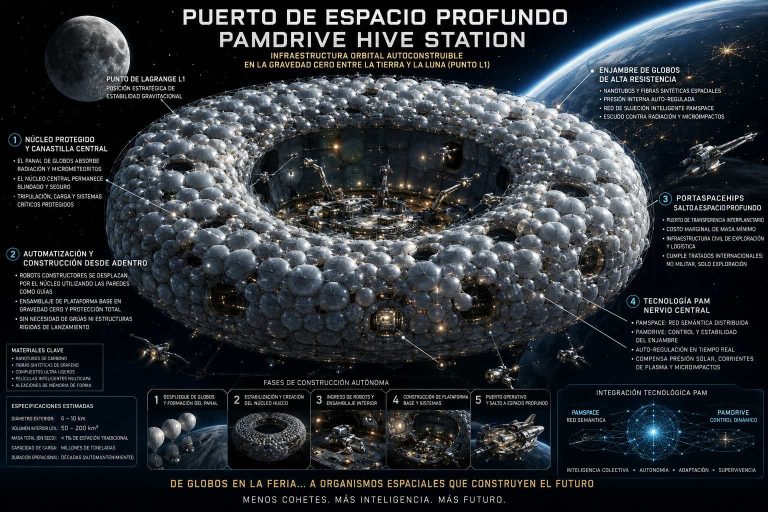
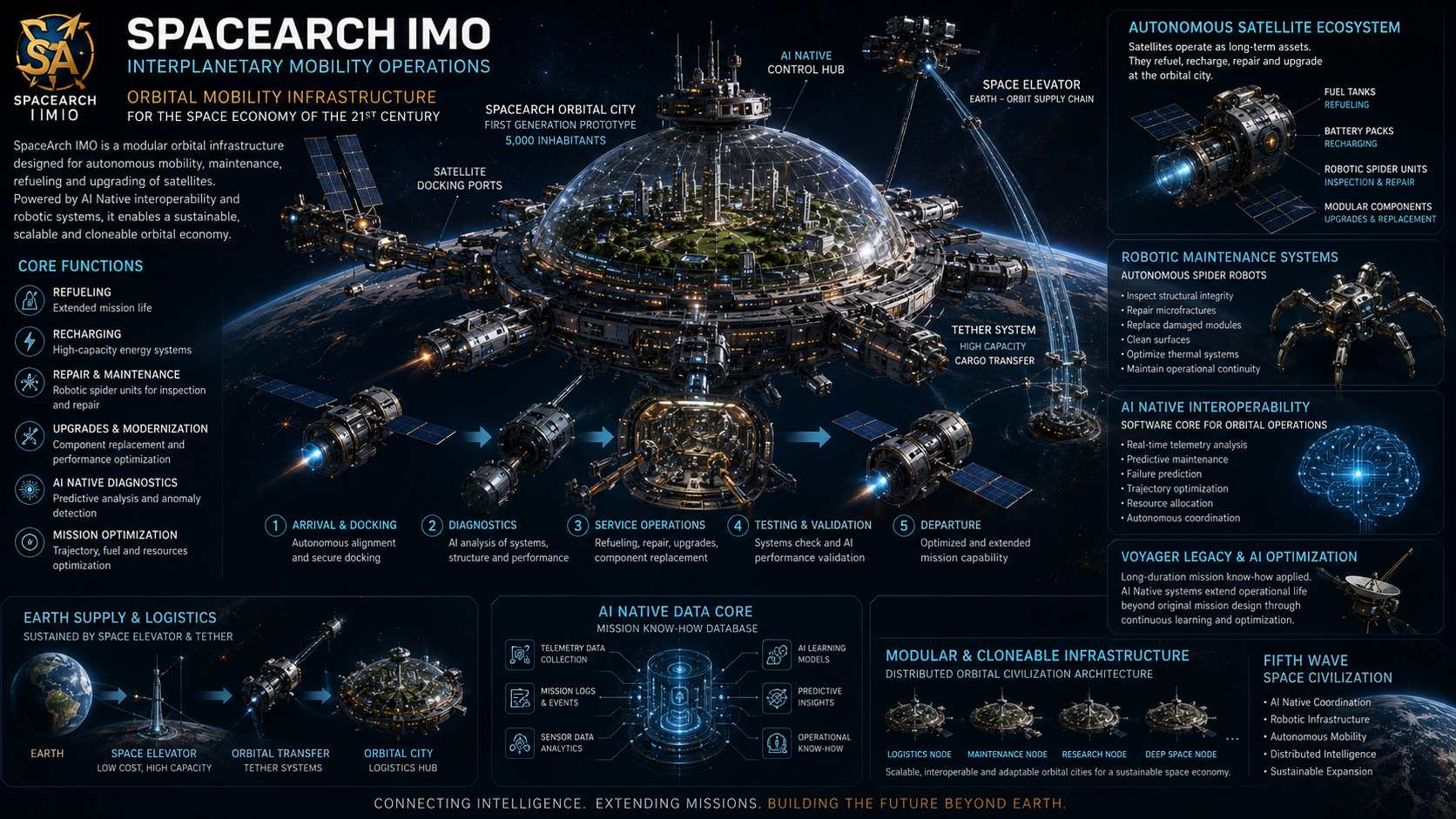
SpaceArch IMO introduces a distributed orbital mobility and maintenance architecture designed for long-term autonomous space operations.
At the center of the system is:
🛰️ the SpaceArch Orbital City Prototype.
A first-generation robotic orbital city designed initially for approximately:
👥 5,000 inhabitants.
The orbital city functions as:
✅ orbital logistics hub;
✅ AI Native control node;
✅ autonomous satellite servicing station;
✅ robotic maintenance ecosystem;
✅ orbital manufacturing and upgrade facility;
✅ and long-term space civilization prototype.
Autonomous Orbital Satellite Ecosystem
Within the SpaceArch IMO framework, satellites evolve from isolated disposable devices into:
🌐 continuously maintainable orbital assets.
Autonomous satellites dock at the orbital city where they:
⚡ refuel;
⚡ recharge;
⚡ replace degraded components;
⚡ receive AI-assisted diagnostics;
⚡ upgrade onboard systems;
⚡ recalibrate navigation systems;
⚡ and undergo robotic structural repairs.
Robotic Maintenance Infrastructure
The system uses:
🕷️ autonomous internal robotic spider units.
These robotic systems:
- inspect structural integrity;
- repair microfractures;
- replace damaged modules;
- clean surfaces;
- optimize thermal systems;
- and maintain operational continuity.
The orbital city becomes:
🌐 a permanent robotic service ecosystem.
Space Elevator & Tether Integration
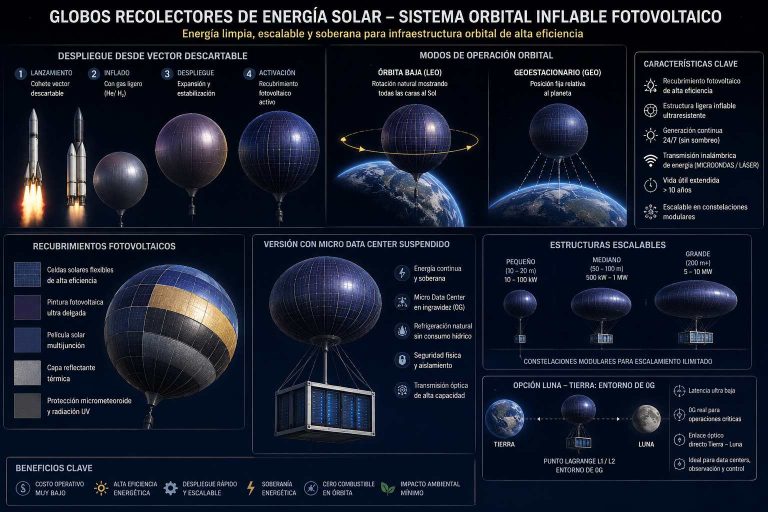
Earth-to-orbit supply chains are maintained through:
🛰️ tether systems;
🛰️ orbital docking corridors;
🛰️ cargo transfer systems;
🛰️ and future space elevator integration.
This dramatically reduces:
- launch dependency;
- operational costs;
- orbital waste;
- and replacement cycles.
The orbital city functions as:
⚡ an orbital recharge and reconfiguration node for autonomous space infrastructure.
AI Native Orbital Interoperability
The core technological layer of SpaceArch IMO is based on:
🧠 AI Native orbital interoperability systems.
The objective is not only hardware integration.
The objective is:
🌐 cognitive orbital coordination.
The system continuously:
- analyzes telemetry;
- predicts failures;
- optimizes trajectories;
- balances fuel efficiency;
- reallocates orbital resources;
- and coordinates autonomous servicing operations.
Voyager Mission Legacy & Long-Duration AI Optimization
One of the conceptual foundations of SpaceArch IMO is inspired by the operational know-how developed through long-duration missions such as:
🚀 Voyager.
NASA engineers demonstrated that:
through advanced software analysis, adaptive operational logic and continuous telemetry optimization, spacecraft could continue operating far beyond their original projected lifespan.
SpaceArch IMO extends this concept using:
⚡ AI Native predictive optimization systems.
The accumulated telemetry and operational logic of long-duration space missions become:
🌐 interoperable AI training architecture.
This enables:
- predictive maintenance;
- adaptive orbital optimization;
- autonomous anomaly detection;
- and long-duration mission self-correction.
Modular & Cloneable Orbital Infrastructure
The system is designed as:
⚡ modular,
⚡ scalable,
⚡ interoperable,
⚡ and clonable.
Each orbital city can become:
- a logistics node;
- a maintenance node;
- a research node;
- or a deep-space transfer node.
This creates:
🌐 a distributed orbital civilization architecture.
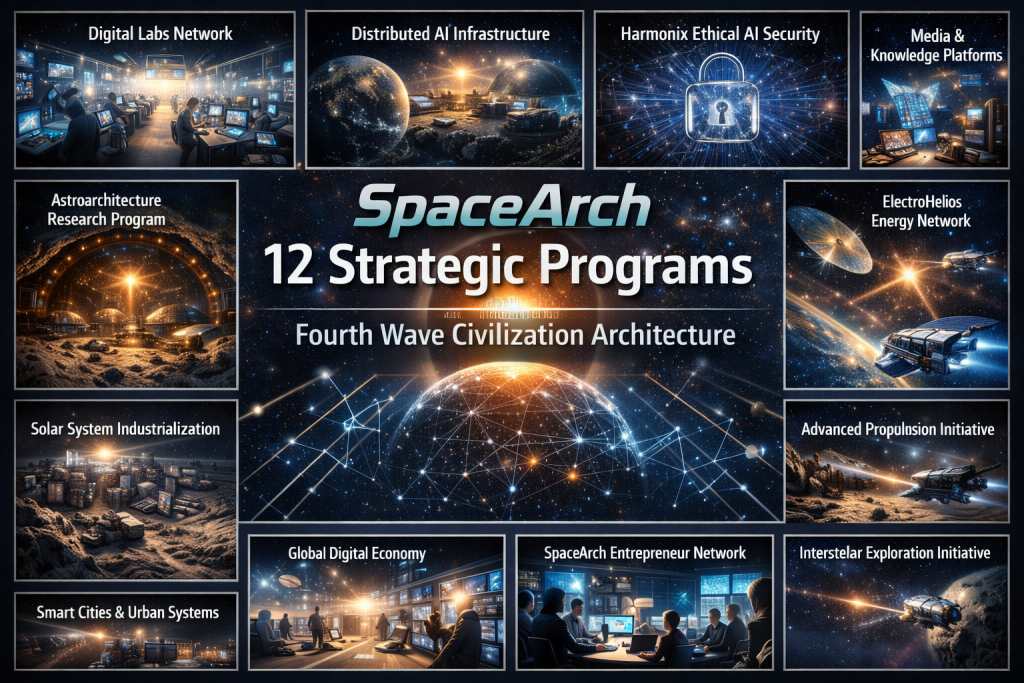
SpaceArch IMO & Fifth Wave Civilization
SpaceArch IMO is not merely an aerospace project.
It represents:
🧠 a Fifth Wave orbital civilization framework.
The future of space infrastructure will depend on:
- AI Native coordination;
- robotic maintenance ecosystems;
- distributed orbital intelligence;
- autonomous mobility;
- and interoperable space logistics.
The transition from isolated satellites to:
🌐 living orbital ecosystems
will define the next stage of human expansion beyond Earth.
Final Concept
SpaceArch IMO proposes a future where orbital systems:
- repair themselves;
- upgrade themselves;
- coordinate autonomously;
- and evolve continuously through AI Native infrastructure.
The orbital economy of the future will not survive through isolated launches alone.
It will require:
⚡ permanent orbital mobility,
⚡ autonomous maintenance,
⚡ distributed intelligence,
⚡ and robotic orbital civilization infrastructure.
SpaceArch IMO is designed as one possible architecture for that transition.