





RealEstateFashion.digital (REFD)
About REFD → Governance & Neutrality Framework
1. Institutional Purpose
REFD is designed as a neutral structuring infrastructure, not as a brokerage, fund manager, or vertically integrated real estate operator.
Its governance model exists to:
- Prevent concentration of power
- Avoid market capture dynamics
- Preserve broker independence
- Ensure regulatory clarity
- Protect long-term structural integrity
Neutrality is not a marketing statement.
It is codified through institutional architecture.
2. Foundational Governance Principles
REFD operates under five structural principles:
1️⃣ Structural Neutrality
REFD provides architecture and activation systems.
Licensed local brokerages execute regulated transactions.
2️⃣ Separation of Roles
Platform ≠ Brokerage
Structuring ≠ Representation
Infrastructure ≠ Capital Custody
3️⃣ Distributed Oversight
Decision-making authority is not centralized.
4️⃣ Transparency by Design
Processes are protocolized, documented, and traceable.
5️⃣ Anti-Capture Architecture
No single actor can dominate or redirect the system.
3. Dual Governance Model
REFD adopts a two-layer governance structure:
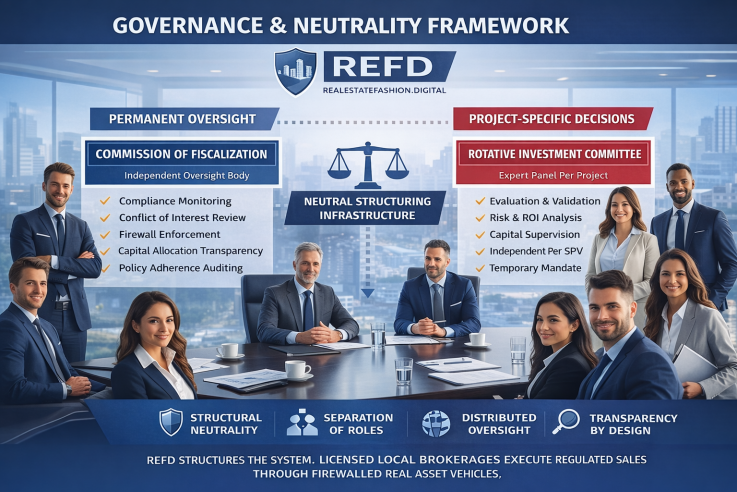
A. Permanent Commission of Fiscalization
(Stable Oversight Body)
A standing supervisory body responsible for systemic integrity.
Mandate:
- Compliance monitoring
- Conflict-of-interest review
- Firewall enforcement
- Capital allocation transparency
- Policy adherence auditing
- Structural neutrality verification
Characteristics:
- Majority independent members
- Fixed-term appointments
- No operational executive power
- Oversight authority only
The Commission does not execute deals.
It supervises the integrity of the framework.
B. Rotative Investment Committee
(Project-Specific Decision Body)
For each structured investment vehicle or SPV, a temporary committee is formed.
Mandate:
- Project risk evaluation
- Financial modeling validation
- Allocation approval
- Capital window supervision
- Compliance confirmation
Structure:
- Majority independent experts
- Financial and real estate specialization
- Network representation (non-dominant)
- Technical structuring input
The committee dissolves upon completion of the project lifecycle.
This prevents structural power accumulation.
4. Firewall & Structural Separation
REFD infrastructure operates separately from investment vehicles and brokerage execution.
Key separation mechanisms:
- Independent SPV structures
- Segmented data access
- Separate operational teams
- No automatic capital prioritization for REFD
- Formal conflict-of-interest declarations
REFD does not custody investor funds.
Capital flows through legally structured vehicles under appropriate jurisdictional frameworks.
5. Brokerage Neutrality Model
REFD integrates into existing real estate ecosystems without replacing local actors.
Core principle:
REFD provides structure.
Licensed brokerages execute regulated sales.
This ensures:
- No monopolistic perception
- No brokerage displacement
- Regulatory compliance across jurisdictions
- Alignment of incentives
The City Representation Model reinforces this structure by granting exclusive city partnerships under defined frameworks.
6. Capital Access Discipline
Investment access within REFD follows structured protocols:
- Time-limited participation windows
- Capital allocation caps
- Transparent qualification criteria
- SPV-based structuring
- Independent committee validation
REFD does not operate as a discretionary fund manager.
It functions as a structuring and activation layer.
7. Long-Term Structural Stability
The ultimate objective of this governance model is system autonomy.
A system is considered mature when:
- It operates without founder dependency
- Decision authority is distributed
- Deviations are detectable and correctable
- Incentives align across participants
REFD is architected to become self-sustaining, not personality-dependent.
8. Institutional Conclusion
REFD’s governance framework is designed to balance:
Scalability
Neutrality
Operational efficiency
Distributed oversight
Long-term integrity
The platform’s objective is not control.
Its objective is structured coordination.