





Structured Capital Exposure Compensation Model
Marketplace operates under structured formatting rules to maintain valuation clarity and capital readability.
RealEstateFashion.Digital
I. Concept Definition
The Promotion Fee Framework (PFF) is a structured compensation architecture governing the financial terms under which RealEstateFashion.Digital activates, manages, and executes controlled asset promotion within institutional capital ecosystems.
It is not a marketing fee.
It is not a brokerage commission.
It is not advertising-based compensation.
It is a structured capital positioning compensation system designed to align:
- Asset complexity
- Exposure intensity
- Capital access tier
- Institutional risk profile
- Strategic engagement duration
The framework ensures pricing discipline, brand protection, and capital integrity.
II. Strategic Objectives
The Promotion Fee Framework is designed to:
- Protect institutional positioning.
- Avoid commoditization of exposure.
- Ensure intellectual work is compensated independently of transaction closure.
- Align incentives without over-reliance on success fees.
- Create scalable, repeatable revenue architecture.
- Maintain high client quality filtering standards.
III. Structural Architecture
The framework operates through five pricing components:
- Base Promotion Activation Fee
- Exposure Intensity Multiplier
- Capital Tier Adjustment Factor
- Strategic Duration Premium
- Performance-Based Incentive Component
Each element is modular and mathematically combinable.
IV. Component 1 — Base Promotion Activation Fee
This fixed fee activates structured exposure.
It covers:
- Campaign architecture design
- Target capital segmentation
- Institutional positioning
- Executive brief adaptation
- Investor-grade asset presentation formatting
Indicative range:
$15,000 – $50,000
(depending on asset size and preparation level)
This fee is non-refundable and payable upfront.
Purpose:
- Compensate intellectual structuring
- Filter speculative clients
- Secure operational commitment
V. Component 2 — Exposure Intensity Multiplier
Exposure intensity varies based on:
- Number of curated capital channels activated
- Editorial amplification level
- Geographic distribution scope
- Network tier accessed
Intensity Levels:
| Level | Description | Multiplier |
|---|---|---|
| Level I | Controlled Limited Circulation | 1.0x |
| Level II | Multi-Channel Institutional | 1.5x |
| Level III | Cross-Regional Strategic | 2.0x |
| Level IV | Global Sovereign-Level | Custom |
The multiplier applies to the base activation fee.
Example:
Base Fee: $25,000
Level III Intensity (2.0x)
Total Activation: $50,000
VI. Component 3 — Capital Tier Adjustment Factor
Exposure to higher-tier capital requires greater preparation and reputation risk.
Capital Tiers:
- Tier A: Institutional Funds, Sovereign Wealth
- Tier B: Private Equity, Family Offices
- Tier C: Accredited Investors
Adjustment Range:
+10% to +40%
depending on capital tier targeted.
Rationale:
Higher-tier capital requires deeper compliance and stronger institutional framing.
VII. Component 4 — Strategic Duration Premium
Promotion cycles longer than 30 days incorporate structured duration pricing.
| Duration | Premium Adjustment |
|---|---|
| 30 Days | Base |
| 60 Days | +20% |
| 90 Days | +35% |
| 6 Months | Custom Mandate |
Longer duration implies deeper network engagement and sustained positioning.
VIII. Component 5 — Performance-Based Incentive
Optional component.
Triggered only if:
- REFD introduces qualified capital
- Negotiation advances due to REFD engagement
- Financial closing occurs
Range:
1% – 2.5% of capital mobilized
This is lower than brokerage norms but aligned with strategic positioning.
IX. Comparative Framework
| Traditional Promotion | REFD Promotion Framework |
|---|---|
| Flat marketing fee | Structured activation |
| Exposure volume focus | Capital precision focus |
| No intensity calibration | Quantified exposure tiers |
| No capital tier adjustment | Institutional segmentation |
| No structured duration logic | Duration-based pricing |
The framework monetizes complexity, not visibility volume.
X. Risk Management Logic
The Promotion Fee Framework protects REFD through:
- Mandatory upfront structuring
- Intensity tier selection control
- Capital channel approval process
- Exposure cap mechanisms
- Asset maturity screening
This prevents:
- Brand dilution
- Underprepared asset circulation
- Misaligned capital introduction
XI. Revenue Modeling Example
Asset Value: $40M
Base Activation: $30,000
Intensity Level II (1.5x): $45,000
Capital Tier Adjustment (+20%): $54,000
60-Day Duration (+20%): $64,800
Optional Success Fee (1.5% on $20M): $300,000
Total Potential Revenue: $364,800
Without capital deployment risk.
XII. Strategic Advantages
- Highly modular.
- Scalable across regions.
- Compatible with Cloud City Nodes.
- Adaptable to sovereign mandates.
- Filters low-quality operators.
- Creates predictable revenue streams.
- Maintains premium positioning.
XIII. Scalability Across CCN Network
The framework can be licensed under:
- Regional Activation Rights
- Strategic Director Mandates
- Controlled Franchise Replication
Revenue split example:
- 65% REFD Central
- 35% Regional Node
Or adjusted based on capital source origin.
XIV. Positioning Statement
The Promotion Fee Framework is a structured compensation architecture that aligns capital exposure intensity, asset complexity, institutional targeting, and strategic duration within a controlled global investment positioning system.
It transforms promotion into engineered capital access.
Mathematical Pricing Calculator Model
Promotion Fee Framework (PFF) — REFD
1) Variable Definitions
Core Inputs
- A = Asset Value (USD)
- C = Complexity Score (1–5)
- R = Readiness Score (1–5) (documentation, legal clarity, data room maturity)
- I = Exposure Intensity Level (1–4)
- T = Capital Tier Target (A/B/C)
- D = Duration (days)
Optional Inputs
- G = Geography Scope (Local/Regional/Global)
- E = Exclusivity (0 = no, 1 = yes)
- S = Success Fee Rate (0–0.025) (optional)
- K = Capital Closed (USD) (only if success event)
2) Base Fee Function (BF)
Base fee is determined by asset value band + complexity/readiness adjustment.
2.1 Asset Band Base (ABB)
Define ABB(A) as:
- If 1M ≤ A < 5M → ABB = 18,000
- If 5M ≤ A < 20M → ABB = 30,000
- If 20M ≤ A < 100M → ABB = 60,000
- If A ≥ 100M → ABB = 120,000 (or mandate)
(All values USD; adjustable by policy.)
2.2 Complexity Multiplier (CM)
Let complexity score C ∈ {1,2,3,4,5}:
- CM(C) = 1 + 0.10 × (C − 3)
So:
- C=1 → 0.80
- C=2 → 0.90
- C=3 → 1.00
- C=4 → 1.10
- C=5 → 1.20
2.3 Readiness Multiplier (RM)
Readiness score R ∈ {1,2,3,4,5}:
- RM(R) = 1 + 0.08 × (3 − R)
So:
- R=1 → 1.16 (low readiness → more work)
- R=2 → 1.08
- R=3 → 1.00
- R=4 → 0.92
- R=5 → 0.84 (high readiness → less work)
2.4 Base Fee (BF)
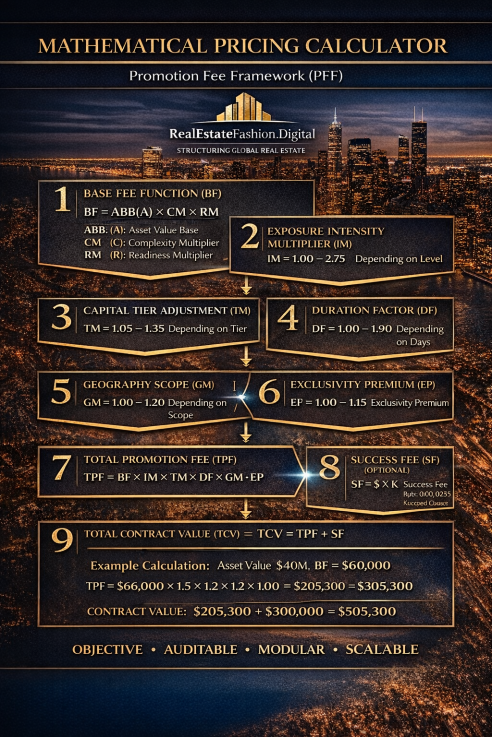
BF = ABB(A) × CM(C) × RM(R)
This is the Promotion Activation Fee (upfront).
3) Exposure Intensity Multiplier (IM)
Intensity level I ∈ {1,2,3,4}:
- I=1 (Controlled Limited) → IM = 1.00
- I=2 (Multi-Channel Institutional) → IM = 1.50
- I=3 (Cross-Regional Strategic) → IM = 2.00
- I=4 (Global / Sovereign) → IM = 2.75 (or custom)
4) Capital Tier Adjustment (TM)
Target capital tier T ∈ {A,B,C}:
- Tier A (Institutional / SWF) → TM = 1.35
- Tier B (PE / Family Offices) → TM = 1.20
- Tier C (Accredited / Exploratory) → TM = 1.05
5) Duration Factor (DF)
Let standard base cycle be 30 days.
- If D ≤ 30 → DF = 1.00
- If 30 < D ≤ 60 → DF = 1.20
- If 60 < D ≤ 90 → DF = 1.35
- If 90 < D ≤ 180 → DF = 1.60
- If D > 180 → DF = 1.90 (or mandate pricing)
(Piecewise step function; can be made continuous if desired.)
6) Geography Scope (GM) — Optional
- Local → GM = 1.00
- Regional → GM = 1.10
- Global → GM = 1.20
7) Exclusivity Premium (EP) — Optional
- If E=0 → EP = 1.00
- If E=1 → EP = 1.15 (15% premium)
8) Total Promotion Fee (TPF)
8.1 Standard Calculator
TPF = BF × IM × TM × DF × GM × EP
Where GM and EP default to 1.00 if not applied.
9) Optional Success Fee (SF)
If success fee is enabled:
SF = S × K
Where:
- S recommended range: 0.01 – 0.025
- K = capital closed attributable to REFD introduction
10) Total Contract Value (TCV)
TCV = TPF + SF
If no success fee applies, TCV = TPF.
11) Example Calculation
Asset value: A = $40M
Complexity: C=4
Readiness: R=3
Intensity: I=2
Capital Tier: T=B
Duration: D=60
Geography: Global (GM=1.20)
Exclusivity: No (EP=1.00)
Step-by-step:
ABB(40M) = 60,000
CM(4) = 1.10
RM(3) = 1.00
BF = 60,000 × 1.10 × 1.00 = 66,000
IM(2)=1.50
TM(B)=1.20
DF(60)=1.20
GM=1.20
EP=1.00
TPF = 66,000 × 1.50 × 1.20 × 1.20 × 1.20
= 66,000 × 3.1104
= $205,286.40 (≈ $205,300)
Optional success:
If S=1.5% and K=$20M → SF = 0.015 × 20,000,000 = $300,000
TCV = 205,300 + 300,000 = $505,300
12) Practical Packaging for the Portal
To keep the public portal clean, expose only:
- Base bands (ABB)
- Intensity tiers (IM)
- Duration tiers (DF)
- Capital tier tiers (TM)
Keep C and R as internal scoring for quotes, not public.
13) Optional: Continuous Duration Model (More “Scientific”)
Instead of step DF, define:
DF = 1 + 0.0045 × max(0, D − 30)
So:
- D=60 → DF=1+0.0045×30=1.135
- D=90 → DF=1+0.0045×60=1.27
- D=180 → DF=1+0.0045×150=1.675
This is smoother but less “menu-friendly”.