






(Zero-Cost Structuring Layer)
Institutional Definition
Design & ROI Support (Zero-Cost Structuring Layer) is a centralized structural engineering service provided by REFD to its Exclusive City Partners, delivering architectural repositioning, financial modeling, risk structuring, and capital optimization without upfront fees, monetized exclusively through transaction-based participation upon successful execution.
REFD does not charge for advisory.
REFD participates only when value materializes.
This aligns incentives structurally.
1. Conceptual Foundation
Traditional advisory models in real estate operate under:
- Upfront consulting fees
- Retainer agreements
- Architectural billing
- Financial modeling charges
- Advisory cost layering
These increase friction and discourage adoption.
REFD replaces fee-based advisory with performance-based structural participation.
2. Structural Objective
The Zero-Cost Structuring Layer aims to:
- Eliminate upfront barriers for local partners
- Accelerate asset structuring velocity
- Increase deal quality
- Enhance ROI predictability
- Standardize project modeling globally
- Align central and local incentives
It converts advisory from expense into alignment mechanism.
3. What “Zero-Cost” Means (Technically)
Zero-cost does NOT mean free.
It means:
- No upfront consulting fee
- No subscription fee
- No retainer fee
- No architectural invoice
- No modeling invoice
Compensation occurs only upon:
- Transaction closing
- Structured capital activation
- Revenue realization
It is contingent monetization.
4. Structural Components of Design & ROI Support
The Zero-Cost Layer includes:
1️⃣ Architectural Repositioning Support
- Programmatic optimization
- Density enhancement analysis
- Mixed-use layering feasibility
- Spatial efficiency recalibration
- Functional upgrade proposals
Design is treated as yield multiplier.
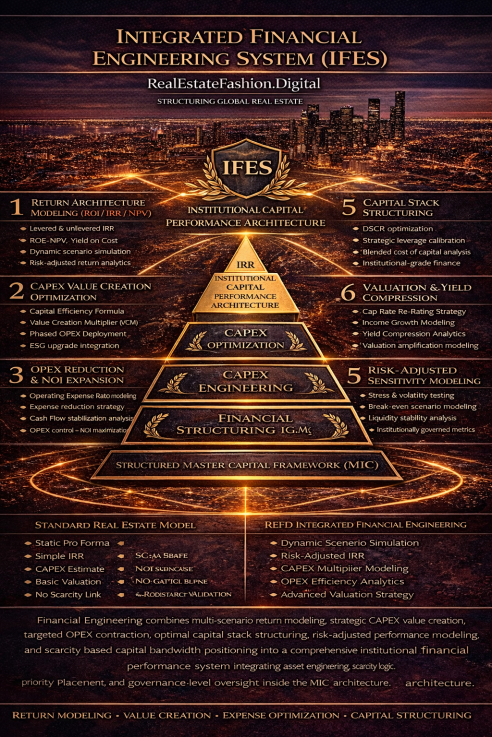
2️⃣ Financial Engineering & ROI Modeling
- CAPEX modeling
- OPEX recalibration
- Yield differential projections
- IRR modeling
- Exit scenario analysis
- Sensitivity testing
Financial modeling transforms narrative into metrics.
3️⃣ Risk Architecture Structuring
- SPV configuration
- Capital stack modeling
- Liability isolation
- Scenario stress testing
- Regulatory mapping
Risk becomes engineered, not assumed.
4️⃣ Capital Positioning Advisory
- Asset eligibility for capital windows
- Bundle integration feasibility
- Intercontinental structuring potential
- Institutional-grade documentation formatting
Assets are structured for capital readiness.
5. Structural Incentive Alignment
The Zero-Cost model ensures:
- REFD is incentivized to improve deal quality
- City Partner is incentivized to cooperate structurally
- No advisory revenue without transaction success
- No artificial over-structuring
This removes advisory moral hazard.
6. Comparative Market Positioning
| Traditional Advisory Model | REFD Zero-Cost Structuring |
|---|---|
| Upfront fee | Performance-based participation |
| Consultant detached from outcome | Structuring tied to execution |
| Advisory cost risk borne by client | Revenue risk shared |
| Potential over-design | Efficiency-focused structuring |
| Transaction-independent billing | Transaction-contingent monetization |
REFD shares risk with the City Partner.
7. Strategic Advantages for City Partner
City Partner receives:
- Institutional-grade structuring
- Enhanced asset credibility
- Higher yield clarity
- Increased buyer confidence
- Improved negotiation positioning
- Capital access integration
Without capital outlay.
8. Strategic Advantages for REFD
REFD gains:
- Access to local asset flow
- Transaction-based monetization
- Scalable global expansion
- Data aggregation for intelligence layer
- Standardization across jurisdictions
Without local overhead.
9. Risk Mitigation Benefits
Zero-Cost Structuring reduces:
- Advisory fee friction
- Local resistance
- Entry barrier for smaller brokerages
- Market distrust
It preserves neutrality.
10. Structural Safeguards
To prevent misuse:
- Structuring provided only to Exclusive City Partner
- Projects must pass Qualification Protocol
- Structural documentation remains IP-protected
- Participation agreement executed prior to structuring
- No resale of modeling without authorization
IP remains centralized.
11. Scalability Logic
Because advisory is centralized and monetization is contingent:
- Unlimited cities can adopt model
- No incremental consulting workforce required
- Revenue scales with transaction volume
- Cost structure remains light
This is operating leverage.
12. Governance & Oversight
All structured projects:
- Are registered in platform
- Have documented ROI model
- Maintain version-controlled structuring files
- Enter institutional reporting system
Transparency sustains integrity.
13. Long-Term Structural Impact
If fully deployed:
- Local brokerages evolve toward institutional-grade modeling
- Capital becomes more structured
- Market transparency increases
- Asset mispricing decreases
- Yield optimization becomes standardized
REFD becomes structural intelligence layer across territories.
14. Institutional Conclusion
Design & ROI Support (Zero-Cost Structuring Layer) represents a performance-aligned structural service that removes upfront advisory friction while preserving incentive alignment and institutional rigor.
It:
- Eliminates fee barriers
- Enhances deal quality
- Shares risk
- Standardizes modeling
- Enables scalable global expansion
REFD does not charge for advice.
It participates in structured value creation.
PART I
Legal Protection & IP Safeguard Annex
(City Representation Model – Structural Layer Protection Framework)
I. Institutional Purpose
This Annex defines the legal, structural, and operational safeguards designed to:
- Protect REFD intellectual property
- Prevent structural replication without authorization
- Avoid territorial appropriation attempts
- Preserve platform neutrality
- Ensure system continuity independent of individuals
- Maintain structural integrity across jurisdictions
This is not defensive law.
It is architectural protection.
II. Definition of Protected Intellectual Property
REFD Intellectual Property (IP) includes but is not limited to:
- Asset Qualification Protocol
- Design Repositioning Methodology
- Financial Engineering & ROI Modeling Templates
- Risk Architecture & SPV Structuring Framework
- Capital Activation Windows Architecture
- Multi-Asset Bundle Modeling Systems
- Governance & Reporting Frameworks
- Revenue Sharing Algorithms
- Portfolio-level Stress Testing Models
- Institutional Documentation Formats
All methodologies, templates, frameworks, financial models, dashboards, and structural processes are proprietary.
III. Ownership Structure
All structural methodologies remain:
- Centralized intellectual property of REFD
- Non-transferable
- Non-exclusive for execution
- Non-assignable without written authorization
City Partners receive usage rights, not ownership rights.
IV. Usage Rights & Limitations
Exclusive City Partners may:
- Apply REFD methodologies for approved projects
- Use structured documentation under agreement
- Present ROI models under REFD framework
City Partners may NOT:
- Replicate structural methodologies independently
- Resell financial modeling frameworks
- Transfer templates to third parties
- Develop competing derivative platforms
- Claim authorship of structural systems
Use is conditional and limited to cooperation scope.
V. Confidentiality Framework
All City Partners must execute:
- Non-Disclosure Agreement (NDA)
- Structural Confidentiality Clause
- Non-Replication Clause
- Non-Circumvention Clause
Confidential information includes:
- Modeling logic
- Capital pipeline structures
- Internal scoring matrices
- Governance evaluation criteria
VI. Non-Circumvention Safeguard
City Partners agree:
- Not to bypass REFD in structured projects
- Not to directly approach capital sources introduced by REFD
- Not to replicate capital activation frameworks
- Not to restructure projects independently after modeling
Breach results in revocation and potential legal remedy.
VII. Territorial Neutrality Clause
To preserve anti-monopoly neutrality:
- REFD does not operate brokerage activity
- REFD does not hold transactional license
- REFD does not interfere with regulated activity
- City Partner retains legal transactional authority
This preserves regulatory compliance.
VIII. Structural Independence Safeguard
To ensure the system operates independently of individuals:
- All methodologies are documented
- All templates are centralized
- Governance logic is standardized
- No structural decision depends on a single executive
- Committee-based oversight applies
This prevents personal capture of system.
IX. Governance Override Mechanism
In case of structural conflict:
- Governance Committee review is triggered
- Independent audit may be conducted
- Temporary suspension possible
- Revocation applied if breach confirmed
Structural continuity prevails over personal interest.
X. Jurisdictional Enforcement
Protection mechanisms are:
- Enforceable under governing law defined in cooperation agreement
- Subject to arbitration clause
- Protected under international IP principles where applicable
Cross-border enforceability is incorporated.
XI. Structural Continuity Clause
If:
- A City Partner exits
- A City Partner is revoked
- A dispute arises
- A structural breach occurs
All project documentation, models, and IP remain centralized.
Continuity is not interrupted.
XII. Institutional Conclusion
The Legal Protection & IP Safeguard Annex ensures:
- Structural immunity
- Intellectual protection
- Neutral market positioning
- Governance stability
- Cross-border enforceability
- Individual independence
REFD is protected structurally, not emotionally.
PART II
City Representation Governance Charter
(Integrated Framework Document)
I. Institutional Declaration
The City Representation Governance Charter establishes the formal operating framework governing:
- City Partner selection
- Role separation
- Revenue alignment
- Compliance standards
- Structural modeling
- Oversight mechanisms
It serves as constitutional document for territorial expansion.
II. Foundational Principles
- Structural Centralization
- Local Execution Decentralization
- Incentive Alignment
- Neutral Market Positioning
- Capital Efficiency
- Governance Transparency
- Performance-Based Exclusivity
III. Governance Structure
The Governance Framework includes:
1. Central Structural Authority (REFD)
Responsible for:
- Modeling standards
- SPV structuring
- Capital activation rules
- Portfolio aggregation
- Risk framework
2. City Partner Execution Authority
Responsible for:
- Regulated transaction execution
- Local compliance
- Market interfacing
- Buyer-seller negotiation
3. Oversight Committee
Functions:
- Performance review
- Structural compliance audit
- Conflict mediation
- Exclusivity renewal
Committee-based review prevents unilateral power.
IV. Performance Monitoring Protocol
Quarterly evaluation includes:
- Transaction velocity
- Compliance adherence
- Reporting accuracy
- Governance alignment
- Structural cooperation
Performance score impacts exclusivity status.
V. Revenue Governance
Revenue allocation governed by:
- Written participation schedule
- Origin-of-lead documentation
- Structured uplift agreement
- Transparent remittance protocol
Disputes subject to pre-defined arbitration process.
VI. Revocation & Replacement Mechanism
Triggers include:
- Regulatory violation
- Structural deviation
- Revenue misreporting
- Reputational harm
- Governance breach
Replacement process reactivates full Application Protocol.
VII. System Independence Safeguard
To ensure continuity:
- No individual holds exclusive structural authority
- Documentation standardized
- Decision processes recorded
- Committee validation required for structural modification
System must survive leadership change.
VIII. Anti-Monopoly Neutrality Clause
The Governance Charter formally states:
- REFD does not operate brokerage activity
- REFD does not restrict market competition
- Participation remains voluntary
- Exclusivity is performance-based, not coercive
Neutrality is codified.
IX. Amendment Protocol
Changes to Governance Charter require:
- Committee review
- Legal validation
- Structural impact assessment
- Majority approval mechanism
Prevents unilateral alteration.
X. Institutional Conclusion
With:
- Legal Protection & IP Safeguard Annex
- City Representation Governance Charter
REFD now possesses:
- Structural immunity
- Intellectual protection
- Incentive alignment
- Compliance integrity
- Territorial scalability
- Institutional durability
This transforms the City Representation Model into a governance-grade expansion framework.