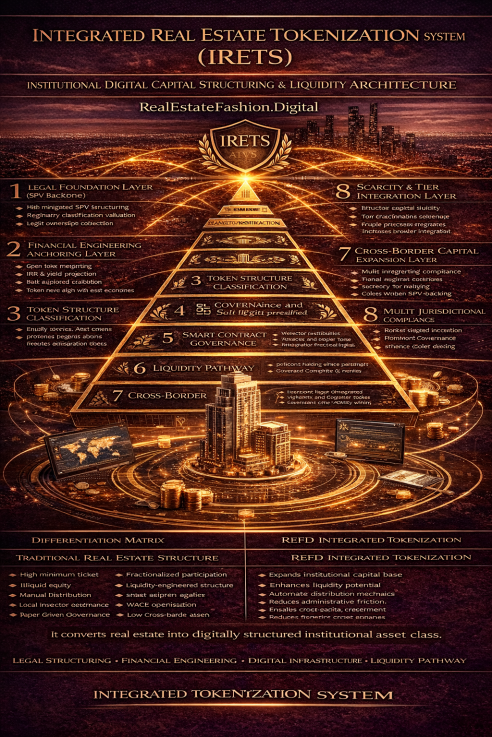







Institutional Capital Visibility Hierarchy Framework
Marketplace operates under structured formatting rules to maintain valuation clarity and capital readability.
RealEstateFashion.Digital
I. Concept Definition
Priority Exposure Placement (PEP) is a structured visibility elevation protocol that grants selected assets preferential positioning within REFD’s institutional capital circulation ecosystem.
It is not advertising prominence.
It is not banner placement.
It is not cosmetic homepage priority.
It is a capital hierarchy prioritization system that determines the sequence, density, and quality of institutional exposure within curated investment networks.
Priority Exposure Placement regulates:
- Order of capital presentation
- Institutional briefing prominence
- Network distribution density
- Strategic circulation frequency
- Capital introduction sequencing
It transforms exposure from static listing to structured capital precedence.
II. Strategic Objectives
The framework is designed to:
- Increase exposure intensity without diluting brand integrity.
- Allocate capital bandwidth strategically.
- Reward performance-certified assets.
- Improve time-to-qualified-capital metrics.
- Monetize priority without commoditizing visibility.
- Create exposure scarcity logic.
PEP operates as a capital access accelerator.
III. Exposure Hierarchy Architecture
The system defines three structured exposure levels:
Level 1 – Standard Placement
Baseline exposure within active circulation cycles.
Level 2 – Enhanced Placement
Increased network density and presentation frequency.
Level 3 – Priority Placement
Top-tier capital sequencing and institutional spotlighting.
Priority Exposure Placement refers exclusively to Level 3.
IV. Structural Components of Priority Placement
Priority Exposure includes:
- First-Sequence Capital Circulation
- Institutional Brief Spotlighting
- Investor Call Scheduling Priority
- Editorial Feature Front Placement
- Strategic Newsletter Top Positioning
- Cross-Node Capital Amplification
- Tier A Network Routing Preference
This affects capital ordering, not aesthetic ranking.
V. Eligibility Framework
Priority Exposure is not automatically purchasable.
Eligibility requires:
- Minimum Silver Certification
- Defined Institutional Readiness Score
- Completed Asset Structuring Protocol
- Capital Tier Targeting Clarity
- Performance Tracking Activation
Gold-tier assets receive automatic eligibility.
Bronze-tier assets require upgrade evaluation before access.
This prevents exposure dilution.
VI. Allocation Logic
Capital network capacity is finite.
Therefore:
Priority slots are limited per cycle.
Example:
- Maximum 3 priority assets per 30-day cycle per capital vertical.
- Geographic segmentation limits cross-saturation.
Scarcity reinforces capital seriousness.
VII. Performance Impact Variables
Priority Placement statistically improves:
- Response Velocity Index (RVI)
- Institutional Engagement Quality (IEQ)
- Capital Tier Distribution (CTD)
- Conversion Probability Index (CPI)
However, it does not guarantee capital closure.
It increases capital signal intensity.
VIII. Quantitative Effect Modeling
Let:
Standard Exposure Engagement Rate = E₀
Priority Exposure Engagement Rate = E₁
Empirical modeling target:
E₁ ≈ 1.5× to 2.2× E₀
(depending on asset tier and capital vertical)
Priority increases engagement probability, not outcome certainty.
IX. Pricing Architecture
Priority Exposure Placement is priced as a multiplier on the Promotion Fee Framework.
Priority Multiplier (PM)
PM = 1.35 – 1.75
(depending on capital tier and network depth)
Example:
If Total Promotion Fee (TPF) = $120,000
PM = 1.50
Priority Exposure Fee = $180,000
Optional structured retainer model:
Flat Priority Allocation Fee per 30-day cycle.
X. Comparative Framework
| Traditional “Featured Listing” | REFD Priority Exposure |
|---|---|
| Visual highlight | Capital sequencing control |
| Homepage badge | Institutional network routing |
| Advertising upgrade | Capital hierarchy elevation |
| Unlimited availability | Scarcity-based allocation |
| Pay-to-display | Performance-gated eligibility |
REFD prioritizes capital routing, not page placement.
XI. Risk Management Controls
To protect institutional integrity:
- Maximum exposure density limits
- No priority access without structuring compliance
- Re-evaluation every 30 days
- Suspension if engagement KPIs decline
- Capital fatigue monitoring
This maintains ecosystem balance.
XII. Integration With Certification System
Priority Exposure interacts with certification tiers:
| Tier | Priority Eligibility |
|---|---|
| Bronze | Conditional / Restricted |
| Silver | Eligible |
| Gold | Preferred Access |
Gold-tier assets may receive:
- Reduced multiplier
- Automatic cycle renewal
- Extended network routing
This incentivizes performance.
XIII. Strategic Business Advantages
Priority Exposure:
- Creates premium revenue tier.
- Rewards high-performance assets.
- Enhances capital efficiency.
- Reinforces institutional exclusivity.
- Increases investor trust.
- Maintains exposure discipline.
It monetizes capital bandwidth, not visibility vanity.
XIV. Scalability Across Cloud City Nodes
PEP can be:
- Centrally controlled
- Regionally allocated
- Performance-ranked
- Audited quarterly
Nodes may receive:
Priority Allocation Quotas
Based on regional performance metrics.
This creates internal competition and quality control.
XV. Institutional Positioning Statement
Priority Exposure Placement is a structured capital sequencing system that grants selected assets preferential routing within curated institutional investment networks, based on performance analytics and certification criteria.
It regulates capital precedence, not marketing prominence.
I. Scarcity Logic Pricing Model (SLPM)
Capital Bandwidth Allocation Economics
RealEstateFashion.Digital
1. Conceptual Foundation
Scarcity is not artificial limitation.
It is structural capital bandwidth management.
Institutional capital networks have:
- Finite attention capacity
- Finite deal evaluation bandwidth
- Finite cognitive allocation per cycle
- Finite due diligence resources
Therefore:
Priority Exposure must be priced according to:
- Slot scarcity
- Capital demand density
- Asset performance tier
- Network congestion level
Scarcity pricing transforms exposure into bandwidth rights allocation.
2. Core Economic Principle
Define:
CBU = Capital Bandwidth Units
Each capital cycle (30 days) has a fixed number of CBUs available.
Example:
Per vertical (e.g., Urban Mixed-Use, Coastal, Institutional Land Banking):
Maximum Priority Slots = 3
Each slot consumes defined bandwidth allocation.
Total Available CBUs per vertical per cycle = 3
This creates structural scarcity.
3. Demand-Supply Pricing Formula
Let:
S = Available Priority Slots
D = Qualified Demand (Eligible Assets)
B = Base Priority Multiplier (1.35–1.75)
A = Asset Certification Tier Factor
Define Scarcity Coefficient (SC):
SC = 1 + (D − S) / S × 0.25
(if D > S)
If D ≤ S → SC = 1.00
4. Certification Tier Factor (CTF)
Gold Tier → 1.00
Silver Tier → 1.10
Bronze Tier → 1.25 (if eligible)
Bronze assets pay higher scarcity premium due to higher capital friction risk.
5. Final Scarcity Pricing Formula
Let:
TPF = Total Promotion Fee (base model)
PM = Priority Multiplier
SC = Scarcity Coefficient
CTF = Certification Tier Factor
Priority Exposure Price (PEP):
PEP = TPF × PM × SC × CTF
6. Example Scenario
Available Slots (S) = 3
Qualified Demand (D) = 6
SC = 1 + (6 − 3)/3 × 0.25
SC = 1 + (3/3 × 0.25)
SC = 1.25
Assume:
TPF = $150,000
PM = 1.50
Asset Tier = Silver → CTF = 1.10
PEP = 150,000 × 1.50 × 1.25 × 1.10
PEP = $309,375
Scarcity pricing increases capital bandwidth value without arbitrarily raising fees.
7. Congestion Escalation Model
If D ≥ 2S:
SC escalates:
SC = 1 + (D − S)/S × 0.40
This ensures pricing reflects institutional congestion.
Scarcity must respond to real capital demand.
8. Time-Based Scarcity Multiplier
If asset requests late-cycle priority (<10 days remaining):
Late Allocation Multiplier (LAM) = 1.15 – 1.25
This reflects compressed network adjustment cost.
9. Strategic Effects of Scarcity Pricing
Scarcity pricing:
- Prevents exposure dilution
- Incentivizes early commitment
- Rewards high certification performance
- Optimizes capital sequencing discipline
- Aligns revenue with network strain
It transforms priority into a managed resource.
II. Integration into Master Institutional Blueprint (MIB)
Now we embed Scarcity Logic into the full REFD architecture.
1. Institutional Structural Layering
Master Institutional Blueprint consists of:
Layer 1: Asset Structuring Framework
Layer 2: Promotion Fee Framework
Layer 3: 30-Day Structured Exposure Model
Layer 4: Performance Tracking
Layer 5: Certification System
Layer 6: Priority Exposure + Scarcity Logic
Scarcity sits at Layer 6 — the capital hierarchy governance layer.
2. Governance Mechanism
Establish:
Capital Bandwidth Allocation Committee (CBAC)
Responsibilities:
- Approve priority slot allocation
- Monitor demand congestion
- Adjust SC dynamically
- Protect institutional network integrity
- Publish quarterly bandwidth reports
This prevents arbitrary pricing decisions.
3. Capital Bandwidth Dashboard Integration
Performance Dashboard must now include:
- Active Priority Slots
- Demand Pressure Ratio (D/S)
- Congestion Index
- Scarcity Coefficient per vertical
- Bandwidth Utilization Rate
- Tier Distribution of Priority Assets
This institutionalizes transparency.
4. Mandate Escalation Path
Assets achieving:
Gold Certification + 2 consecutive Priority Cycles
may qualify for:
Strategic Mandate Status
This reduces:
PM multiplier
and partially neutralizes SC
Rewarding consistent capital resonance.
5. Revenue Forecast Implications
If per quarter:
Average 3 priority slots × 4 verticals × 3 cycles
= 36 slots per quarter
If average PEP = $275,000
Quarterly Revenue Potential ≈ $9.9M
Without capital deployment risk.
Scarcity logic materially impacts revenue architecture.
6. Institutional Credibility Protection
To preserve credibility:
- Publish maximum slot limits
- Do not expand slots arbitrarily
- Maintain cycle discipline
- Require eligibility compliance
- Audit certification scoring quarterly
Scarcity must remain structural, not opportunistic.
7. Strategic Differentiation
| Market Practice | REFD Scarcity Model |
|---|---|
| Featured Listing Pay Upgrade | Capital Bandwidth Allocation |
| Unlimited Premium Placement | Slot-Governed Priority |
| Arbitrary Pricing | Formula-Based Scarcity |
| Marketing Incentive | Institutional Congestion Logic |
This elevates REFD to capital infrastructure tier.
8. Institutional Positioning Statement
Priority Exposure within REFD operates under a Scarcity Logic Pricing Model governed by capital bandwidth allocation principles, congestion-responsive coefficients, and performance-tier adjustments, ensuring disciplined institutional visibility management.
9. Strategic Conclusion
Scarcity is not used for marketing urgency.
It is used for:
- Capital network integrity
- Exposure efficiency
- Institutional hierarchy control
- Revenue optimization aligned with network strain
This converts visibility into a regulated capital asset class.