





Operational Revenue Model & Governance Framework
Institutional Positioning Note
1. Operational Revenue Model
20% Activation Fee Structure
REFD operates as a structured activation channel within the existing real estate commercialization system.
The platform does not replace licensed brokers.
It enhances and activates their commercial capacity.
1.1 Telesales Activation Fee
When a property transaction is generated through REFD’s telesales system, REFD receives:
20% of the brokerage commission earned in that transaction.
This percentage mirrors the standard internal commission split commonly allocated to in-house sales agents within brokerage firms.
REFD does not charge an additional commission.
REFD substitutes the internal sales function through structured telesales activation.
The 20% is contractually defined as:
- Lead generation fee
- Commercial activation fee
- Structured telesales service participation
It is not characterized as brokerage commission unless legally permissible within the relevant jurisdiction.
1.2 Marketplace Activation Fee
If a brokerage closes a transaction involving a property listed on the REFD portal that was not contributed by another brokerage, REFD receives:
20% participation based on activation and infrastructure use.
This fee is justified as:
- Platform infrastructure fee
- Structured visibility fee
- Deal activation participation
It reflects value generated through:
- Digital exposure
- Structured lead routing
- CRM tracking
- Operational activation systems
REFD does not negotiate, represent parties, or execute contracts.
Licensed brokers remain solely responsible for:
- Representation
- Negotiation
- Contract execution
- Regulatory compliance
- Commission collection
2. Strategic Positioning: Neutral Infrastructure Model
REFD is designed as:
A neutral structured activation infrastructure within the existing real estate ecosystem.
It is not:
- A brokerage competitor
- A commission aggregator
- A vertically integrated monopolistic actor
Its function is:
- Demand generation
- Structured activation
- Capital routing
- Data intelligence
- Operational optimization
Neutrality is foundational to scalability.
3. Evolution Toward Operational Intelligence
The activation model evolves through structured data collection:
- Telesales activation
- CRM-based tracking
- Performance metrics
- Lead scoring
- Predictive assignment models
Over time, REFD develops:
- Probability-of-close analytics
- Broker performance mapping
- Zone-level absorption metrics
- Capital velocity insights
This intelligence remains infrastructure-level and does not convert REFD into a brokerage entity.
4. Investment Access Layer (Structured Evolution)
As an evolutionary extension of the platform, REFD may facilitate structured real estate investment access under strict neutrality principles.
The model follows a phased approach:
Phase 1 – Internal Realtor-Level Participation
- Club-deal structure
- Limited access to network members
- No public offering
- Project-specific SPVs
- Transparent capital caps
Participation is optional, limited by:
- Time window
- Capital allocation cap
- Clear eligibility criteria
Phase 2 – Controlled Public Visibility
After operational validation:
- Transparent investment access policies
- Structured opportunity segmentation
- Accredited investor priority
- Retail access only within regulatory frameworks
REFD does not act as a discretionary capital controller.
5. Governance Architecture
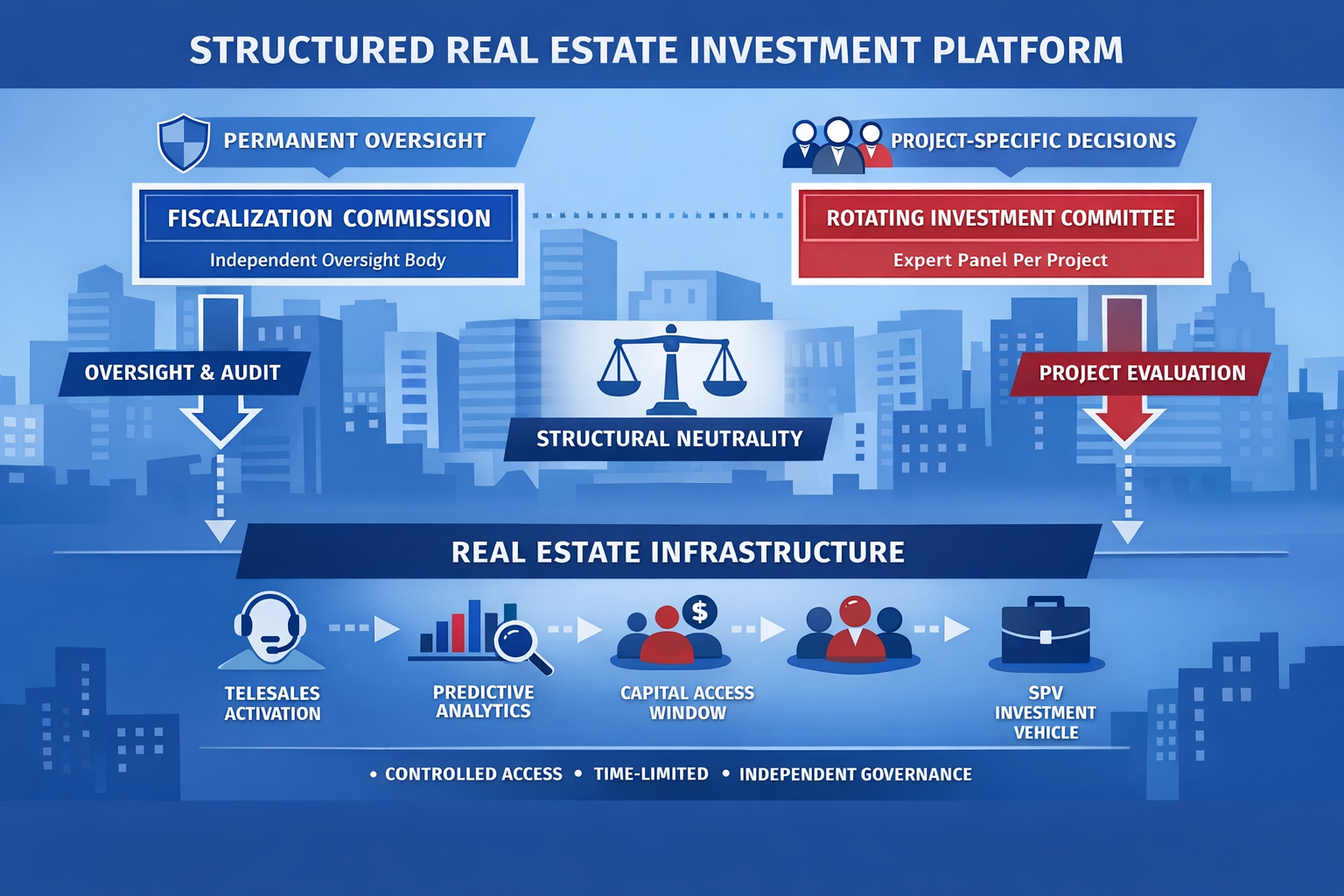
To institutionalize neutrality and avoid concentration of control, REFD adopts a dual governance structure:
5.1 Permanent Fiscalization Commission (Oversight Body)
A stable, independent supervisory body responsible for:
- Compliance monitoring
- Conflict-of-interest review
- Firewall enforcement
- Allocation transparency verification
- Policy adherence auditing
- Reporting integrity
Characteristics:
- Majority independent members
- Fixed mandate duration
- No operational executive authority
- Oversight power, not investment execution power
The Commission safeguards neutrality.
5.2 Rotative Investment Committee (Per Project)
For each investment vehicle or project, a temporary committee is formed.
Responsibilities:
- Evaluate risk
- Approve participation
- Validate financial modeling
- Confirm capital allocation rules
- Ensure policy compliance
Composition:
- Majority independent experts
- Real estate expertise
- Financial expertise
- Network representation (non-dominant)
- Technical structuring input
The committee dissolves upon project completion.
This prevents structural capture of decision-making power.
6. Structural Separation (Firewall Principles)
REFD Infrastructure and Investment Vehicles operate under strict separation:
- Separate legal entities
- Separate operational teams
- Segmented data access
- Independent committee oversight
- No preferential capital allocation to REFD
REFD does not auto-prioritize its own capital.
Neutrality is codified in governance.
7. Institutional Intent
REFD’s objective is not to dominate the real estate market.
It is to:
- Optimize flow
- Strengthen broker networks
- Improve transaction intelligence
- Democratize structured access
- Preserve regulatory integrity
- Build scalable global infrastructure
The system is designed to function for all participants — not to centralize power.
8. Structural Conclusion
The REFD model integrates:
- 20% activation fee aligned with industry standards
- Operational intelligence through telesales and predictive CRM
- Optional structured investment access
- Time-limited capital windows
- Transparent allocation caps
- Permanent independent oversight
- Rotative project-level decision committees
This architecture balances:
Scalability
Neutrality
Operational control
Distributed governance
Long-term legitimacy
REFD is designed as infrastructure — not monopoly.