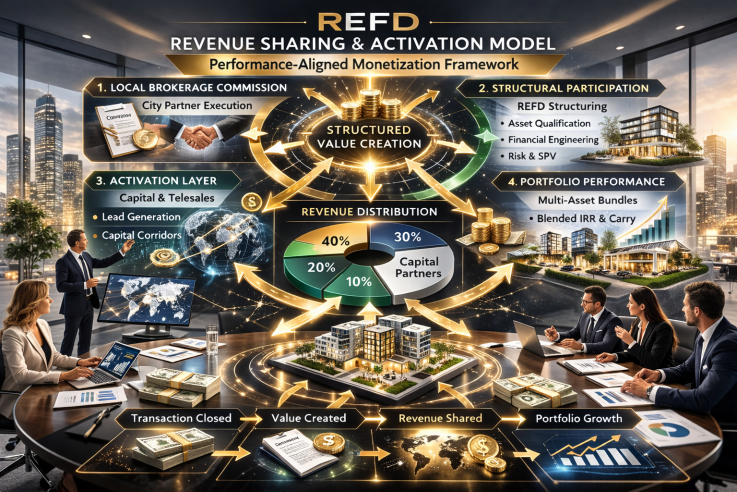







ROI Projection Model & Labor Market Multiplication Effect
Digital Labs Real Estate – AI-Driven Intermediation System
1️⃣ Executive Summary
The DLRE model restructures real estate intermediation by:
- Automating valuation, compliance, and qualification via AI
- Certifying property visualization through 3D digital twins
- Embedding fiscal compliance at system level
- Redistributing up to 50% of commission revenue to sellers
- Converting sellers into certified Digital Sales Partners
This produces:
- Higher system margins
- Reduced operational overhead
- Increased labor participation
- Expanded formalized economic activity
- 2x–5x multiplication of active participants in the specific intermediation labor market
2️⃣ Financial Architecture Overview
Legacy Model Economics (Benchmark)
Assume:
- Average property value: $150,000
- Commission: 4% (split between listing and buyer broker)
- Total commission pool: $6,000
Typically:
- Broker retains majority after internal splits
- Seller receives zero commission share
- High overhead: office, staff, marketing
DLRE Model Economics
Same property value: $150,000
Commission: 4% = $6,000
Revenue Allocation Example
| Allocation | Amount |
|---|---|
| 50% to Certified Seller Partner | $3,000 |
| 25% DLRE System Infrastructure | $1,500 |
| 15% Local Franchise Node | $900 |
| 10% AI + Compliance + R&D | $600 |
Total = $6,000
Key shift:
Seller becomes economically incentivized participant, not passive asset holder.
3️⃣ ROI Projection – System Level
Assumptions (Mid-Scale City Deployment)
- 1,000 annual transactions
- Average price: $150,000
- Commission: 4%
Total Transaction Volume = $150M
Total Commission Pool = $6M annually
DLRE Revenue Capture
System Infrastructure Share (25%)
= $1.5M annually
Operating cost (cloud, AI, admin) estimated at 35% of system revenue
= ~$525,000
Net Operating Surplus = ~$975,000
If initial system deployment cost = $2.5M
ROI Timeline:
- Year 1: 39% capital recovery
- Year 2: breakeven
- Year 3+: high-margin scaling
Scalability increases ROI exponentially due to cloud-based marginal cost reduction.
4️⃣ Labor Market Multiplication Effect (2x–5x Expansion)
Traditional Model
- Limited number of licensed brokers
- Sellers remain external to commission pool
- Fixed participation structure
- High entry barriers
Labor participation index = 1x
DLRE Model
When sellers receive up to 50% commission:
- Sellers are incentivized to:
- Market property actively
- Participate in digital ecosystem
- Complete certification training
- Maintain platform presence
- System allows:
- Independent Digital Sales Partners
- Micro-franchise activation
- Hybrid participation (part-time certified sellers)
This produces:
- Entry democratization
- Reduced monopoly effect
- Incentivized productivity
- Commission redistribution
Labor participation index expands between:
2x and 5x, depending on market elasticity.
Example:
If traditional city supports 300 active brokers,
DLRE could activate 600–1,500 certified seller-partners and micro-nodes.
This does not cannibalize the market.
It expands it by:
- Lowering structural friction
- Increasing transparency
- Reducing distrust
- Formalizing informal actors
5️⃣ Fiscal Control & AI Governance
Unlike the legacy model, DLRE embeds:
- Automated invoicing
- Mandatory digital ledger recording
- AI anomaly detection
- Real-time commission traceability
- Integrated tax reporting compatibility
The system:
- Reduces underreporting risk
- Prevents valuation distortion
- Creates compliance by design
- Eliminates manual fiscal leakage channels
Fiscal governance is algorithmic, not discretionary.
6️⃣ Human Capital Quality Control
DLRE sellers must:
- Complete continuous digital training
- Pass periodic certification updates
- Maintain performance KPIs
- Comply with code-of-conduct protocols
Training includes:
- Market analytics interpretation
- AI-assisted negotiation tools
- Legal compliance standards
- Cybersecurity awareness
- Digital twin property capture standards
Non-compliant or inactive participants are automatically downgraded or removed.
This creates:
A dynamic meritocratic marketplace
Instead of a static licensing gatekeeping model.
7️⃣ Comparative Efficiency Gains
| Variable | Traditional | DLRE |
|---|---|---|
| Seller Incentive | Low | High (50%) |
| Labor Participation | Restricted | Expanded |
| Tax Compliance | Manual | Automated |
| Media Verification | Subjective | Certified |
| Scalability | Limited | Exponential |
| Overhead | High | Reduced |
| Transparency | Variable | Algorithmic |
8️⃣ Macro-Level Economic Impact
1. Increased Market Liquidity
Faster transaction velocity.
2. Income Redistribution
Commission spread more equitably.
3. Formalization of Informal Actors
AI compliance reduces grey economy zones.
4. Productivity Amplification
Digital qualification reduces wasted visits.
5. Reduced Structural Corruption Risk
AI audit trail reduces manipulation.
9️⃣ Long-Term Capital Valuation
Platform valuation logic (SaaS + Transactional Hybrid):
If system scales to:
- 10 cities
- 10,000 annual transactions
- $60M commission pool
System share (25%) = $15M revenue
At 8–12x EBITDA valuation multiple (PropTech benchmark):
Enterprise valuation range:
$80M – $180M
This excludes data monetization layer.
🔟 Strategic Conclusion
DLRE is not simply:
A digital brokerage.
It is:
- A fiscalized AI-governed intermediation infrastructure
- A labor market multiplier
- A commission redistribution model
- A compliance engine
- A scalable franchise platform
By assigning up to 50% commission to sellers and certified partners:
- Labor participation increases 2x–5x
- Market formalization increases
- Operational inefficiencies are structurally eliminated
- AI becomes the regulatory backbone
This model aligns fully with SpaceArch’s:
Asset-light • Digital-first • Governance-embedded • Franchise-scalable architecture.