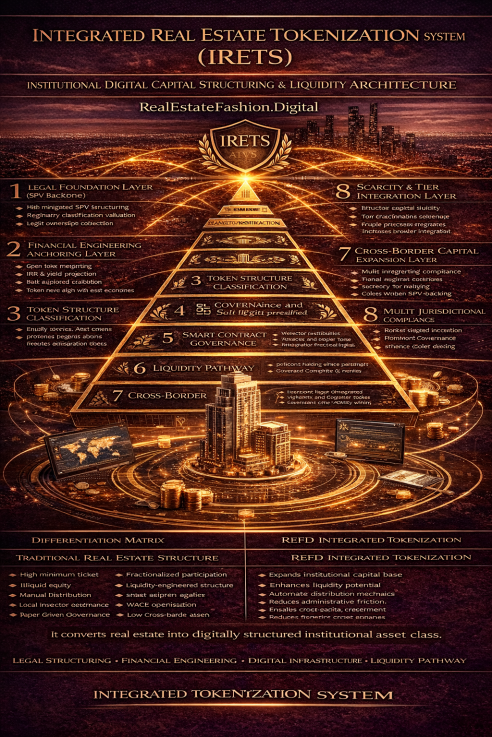







From Asset to Structured Opportunity
4. Risk Architecture & SPV Structuring
Risk Architecture & SPV Structuring
Legal, Structural & Capital Protection Framework for Structured Real Assets
1. Conceptual Definition
The Risk Architecture & SPV Structuring Layer formalizes the legal, operational, and capital containment mechanisms that protect investors, partners, and the REFD platform itself.
Its purpose is to:
- Isolate project-specific risk
- Protect capital allocation integrity
- Prevent cross-liability exposure
- Ensure jurisdictional compliance
- Enable scalable, repeatable capital deployment
Risk is not passively disclosed.
It is engineered structurally.
2. Structural Market Problem
In traditional real estate operations:
- Projects are often executed within a single legal entity.
- Risk exposure is not segmented.
- Capital participation lacks structural containment.
- Governance is informal or centralized.
- Liability spillover is common.
This creates:
- Legal exposure beyond asset boundaries
- Investor distrust
- Capital withdrawal risk
- Difficulty scaling multi-project portfolios
REFD eliminates these weaknesses through structured legal segmentation.
3. Risk Architecture Framework
REFD applies a multi-dimensional risk evaluation model across:
1️⃣ Legal Risk
Assessment includes:
- Title verification
- Zoning and regulatory compliance
- Permit certainty
- Jurisdictional stability
- Contract enforceability
Legal risk informs SPV jurisdiction selection.
2️⃣ Development Risk
For repositioning or development projects:
- Construction timeline exposure
- Cost overrun probability
- Contractor dependency
- Supply chain variability
- Engineering uncertainty
Risk mitigation mechanisms may include contingency buffers and phased structuring.
3️⃣ Market Risk
Includes:
- Absorption volatility
- Demand elasticity
- Competitive saturation
- Pricing compression risk
Market exposure influences capital stack design.
4️⃣ Financial Risk
Assessment of:
- Debt exposure (if applicable)
- Interest rate sensitivity
- Cash-flow variability
- Liquidity horizon
- Exit feasibility
Financial risk determines capital tier hierarchy.
5️⃣ Operational Risk
Includes:
- Asset management dependency
- Tenant concentration
- Maintenance volatility
- Regulatory change exposure
Operational risk affects yield stabilization modeling.
4. SPV Structuring Framework
Each structured project is executed through a Special Purpose Vehicle (SPV) or legally equivalent entity.
SPV Objectives:
- Ring-fence liability
- Isolate capital participation
- Segment financial exposure
- Enable defined governance structure
- Provide exit clarity
SPVs ensure that one project’s exposure cannot contaminate another.
5. SPV Structural Components
Each SPV is designed with:
A. Defined Ownership Structure
- Equity tier definition
- Participation percentages
- Voting rights allocation
- Minority protection clauses
B. Capital Stack Segmentation
- Senior capital
- Preferred equity
- Common equity
- Performance participation
Clear waterfall modeling defines distribution order.
C. Governance Mechanism
- Project-level Investment Committee
- Defined approval thresholds
- Reporting cadence
- Transparency standards
SPVs operate under pre-defined governance protocols.
D. Liability Containment
- No cross-guarantees
- No shared debt exposure
- Defined legal boundaries
- Contractual indemnity structures
Legal isolation is mandatory.
6. Jurisdictional Structuring Strategy
SPV jurisdiction is selected based on:
- Legal stability
- Investor familiarity
- Tax neutrality (where compliant)
- Regulatory transparency
- Enforcement reliability
REFD does not impose a single jurisdiction model.
Structuring adapts to asset and capital profile.
7. Risk Mitigation Instruments
REFD integrates protective mechanisms including:
- Contingency reserves
- Escrow structures
- Milestone-based capital release
- Performance guarantees (where applicable)
- Independent auditing rights
Capital is deployed under controlled conditions.
8. Governance & Oversight Integration
Risk Architecture & SPV Structuring operate under:
- Permanent Commission of Fiscalization oversight
- Rotative Investment Committee review
- Compliance validation
- Conflict-of-interest controls
No SPV operates outside governance architecture.
9. Comparative Positioning
| Traditional Developer Model | REFD SPV Structuring Model |
|---|---|
| Single corporate exposure | Project-level legal isolation |
| Informal capital agreements | Structured capital stack |
| Limited investor protection | Defined waterfall & governance |
| Cross-project liability | Ring-fenced SPV containment |
| Exit ambiguity | Pre-modeled exit clarity |
REFD institutionalizes risk containment.
10. Capital Confidence Impact
Robust risk architecture increases:
- Institutional participation probability
- Capital inflow stability
- Investor protection clarity
- Multi-project scalability
- Cross-border deployment feasibility
Capital prefers structured containment.
11. Platform Protection Dimension
SPV structuring protects not only investors but also:
- The REFD infrastructure
- City representation partners
- Capital network participants
- Cross-project operational continuity
The platform remains insulated from individual project exposure.
12. Long-Term Structural Scalability
Because each project is legally segmented:
- Portfolio aggregation becomes possible
- Multi-territory deployment is simplified
- Capital recycling becomes structured
- System resilience increases
SPV architecture enables scale without systemic fragility.
13. Institutional Conclusion
Risk Architecture & SPV Structuring transform financial modeling into legally contained capital vehicles.
This layer ensures:
- Liability isolation
- Capital protection
- Governance clarity
- Jurisdictional compliance
- Scalable deployment
REFD does not expose capital to uncontrolled systemic risk.
It engineers containment.