





Structural Integrity, Intellectual Capital & Institutional Continuity
1. Foundational Principle
REFD operates as a structured digital infrastructure.
Its primary asset is not listings, inventory, or brokerage relationships.
Its core assets are:
- Methodology
- Protocols
- Taxonomies
- Structuring frameworks
- Scoring systems
- Activation logic
- Governance architecture
IP & Platform Governance exists to protect, standardize, and ensure the continuity of these structural assets.
2. Definition of Intellectual Property Within REFD
REFD’s intellectual property includes, but is not limited to:
A. Structural Methodologies
- Design–Finance Integration Model (DFIM)
- Asset Qualification Protocols
- Risk Architecture Frameworks
- Capital Activation Sequencing
- City Representation Model
B. Data Architecture
- CRM scoring logic
- Predictive assignment systems
- Market structuring taxonomies
- Standardized modeling templates
C. Operational Frameworks
- Governance structure
- Commission of Fiscalization protocols
- Rotative Investment Committee rules
- Capital window allocation models
D. Platform Logic
- Structured listing architecture
- Visibility tier system
- Revenue-sharing framework
- Brokerage neutrality model
These are institutional assets, not individual tools.
3. Platform Governance Philosophy
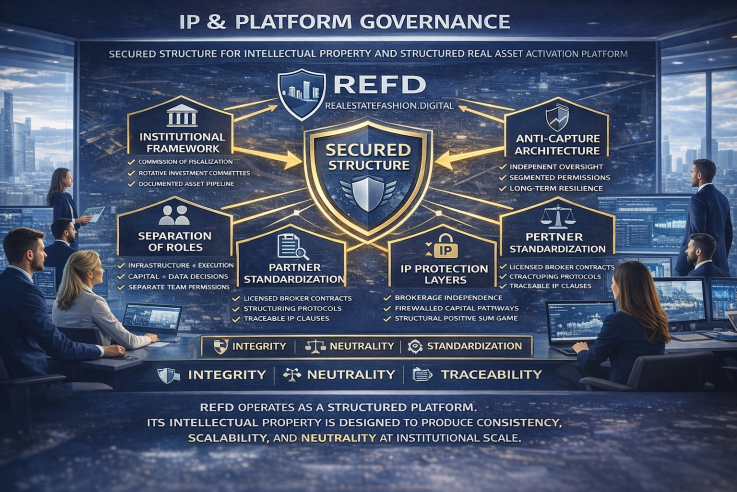
Platform governance is based on four structural pillars:
1️⃣ Integrity
The system must operate consistently across jurisdictions.
2️⃣ Neutrality
No internal actor may capture or redirect the platform.
3️⃣ Standardization
All structuring processes must follow defined protocols.
4️⃣ Traceability
All decisions and activations must be documentable and auditable.
4. Separation of Control & Protection Mechanisms
REFD protects its IP through layered governance mechanisms:
A. Legal Protection
- Trademark registration (brand and visual identity)
- Copyright protection of methodologies
- Contractual IP clauses with partners
- Licensing agreements for city representation
B. Operational Safeguards
- Restricted access to scoring systems
- Controlled deployment of financial templates
- Data compartmentalization
- Partner-level permission hierarchy
C. Institutional Firewalls
- Separation between infrastructure and investment vehicles
- Separation between platform and brokerage execution
- Separation between data analytics and capital decision-making
No single entity controls the full operational chain.
5. Platform Governance Structure
REFD governance integrates:
- Permanent Fiscalization Commission
- Rotative Investment Committees
- Defined partner agreements
- Documented activation protocols
This ensures:
- No informal decision-making
- No discretionary asset favoritism
- No unilateral capital prioritization
- No governance drift
Governance is structural, not personal.
6. Anti-Capture Architecture
REFD is explicitly designed to prevent:
- Vertical monopolistic consolidation
- Brokerage displacement
- Data misuse
- Capital manipulation
- Founder-dependent governance
This is achieved through:
- Majority independent oversight
- Transparent capital allocation windows
- Structured city exclusivity rules
- Time-bound partner agreements
Institutional longevity requires distributed authority.
7. Data Governance & Confidentiality
Data governance follows strict segmentation principles:
- Asset-level data remains traceable
- Investor data remains jurisdiction-compliant
- CRM intelligence is restricted by tier
- Predictive analytics are not publicly exposed
Data is treated as structural infrastructure, not commercial commodity.
Compliance with local regulatory frameworks (data protection, AML/KYC, financial disclosure laws) is mandatory.
8. Platform Standardization Protocol
All structured projects must adhere to:
- Defined modeling templates
- Risk disclosure matrices
- ROI transparency standards
- SPV structuring guidelines
- Documentation completeness criteria
Assets that do not meet structuring criteria do not enter the institutional layer.
This preserves credibility.
9. Comparative Governance Positioning
| Traditional Portal | REFD Platform Governance |
|---|---|
| Listing aggregation | Structured asset qualification |
| Ad-driven model | Methodology-driven model |
| Minimal oversight | Independent fiscalization |
| Informal commission splits | Protocolized revenue-sharing |
| No capital firewall | Structural separation mechanisms |
REFD governance operates at institutional scale.
10. Continuity & Succession Design
The platform is architected to function independently of individual founders or executives.
Continuity mechanisms include:
- Documented procedural manuals
- Governance oversight layers
- Defined authority scopes
- IP licensing controls
- Audit-ready structuring standards
Institutional systems must survive personnel transition.
REFD is designed accordingly.
11. Commercial Implications
Strong IP & Platform Governance enables:
- International scalability
- Regulatory defensibility
- Broker trust
- Investor confidence
- Partnership stability
- Long-term valuation integrity
Governance is not overhead.
It is capital protection infrastructure.
12. Institutional Conclusion
REFD’s intellectual property is embedded in its methodology, governance architecture, and structured activation systems.
Platform governance ensures:
- Structural neutrality
- Operational discipline
- Anti-capture resilience
- Institutional continuity
REFD does not compete through volume.
It competes through structure.